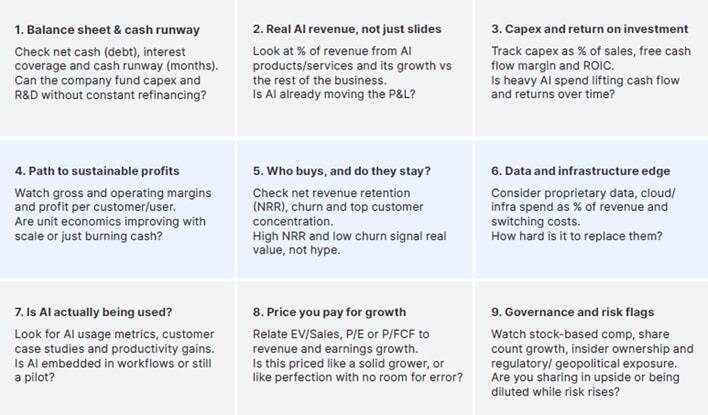
Summary: AI remains the defining equity theme, but the “buy anything AI” phase is over. Q1 2026 is the quarter where AI moves from hype to accountability: balance sheets, cash flow and valuations matter again. Expect more rotation and dispersion, so diversification by sector, region and real assets becomes the main risk-management tool as yields and policy uncertainty keep volatility alive.
As we head into Q1 2026, AI remains the defining equity theme, but the “buy anything AI” phase is over. Strong earnings from leading AI players have validated demand, yet they have not fully defused concerns about stretched valuations, massive spending and execution risk. As a result, investors are rebalancing away from the most crowded AI names.
Meanwhile, US Treasury yields remain volatile as markets grapple with fiscal deficits, term premia and the pace of Fed cuts. That leaves AI leaders facing a double trouble: they must keep delivering on growth and justify premium multiples in a higher-for-longer cost-of-capital world.
For investors, the AI question in Q1 2026 is no longer simply “how much AI exposure do I have?”, but “what kind of AI exposure do I own – and how sensitive is it to earnings, balance sheets and bond yields?”
AI in early-2026: From momentum to a balance-sheet test
After two years of extraordinary optimism, Q1 is about proving that the AI build-out can generate sustainable financial returns, not just impressive narratives.
- Capex and cash flow: Investment in data centres, advanced chips, power infrastructure, and connectivity continues to rise. Investors now want evidence that incremental capex is translating into durable revenue and improved free cash flow rather than just expanded capacity.
- Margins and balance sheets: Hardware-heavy build-outs and custom silicon strategies can pressure margins and raise capital needs. Higher long-end yields mean refinancing is more expensive and heavy capex, buybacks and M&A can slowly erode even “fortress” balance sheets, especially for companies relying on debt to fund the AI race.
Even as the earnings story starts to be questioned on multiple fronts, parts of US mega-cap tech still trade at elevated valuations. In that environment, cash-generative AI names with disciplined investment have more resilience, while those “priced for perfection” will be vulnerable to slower capex, weaker monetisation, or any regulatory/geopolitical shifts.
Bottom line: AI remains a structural growth story with numerous use cases in boosting productivity, but Q1 is where enthusiasm meets accountability. Only those with strong execution, efficient capital deployment and resilient balance sheets can comfortably defend premium valuations.
AI positioning for Q1:
- Broaden along the value chain: Look beyond a narrow cluster of mega-cap software and platforms towards the “picks and shovels” of AI – semiconductors, industrial automation, connectivity and power infrastructure.
- Look for “AI with receipts”: Focus on businesses already showing healthy profitability, positive free cash flow and manageable leverage, rather than those leaning heavily on debt or distant promises.
- Diversify geographically: Parts of North Asia and Europe sit at the heart of the physical AI build-out and trade at lower AI premia than US mega-caps, offering a different balance of growth and valuation risk.
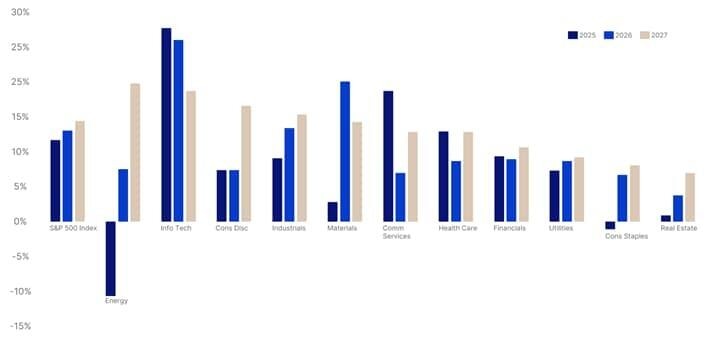
Rotations and diversification: Where to look if the AI trade cools
If the AI trade takes a breather, we see the opportunity less as “AI vs. everything else” and more as a rotation towards parts of the market that are better aligned with the macro backdrop.
Industrials: Policy-backed resilience
Industrials benefit from reshoring, infrastructure renewal, defence modernisation and the energy transition. Governments are directing capital into transport, logistics, robotics and grid reinforcement – all reliant on industrial expertise. These are long-cycle commitments, not quarterly fashion trends, and create a steadier demand runway for engineering, manufacturing and automation firms than the narrow leadership in mega-cap tech.
Energy and nuclear: Years of underinvestment meets stubborn demand
Even under conservative climate-policy assumptions, global oil demand is projected to be higher in 2030 than in 2023. Years of underinvestment in upstream capacity leave less slack just as emerging markets drive incremental demand. These dynamics create a structurally tighter market than headline prices sometimes suggest.
At the same time, energy systems are being redesigned to support electrification and AI‑driven power needs. This has brought nuclear energy back into strategic conversations. While it won’t displace hydrocarbons in the short term, nuclear’s role as a stable, low‑carbon baseload source reinforces the long‑cycle capex story underpinning global energy security.
Healthcare: Structural growth with defensiveness
Healthcare lagged through parts of 2025, but its drivers – ageing populations, rising healthcare consumption and innovation in biotech and medtech – remain in place. The sector offers a rare mix of secular growth and defensiveness, as people need treatment through the cycle. That can help offset volatility if cyclical growth or AI sentiment swings around.
Small caps: Selective opportunities as financing conditions evolve
Expectations for Fed rate cuts have already shifted leadership, with lower expected funding costs helping small-cap indices outperform recently. If gradual easing becomes clearer in Q1 and growth holds up, that tailwind could strengthen.
However, sticky long-end yields and more fragile earnings mean small caps, in aggregate, still carry more risk than large caps. The opportunity is not “small caps as a block” but quality smaller companies with clean balance sheets, pricing power and niche leadership in industrials, healthcare or specialist tech.
Positioning away from AI in Q1:
For investors who entered 2025 with large exposures to US mega-cap tech, some ways to consider rotation is:
- At the index level: Complement cap-weighted US indices with equal-weight or more cyclically tilted indices that carry heavier industrials, healthcare and financials, and less reliance on a handful of mega-caps.
- At the sector level: Tilt incremental allocations towards industrials, energy and healthcare, while keeping AI as a core but not dominant risk driver.
Regional diversification: Europe, Japan and China tech as structural complements
Europe: From “cheap value” to strategic autonomy
Europe still trades at a discount to the US, but its long-term case is increasingly defined by a push toward strategic autonomy. Governments are prioritising defence readiness, energy security and large-scale upgrades to grids, transport links and cross-border infrastructure. Reconstruction needs linked to Ukraine add another potential layer of long-tail demand, even if the pace is uneven.
For long-term investors, that shifts Europe from a simple “value discount” to a market where you own specific champions aligned with defence, energy security and infrastructure, ideally with strong balance sheets and recurring cash flows. Risks remain – uneven growth across member states and political fragmentation can affect policy execution and earnings visibility – but Europe is becoming a more important structural leg in global portfolios, not just a mean-reversion trade.
Japan: Reform, reshoring and capital discipline
Japan’s story is rests on several reinforcing pillars:
- Governance reform: The Tokyo Stock Exchange’s push for “management conscious of cost of capital and stock price” has driven better capital discipline, more ROE targets and buyback plans.
- Reshoring tailwind: Friend-shoring in autos, electronics and high-end manufacturing is supporting capex and earnings.
- Rebuilding ownership: Years of under-ownership are reversing as domestic and foreign flows return.
A weak yen has boosted exporters, but any medium-term yen recovery would shift the focus towards domestic-demand and quality balance-sheet names. That keeps Japan attractive as a structural Asia leg, while underscoring that the currency is both a support and a source of volatility.
China tech: Self-sufficiency push vs. the “investability” question
China’s tech story is increasingly about self-sufficiency – from chips, operating systems and cloud infrastructure to industrial automation and AI. Policy support, funding and procurement are increasingly directed towards building domestic champions and reducing reliance on foreign suppliers. For investors, that shifts the focus towards hardware, infrastructure and AI-adjacent names that sit inside the self-reliance agenda and combine policy tailwinds with robust balance sheets and real cash generation.
The uncomfortable reality is that global investors still ask, “Is China investable?”. Regulatory swings, geopolitics, capital controls and the property overhang haven’t gone away, helping explain low valuations and underweight positions for Chinese equities. In this context, China looks more like a selective satellite than a core block. The key is recognising that the discount reflects both opportunity and risk, and sizing any exposure accordingly rather than treating China as an all-or-nothing call.
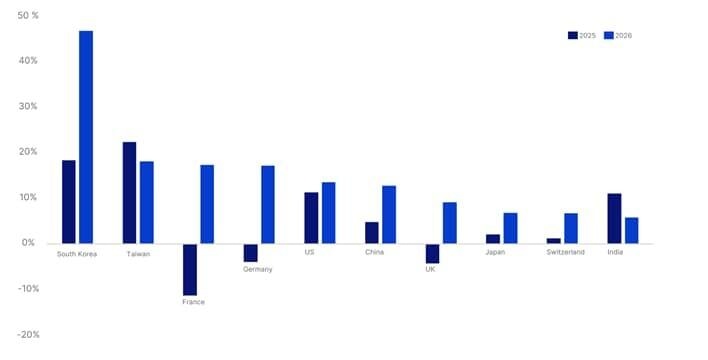
Bottom line: Taken together, Europe’s strategic autonomy, Japan’s reform cycle and China tech self-sufficiency trade provide three distinct regional legs that can help rebalance portfolios away from concentrated US mega-cap AI exposure without sacrificing long-term growth potential.
Real assets: AI electrification meets inflation risk and geopolitics
AI is not just a tech story – it is an energy and materials story. Data centres, power networks, and electrification require large volumes of copper, aluminium, and silver. That sits on top of years of underinvestment in new mining capacity and long lead times for new projects.
At the same time, investors are still dealing with three persistent macro forces:
- High public debt and changing fiscal regimes.
- Sticky inflation risks in some regions and generally with volatile inflation readings.
- Recurring geopolitical shocks and supply-chain rewiring that keep a premium on security of supply for energy and key industrial metals.
That is where real assets become a core portfolio component to help buffer portfolios when traditional stocks and bonds move in tandem, offering an additional source of diversification tied to tangible scarcity and long-cycle investment needs.
For long-term investors, this could mean:
- Broad commodities: Diversified baskets across energy, industrial and precious metals, rather than single-commodity bets.
- Miners and resource equities: Higher-beta plays on metals and energy; best treated as satellite, higher-volatility exposures, especially after strong 2025 gains.
- Infrastructure and real estate: Utilities, grids, pipelines and specialised REITs (including data centres) directly in the path of electrification and energy transition.
- Gold: Classic macro hedge for geopolitics, debt and currency risk; no income and often volatile, but can help when stocks and bonds struggle together.
Bottom line: Real assets can help hedge an AI-driven, energy-hungry, geopolitically messy world – but they do so with higher volatility and cyclical risk. Industrial commodities are vulnerable to a sharper-than-expected global slowdown, and policy or regulatory shifts can hit specific segments such as fossil fuels or certain mining activities. Miners in particular can both amplify the upside and the downside in any commodity cycle and may already reflect part of the 2025 rally.
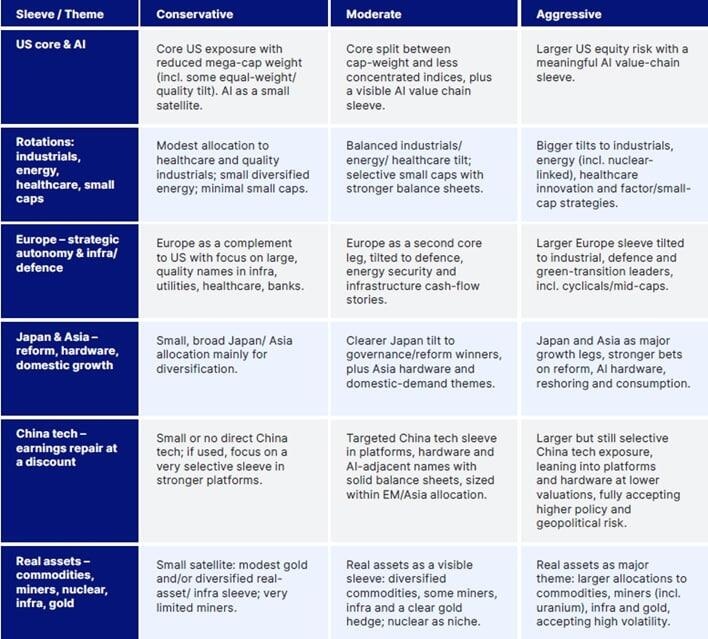
How investors might think about combining these themes