


Introduction
Throughout American history, the federal government has played a role in state and local policy. The Congressional Research Service (CRS) breaks down the history of federal transfers to the states into four distinct time periods: the Antebellum Land Grants period, the Civil War Era, the New Deal Era, and the Great Society.
This explainer will elaborate on that history, examining the complex and often mutually dependent relationship between the federal government and the states.
The Antebellum Land Grants (1776-1860)
Prior to the Civil War, the federal government transferred land grants to the states as new territories were added to the US. Under the Articles of Confederation, states were, according to the CRS, “expected to be the primary instrument of governance in domestic affairs.” The Congress of Confederation was limited mostly to national defense spending, but the Land Ordinance of 1785 enabled the federal government to collect revenue from land sales acquired from Great Britain at the end of the American Revolution.
Even at this early stage, the federal government attached terms and conditions to land sales. The Ordinance required every new township incorporated in these lands to be subdivided into 36 sections (also known as lots), each one square mile. According to the CRS, “Lots 8, 11, 26, and 29 were reserved for the United States. The new townships were required to use Lot 16 ‘for the maintenance of public schools, within the said township.’” These land grants for education were retained under the Northwest Ordinance of 1787.
With the ratification of the Constitution, Congress gained the power to regulate interstate commerce, and the land grant system was maintained to add new states to the Union. However, federal encroachment was mostly kept at bay by the Tenth Amendment: “The powers not delegated to the United States by the Constitution, nor prohibited by it to the States, are reserved to the States respectively, or to the people.” One rare exception to this occurred in 1837. The federal government used proceeds from Western land sales to retire the federal debt in 1836, reserved $5 million, and then dispersed the remainder to the states “in proportion to their respective representation in the House and Senate.” The states received $30 million in three quarterly payments in 1837 before the banking crisis of that year, which incentivized the Treasury to cease these payments. This era of American history comes closest to Michael Greve’s description of “competitive, market-preserving federalism.” Yet some state policymakers lobbied for transfer payments, and certain federal officials were equally willing to provide them.
This era of American history comes closest to Michael Greve’s description of “competitive, market-preserving federalism.” Yet some state policymakers lobbied for transfer payments, and certain federal officials were equally willing to provide them.
The Civil War and the Progressive Era Lay the Foundation for Centralization (1860-1932)
The CRS report notes that the “modern Grants-In-Aid System” began with the Civil War. During that time, the federal government began providing “assistance for business, industry, and farming: the protective tariff, homestead, land subsidies for agricultural colleges, transcontinental railroads and other internal improvements, national banks.”
In 1879, the Federal Act to Promote the Education of the Blind—the first ongoing federal grant to states aside from the National Guard—was adopted to “create a perpetual source of income for the purchase of teaching materials for the blind.” This was accomplished through a dedicated federal revenue fund that would be used to purchase interest-bearing bonds, with the interest income used to purchase the teaching materials.
Economist Robert Higgs, in his critical work Crisis and Leviathan, also notes that while the Civil War saw increases in government, these expansions did not take hold because the “ideological conditions that favor [government] growth must also be present” and were not present in the postwar period. He points to the economic crisis of 1893-1896, during which President Grover Cleveland, holding fast against ideological pressure, did not allow the government to grow. Higgs notes that the key moment of ideological and government growth was the Progressive Era.
Progressivism, the belief in a positive state, was, in Higgs’ words, “the dominant ideology of the elite on the eve of World War I and…was fundamentally at odds with the dominant ideology of the ruling elites in the late nineteenth century.” In 1902, there were a total of six federal grants to state and local governments: the National Guard as well as “teaching materials for the blind, agricultural experiment stations, the care of disabled veterans, resident instruction in the land grant colleges, and funding to the District of Columbia.” Higgs notes that while businessmen throughout American history sought advantages gained through government (i.e. protective tariffs), what was unique about this period was the “undisguised position” of businessmen who openly advocated perpetual government intervention in the economy and greater centralization. While elite ideology in the late nineteenth century restrained government growth, federal grants to states that began during the Civil War and continued into the following century proved to be the “thin edge of the wedge.” These grants powered ideological shifts and expanded federal influence in domestic affairs throughout the twentieth century.
Higgs notes that while businessmen throughout American history sought advantages gained through government (i.e. protective tariffs), what was unique about this period was the “undisguised position” of businessmen who openly advocated perpetual government intervention in the economy and greater centralization. While elite ideology in the late nineteenth century restrained government growth, federal grants to states that began during the Civil War and continued into the following century proved to be the “thin edge of the wedge.” These grants powered ideological shifts and expanded federal influence in domestic affairs throughout the twentieth century.
The New Deal Expands Federal Control (1932-1960)
Federal grants to the states sharply increased during the New Deal era (1933-1939). This was thanks to what the CRS generously calls “an expanded interpretation of congressional authority…under Article 1, Section 8, clause 1 of the Constitution,” which outlines Congress’s spending power.This “expanded interpretation” was spurred on by the ideological changes Higgs mentioned in Crisis.
Furthermore, changes in the Supreme Court’s ideological makeup enabled the federal government to grow unabated. In the wake of the Depression and World War II, despite some ratcheting back, federal transfers to the states never returned to pre-crisis lows. Additionally, elite opinion accepted federal intervention in economic affairs (whether during a crisis or in normal times). Federal policymakers were also eager to use federal transfers to intervene in state affairs and states could use these transfers for their gain over one another.
One notable example occurred when the state of Arkansas defaulted on its highway bonds in 1933. When the state of Arkansas failed to pay bondholders, it attempted to declare sovereign immunity and shed its losses, leaving bondholders empty-handed. The bondholders, who mainly resided in New York, turned to the federal government to force Arkansas to pay. The federal government then threatened to suspend all federal Public Works Administration loans to Arkansas until its bond refunding issues were resolved. This brought Arkansas back to the negotiating table and the New York bondholders were made “practically whole.” Arkansas agreed to pay back the bondholders by collecting 6.5 cents per gallon in gasoline taxes and ceding control of its highway-related revenues until the debts were paid.
In the period that followed, competitive federalism would be severely diluted, as states grew dependent upon federal transfers and ceded governing powers to the federal government. Greve notes that the Supreme Court of the New Deal era created the conditions “for unchecked cartel federalism of conditional funding programs and federal minimum standards.”
The Great Society (1960-1980)
Federal grants to the states increased again between 1960 and 1980 due to the Great Society programs. The CRS report notes that federal grants to state and local governments tripled between 1960 and 1970, from 132 in 1960 to 387 in 1968. In the 1970s, the federal government shifted from narrowly focused categorical grants to block grants and revenue sharing that allowed state and local governments greater discretion over how the money was spent. During the 1980 s, grants were further consolidated, but federal transfers to state and local governments increased.These programs enabled state governments to raise spending at the cost of federal taxpayers in other states and gave the federal government greater control over state and local affairs.
Figure 1 (below) shows the progression of federal transfers to state and local governments since 1940 (the earliest year of data available). Data prior to 1940 is sparse, but estimates from the Historical Statistics of the United States, 1789-1945 show that federal transfers to state and local governments were estimated at $86.8 million in 1902 and $97.6 million in 1913 (in 2025 dollars). In 1932 (just before FDR took office), federal transfers exceeded $3.5 billion in chained 2017 dollars.
Total spending frequently increases the most following periods of recession. Transfers to state and local governments increase and then slightly decrease but are still higher than pre-recession levels. This is a demonstration of what is known as a “the ratchet effect,” discussed extensively by Higgs in Crisis, where crises are used to expand government size and scope of authority.
One notable exception to the ratchet effect is the period from FY 1982-1990. This is due to the Omnibus Budget Reconciliation Act of 1981, which merged 77 categorical grants and two block grants into 9 block grants. What later became known as the “Devolution Revolution” under President Reagan, however, was short-lived. Federal grants to states continued in 1983, particularly for “payments to individuals” which included welfare programs such as Medicaid, Aid for Families with Dependent Children (which became Temporary Assistance for Needy Families in 1996), as well as job training programs.
Despite a brief pause in the early 1980s, federal grants to states increased steadily into and beyond the turn of the millennium. Each economic downturn brought greater demand from state officials to receive federal grants, which those in DC were more than happy to dole out. State officials received increased spending paid for by federal taxpayers in other states, while federal officials received influence over state and local policy by dictating behavior through compliance with the terms and conditions of receiving these grants.
Figure 1: Federal Grants to State and Local Governments
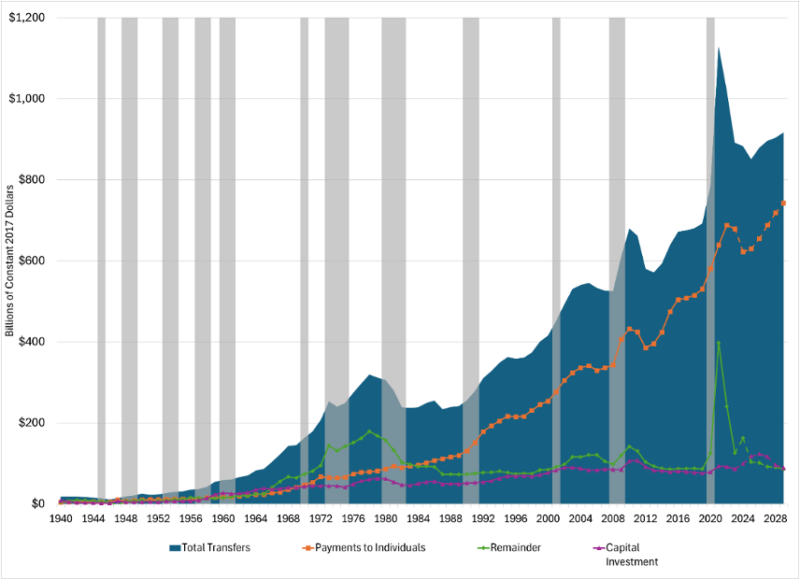
Source: “Historical Tables: Table 12.1—Summary Comparison of Total Outlays for Grants to State and Local Governments: 1940-2029” in The President’s Budget. White House Office of Management and Budget. Accessed September 5, 2024.
Notes: Years 2024-2029 are projected. Shaded areas indicate periods of recession.
Conclusion
What we’re seeing now in state funding is a slow creep of the influence that has been present since America’s founding. While it was kept at bay for most of the country’s history, federal growth in government rapidly metastasized during the twentieth century.
As America approaches the 250th anniversary of its Founding, federal policymakers can no longer ignore the need for spending cuts. The national debt has reached unsustainable levels. Federal transfers to state and local governments are likely to be among the first targets. State and local policymakers would be wise to make those cuts now, on their own terms.
