


What Is The Forgetting Curve?
The forgetting curve explains how quickly people lose newly learned information if it is not reinforced. First introduced by Hermann Ebbinghaus in the late 19th century, the Ebbinghaus forgetting curve demonstrates that we forget information quickly after we first learn it, and then the rate of forgetting slows down over time.
In simple terms, the curve of forgetting shows that without review, application, or reinforcement, learners may forget a significant portion of new information within days. The steepest drop happens within the first 24 hours. After that, the rate of forgetting slows, but the damage is already done. For learning leaders, this is not just a psychological theory. It is a business reality.
In corporate training, this means that one-time learning events usually do not help build long-term skills. Therefore, understanding the forgetting curve definition helps organizations shift from delivering content to designing reinforcement systems. Without intentional follow-up, such as spaced repetition, retrieval practice, or on-the-job application, training investment erodes faster than most leaders expect. Thankfully, you’ll find all the useful tips you need to overcome this below. Let’s begin.
Table Of Contents
The Origins Of The Forgetting Curve: Hermann Ebbinghaus And The Science Of Memory
The forgetting curve begins with one man: Hermann Ebbinghaus. In 1885, Ebbinghaus conducted one of the first controlled experiments on human memory. At a time when psychology was still emerging as a science, he wanted to measure something many assumed could not be measured: how quickly we forget.
To eliminate bias, he used what he called “nonsense syllables,” which were three-letter combinations like BOK or YAT that had no meaning. By memorizing and relearning thousands of these syllables himself, he tracked how long it took to forget them over time. What he discovered became known as the Ebbinghaus forgetting curve, or, simply, the Ebbinghaus curve.
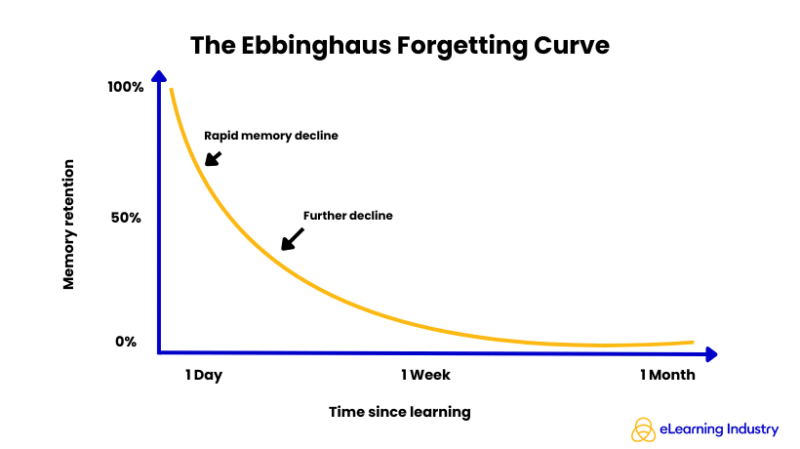
As you see above, the curve of forgetting shows a clear pattern: memory drops sharply soon after learning, then declines more gradually. In simple terms, we forget fast at first, and then the rate of forgetting slows down.
Why does research from 1885 still shape 21st-century learning platforms? Because the underlying biology of memory has not changed. Modern LMSs, LXPs, and AI-driven reinforcement tools are essentially engineered responses to the Ebbinghaus forgetting curve. Spaced reminders, micro-assessments, and adaptive nudges are all built around the same insight: without reinforcement, knowledge fades. Therefore, Ebbinghaus not only identified the problem but also set the guidelines for modern learning design.
Forgetting Curve Psychology Definition: What Happens In The Brain
At its core, the forgetting curve psychology definition describes how information fades from memory over time when there is no attempt to retain or revisit it. The forgetting curve definition is not about motivation or intelligence. It is about how the brain naturally processes, stores, and retrieves information. To understand the curve of forgetting, we need to look at four key stages of memory.
1. Encoding
This is the moment learning happens. The brain takes in new information and translates it into a usable format. If attention is low or cognitive load is too high, encoding is weak from the start. In corporate settings, this often happens when the learning material is too dense and overwhelms working memory.
2. Storage
After encoding, information moves into short-term or long-term storage. But storage is not permanent. Without reinforcement, neural connections begin to weaken.
3. Memory Consolidation
Consolidation strengthens those neural pathways, especially during sleep or through repeated exposure. This is why spaced reinforcement flattens the Ebbinghaus forgetting curve.
4. Retrieval Failure
Information is often not lost; it is just hard to access. Retrieval failure happens when there are no cues or when the memory has faded. The Ebbinghaus curve shows that without reinforcement, the chance of remembering drops quickly.
Two additional forces accelerate the decline:
- Cognitive load: When too much information competes for attention, the brain filters aggressively.
- Interference theory: New information overwrites or competes with older knowledge.
It’s important to note here that the curve shows how likely someone is to remember information over time. It does not tell us about their intelligence, skills, or effort. For L&D leaders, this means we should view forgetting as a challenge in design, not a failure of the learner.
Why The Forgetting Curve Matters In Corporate Learning
The forgetting curve is not just a psychological concept. In corporate learning, it is a business variable. When we discuss the Ebbinghaus forgetting curve, we often focus on how quickly people forget information after learning it. But in organizational settings, forgetting is not abstract. It shows up in onboarding delays, compliance errors, inconsistent leadership behaviors, and missed sales targets. Let’s see how the forgetting curve impacts different aspects of business operations.
Onboarding
New hires typically complete intensive training in their first weeks. Yet according to the logic behind the curve of forgetting, without structured reinforcement, much of that information fades rapidly. The result? Productivity lag. Employees take longer to perform independently, managers spend more time correcting mistakes, and early engagement suffers.
Compliance Training
Teams may pass an assessment immediately after training, but months later, critical procedures are forgotten. The forgetting curve definition helps explain why memory declines predictably without retrieval and application. In regulated industries, this is not just inconvenient; it is illegal, creating risk exposure, audit failures, and financial penalties.
Leadership Development
Workshops inspire, but behavior change requires sustained reinforcement. Without it, insights decay. The Ebbinghaus retention curve reminds us that retention is not automatic; it must be engineered. Otherwise, organizations invest in leadership programs that do not translate into measurable cultural or performance shifts.
Sales
Product knowledge, objection handling techniques, and pricing frameworks fade if not applied consistently. That knowledge loss affects revenue directly.
The forgetting curve in psychology is not just about memory; it also relates to how well people perform over time. The main issue is not that people forget, but that organizations treat training as one-time events rather than as ongoing systems. This leads to extra costs from retraining employees, slower ramp-up times, and mistakes that could be avoided. So, the real problem is not a lack of cognitive ability; it’s how the training is designed.
Things To Pay Attention To When Designing For The Forgetting Curve Theory
The Ebbinghaus forgetting curve remains one of the most cited models in learning science. But in corporate learning, applying the curve of forgetting too literally can lead to shallow design decisions. Below are some things you should pay attention to when designing with the theory in mind.
Context
When Hermann Ebbinghaus developed what we now call the Ebbinghaus curve, he studied isolated memory. However, workplace learning rarely involves meaningless information. It involves context, emotion, pressure, and relevance. Those variables change everything.
Emotions
When learners find meaning in content that impacts their performance, identity, or teamwork, they are more likely to remember it. The forgetting curve shows that memory loss happens naturally, but it doesn’t take into account factors like motivation, the importance of the task, or psychological safety in organizations.
Social Learning
Talking, coaching, and support from peers help improve how we remember information. In real organizations, people share and reinforce knowledge socially, not just through individual thinking. The traditional forgetting curve does not account for these social interactions.
Digital Reinforcement
Modern LMSs can trigger nudges, spaced assessments, and workflow-based reminders. This means the forgetting pattern is no longer passive. It can be actively engineered. The Ebbinghaus retention curve shows what happens without reinforcement; today’s systems, though, allow us to intervene continuously.
For L&D leaders, the main point is clear: the forgetting curve is a limitation, not a guide. It helps shape your strategy, but it should not be the only factor in your planning.
5 Strategies To Battle The Forgetting Curve
Understanding the forgetting curve is only the first step. The real strategic question for L&D leaders is this: how do we flatten it? The goal is not to eliminate forgetting, as that’s impossible, but to design learning ecosystems that interrupt memory decay. Here are five evidence-based strategies that do exactly that.
1. Spaced Repetition
One of the most validated ways to counter the curve of forgetting is spaced repetition. Instead of an intensive learning session, distribute practice in learning over time. When learners review material at longer intervals, their memory improves, as each review signals to the brain that this information is important.
Adaptive reinforcement takes this idea further. Modern LMSs can provide refreshers based on how well learners perform instead of using a set schedule. Those who do well might need fewer reviews, while others might need more frequent practice. This method supports the idea from the Ebbinghaus retention curve: memory becomes stronger with timely recall. Overall, spaced repetition helps slow down forgetting by interrupting the decline in memory before it gets too steep.
2. Retrieval Practice
Retrieval practice is a powerful strategy for preventing forgetting. The testing effect shows that recalling information strengthens memory more than simply reviewing it. Recognizing answers is easier, while recalling them takes more effort. This is what helps make memories last longer.
It’s important to note the difference between these types of knowledge checks, though. Multiple-choice questions that test recognition can be helpful, but exercises that require recall are even more effective. These include short-answer questions, reflection prompts, or tasks that apply knowledge and ask learners to remember information without hints. This process strengthens connections in the brain, so when learners retrieve information on their own, they slow the forgetting curve.
3. Interleaving
Interleaving means mixing topics rather than teaching them in isolated blocks. While it may feel less smooth in the moment, it strengthens long-term retention. Why? Switching between topics forces learners to distinguish between concepts. Instead of just memorizing, they have to think about which principle applies, which helps them understand better.
In corporate learning, interleaving might involve combining compliance training with leadership skills or mixing product knowledge with customer service training. When learners go over material in different contexts, they can remember it more flexibly. This variety makes it less likely they will forget what they learned, as the knowledge becomes connected rather than isolated.
4. Application And Contextualization
One limitation of how many interpret the Ebbinghaus curve is assuming repetition alone is enough. It is not. Learners must also apply knowledge and connect it to a context. This can happen through scenario-based learning, simulations, and solving real problems, which help people remember what they learn right away. This is because the brain tends to remember information that is linked to actions.
For L&D leaders, this means creating training that quickly shifts from teaching to practical use. For example, sales teams should practice handling objections in real time; managers should use feedback tools during actual meetings; and engineers should work on realistic challenges. When people apply knowledge instead of just consuming it, they forget much less over time.
5. Social Reinforcement
The forgetting curve is usually seen as something that happens to individuals. So, what better way to battle it than by reinforcing social learning, which naturally happens in the workplace? Conversations with coaches, discussions with peers, and structured follow-ups from managers help keep learning going after formal training. Each discussion acts as a chance to remember what was learned, and each coaching session reinforces important ideas.
Organizations that include social support in their learning strategies see better memory retention over time. Talking, reflecting, and being accountable help strengthen memory. To put it simply, reducing the forgetting curve is less about creating better courses and more about building systems for reinforcement.
Common Misconceptions About The Forgetting Curve
Even experienced L&D leaders sometimes oversimplify the forgetting curve. While the Ebbinghaus forgetting curve remains foundational in learning science, its application in corporate training is often misunderstood. Let us clarify a few common myths.
- “People forget 90% in 7 days.”
This statement is often linked to the forgetting curve, but it misses important details. Hermann Ebbinghaus’s original research involved memorizing meaningless syllables in controlled situations. However, workplace learning is usually relevant and meaningful. Emotional connections, existing knowledge, and practical use greatly affect how well we remember information. The forgetting curve explains how memory fades without practice, but it does not represent a fixed percentage. - “Microlearning alone solves forgetting.”
Microlearning supports reinforcement, but it does not automatically flatten the Ebbinghaus curve. Without spaced repetition, retrieval practice, and real-world application, short content bursts become fragmented exposure. The Ebbinghaus retention curve shows that the timing of reinforcement is more important than just the length of content when it comes to how well we remember information. - “One refresher session is enough.”
The psychology behind the forgetting curve definition is clear: memory weakens progressively. A single refresher may slow decline, but ongoing reinforcement is required to meaningfully reshape the curve. Retention is engineered over time, not restored with a single event. - “The forgetting curve applies equally to all content types.”
It does not. Compliance rules, leadership behaviors, technical procedures, and soft skills fade away at different rates. When leaders ask, “What is the curve of forgetting?” a better question is, “How does it relate to this specific skill?”
Conclusion
Forgetting doesn’t mean learners failed. It is a natural function of how the brain protects itself from overload. The forgetting curve reminds us that memory fades without reinforcement. That reality is not discouraging, though. Retention must be intentionally designed through spaced practice, retrieval, and real-world application. In this sense, the curve is not a limitation. It is a design constraint that helps us build smarter systems. When learning leaders accept this, they’ll begin creating courses that reinforce durable capability, driving sustained performance.
Forgetting Curve FAQs
The forgetting curve shows how memory declines over time without reinforcement. It illustrates that people forget information rapidly at first, then more slowly later.
Use spaced repetition, retrieval practice, and real-world application. Reinforcing learning at strategic intervals improves long-term retention.
It’s a guideline suggesting we forget roughly 20% after 2 days, 70% after 7 days, and 90% after 30 days without review or practice.
Memory drops sharply soon after learning, then gradually levels off. Early repetition flattens the curve and improves recall over time.
Yes, but retention rates vary based on context, emotional relevance, and learning methods.
Yes. Adaptive learning platforms, spaced repetition tools, and AI-driven reminders help learners retain knowledge longer.
