


How Do Tech Giants Dominate, And What Does That Mean For Smaller Companies?
A handful of companies dominate the global technology landscape, and the influence of today’s tech giants extends far beyond products into markets, ecosystems, and innovation cycles that shape entire industries. In 2025, the concentration of power has reached unprecedented levels, with the top seven U.S. technology firms accounting for roughly 33% of the S&P 500’s total market capitalization, highlighting just how tightly global growth is tied to a small group of players.
For smaller companies, understanding how these firms operate is critical, especially as they redefine competitive benchmarks, capital allocation, and platform dependency. Their decisions directly impact pricing structures, distribution channels, and even the speed of technological adoption across sectors.
This is where CEO strategies become increasingly important. Leaders are no longer competing in isolated markets. Instead, they are competing against ecosystems powered by scale, data, and Artificial Intelligence integration. As a result, strategic planning now requires awareness of how platform-driven economies evolve and how value shifts within them.
At the center of this shift is big tech innovation, which is no longer incremental but structural. From AI infrastructure to cloud ecosystems, these companies are reshaping how products are built, delivered, and monetized. This article delivers a strategic breakdown of how big tech companies shape innovation and competition, and what it means for the rest of the market.
TL;DR
- Tech giants influence how innovation spreads across industries.
- Their ecosystems shape competition and market access.
- AI is accelerating its impact on global markets.
- Smaller companies must adapt to, or strategically position against, big tech dominance.
Do you need to stand out in a landscape dominated by giants?
eLearning Industry helps learning and HR tech vendors increase their visibility.
In This Guide, You Will Find…
Who Are The Tech Giants Today?
Apple is one of the largest tech companies in the world, built on a tightly integrated ecosystem of devices, operating systems, and services. Its strength lies in hardware-software alignment, where iPhone, Mac, iOS, and services like iCloud create long-term user retention. Apple is also increasingly positioning itself among companies that use AI today, integrating on-device intelligence for personalization and productivity features. Its ecosystem strategy ensures that users remain inside its digital environment, reinforcing its dominance in consumer technology and services.
Microsoft operates across cloud computing, enterprise software, and productivity tools, making it a central force in enterprise digital transformation. Through Azure, Office 365, and AI integrations, it connects cloud infrastructure with workplace applications. Its partnership-driven AI strategy places it at the center of enterprise automation and productivity evolution. Also, Microsoft’s ability to embed intelligence into business workflows positions it as one of the strongest technology market leaders in the corporate software space.
Google dominates search, digital advertising, and data-driven services while expanding aggressively into AI infrastructure. Its Gemini ecosystem and cloud platform make it a core player in global AI development. Google’s strength lies in scale, as billions of users interact daily with its products, generating feedback loops that continuously improve its systems. It remains one of the clearest examples of innovation in technology driven by data, algorithms, and platform integration.
Amazon combines eCommerce dominance with AWS cloud infrastructure, making it one of the most diversified tech giants. AWS is a backbone of global internet infrastructure, powering startups and enterprises alike. Beyond retail, Amazon uses machine learning for logistics optimization, recommendation systems, and automation. Its dual strength in commerce and cloud places it at the center of digital economy infrastructure.
Meta controls some of the world’s largest social platforms, including Facebook, Instagram, and WhatsApp. Its business model is deeply rooted in attention, engagement, and advertising systems powered by AI. Meta is also investing heavily in generative models and virtual environments, signaling a shift toward immersive digital ecosystems. It remains a core example of how tech giants evolve from social platforms into full-scale AI-driven ecosystems.
NVIDIA is the backbone of modern AI computing, powering training and deployment for nearly all major model developers. Its GPUs dominate data center infrastructure, making it essential for scaling AI systems globally. As one of the biggest AI companies, NVIDIA sits at the center of computational demand, enabling everything from large language models to advanced simulation systems.
Oracle is a major enterprise software and cloud infrastructure provider specializing in databases and mission-critical systems. It has expanded into AI-ready cloud services, supporting large-scale enterprise workloads. Oracle’s strength lies in data management at scale, making it a foundational layer for enterprise-grade AI deployment.
IBM focuses on hybrid cloud and enterprise AI solutions, particularly through its Watsonx platform. It serves industries requiring secure, regulated, and scalable AI systems. IBM’s approach emphasizes enterprise integration, making it a key player in corporate AI transformation and industrial computing systems.
How Tech Giants Drive Innovation
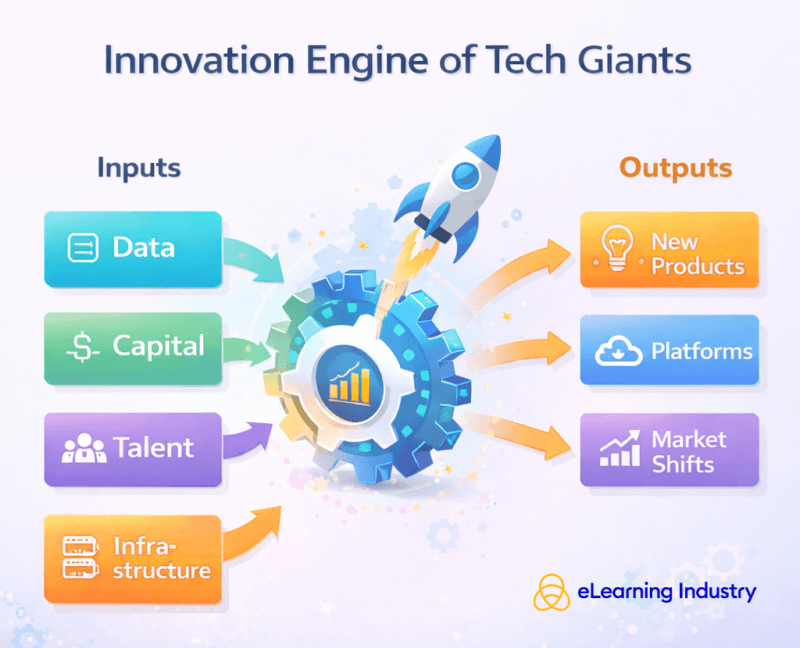
Tech giants allocate billions annually into research and development, enabling long-term experimentation rather than short-term iteration. This scale allows them to explore emerging fields such as generative AI, quantum computing, and advanced chip design simultaneously. Unlike smaller firms, they can absorb high failure rates because successful breakthroughs are scaled globally across their ecosystems.
One of the strongest mechanisms used by global tech companies is ecosystem expansion. By connecting hardware, software, cloud services, and developer platforms, they create environments where third-party innovation naturally depends on their infrastructure. This allows them to indirectly influence thousands of products and services without directly building them.
Many leading firms control multiple layers of the technology stack, from infrastructure to end-user applications. This reduces dependency on external suppliers and increases control over performance, pricing, and innovation cycles. Vertical integration also accelerates product development and ensures tighter coordination across systems.
AI has become central to modern competitive positioning. Through large-scale model development, infrastructure investment, and embedded intelligence in products, companies are redefining digital experiences. A strong AI business strategy now determines how effectively firms can automate workflows, personalize services, and optimize decision-making systems.
Access to large-scale behavioral and operational data allows continuous system improvement. These datasets refine algorithms, improve recommendations, and enhance predictive capabilities across products. This feedback loop strengthens competitive positioning over time.
Another key driver is the ability to attract and retain top engineering and research talent globally. These organizations compete aggressively for AI researchers, product designers, and infrastructure engineers, building internal cultures that accelerate experimentation and execution speed.
Beyond consumer markets, these firms increasingly shape enterprise adoption patterns. By embedding cloud, AI, and productivity tools into corporate workflows, they position themselves as digital transformation leaders, effectively defining how modern organizations operate, automate, and scale.
The Role Of AI In Big Tech Dominance
Artificial Intelligence has become the critical layer behind modern digital power. What was once a supporting capability is now the foundation of how leading companies build products, scale infrastructure, and outperform competitors. Today’s tech giants are not just adopting AI, but structuring entire ecosystems around it, turning intelligence into a long-term competitive advantage.
AI creates defensibility through proprietary models, data access, and continuous learning loops. These systems improve over time, making it difficult for smaller players to replicate performance or scale. This dynamic is reshaping tech competition, where advantage is no longer just about features but about learning speed and model quality.
From search engines to productivity tools and recommendation systems, AI is deeply integrated into everyday user experiences. This enhances personalization, automation, and usability, increasing user dependency and engagement across platforms.
AI now operates as a foundational layer delivered through cloud platforms, APIs, and model-as-a-service offerings. Companies provide tools that allow others to build on top of their systems, reinforcing ecosystem control and expanding reach across industries.
-
Acceleration Of Innovation Cycles
AI significantly reduces development time by automating coding, testing, content creation, and decision-making. This allows faster iteration, quicker product launches, and continuous improvement across services.
AI systems rely on vast datasets, and more usage leads to better outputs. This creates a self-reinforcing loop where increased adoption strengthens product performance and market position.
AI is increasingly embedded into business operations, from analytics to workflow automation. A strong enterprise AI strategy determines how effectively organizations can scale intelligence across departments.
The growing big tech influence through AI is redefining how industries operate, setting new standards for efficiency, personalization, and scalability across global markets.
How Tech Giants Shape Competition
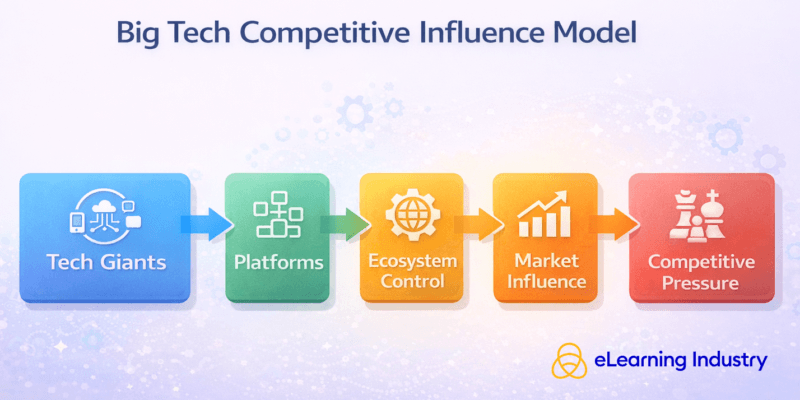
Global tech companies define the technical and operational rules that shape entire industries. From cloud infrastructure requirements to AI model frameworks, these standards influence how products are built and scaled. Over time, they evolve into widely accepted norms, making it difficult for competitors to introduce alternative approaches.
Tech giants operate interconnected ecosystems that combine platforms, services, and user networks. This level of control creates strong dependency, as businesses rely on these environments for distribution, visibility, and growth. The more integrated the ecosystem, the harder it becomes to compete outside of it.
Strategic acquisitions allow dominant players to absorb innovation early. Instead of competing with emerging solutions, they integrate them into existing systems, accelerating development while limiting external disruption. This approach also helps them stay ahead of shifting market demands.
-
Influencing Pricing Models
By controlling infrastructure and distribution channels, major players can shape pricing expectations across industries. Subscription models, freemium tiers, and bundled services often originate from these firms, gradually becoming learning tech benchmarks for other companies to follow.
-
Creating Barriers To Entry
High infrastructure costs, data requirements, and ecosystem dependency make market entry increasingly difficult. New competitors must overcome significant technical and operational challenges to compete at scale.
The Ripple Effect Across Industries
SaaS
Innovation from tech giants reshapes the SaaS landscape through cloud infrastructure, APIs, and AI-powered tools. Platforms increasingly depend on integrations, making interoperability essential. As leading tech companies introduce features like embedded AI copilots, expectations shift toward automation, personalization, and real-time insights. Buyers now prioritize scalable platforms that fit seamlessly into workflows, pushing SaaS providers to align with broader tech industry trends and accelerate product evolution.
HR Tech
In HR tech, talent management and recruitment platforms are becoming more data-driven and automated. Inspired by digital transformation leaders, solutions now use AI for candidate screening, workforce analytics, and personalized employee experiences. Buyers expect faster hiring, smarter insights, and intuitive interfaces. This shift forces vendors to refine their AI strategy, ensuring platforms go beyond process management to actively improve organizational performance.
Learning Tech
Learning platforms are moving from static content to adaptive, AI-powered experiences. This shift reflects broader changes driven by tech giants, where personalization and continuous improvement are standard. Users expect content tailored to their needs, real-time progress tracking, and measurable outcomes. For providers, success depends on aligning with a modern CEO playbook focused on engagement, scalability, and long-term value.
Finance
Financial services are evolving through automation, data analytics, and platform-based models. Innovation spreads via APIs, embedded finance, and AI-driven risk tools. Buyers now expect speed, transparency, and personalized insights, pushing institutions to modernize infrastructure and deliver more agile digital services.
Healthcare
Healthcare is adopting digital systems, AI diagnostics, and cloud-based records to improve efficiency and outcomes. Innovation spreads through predictive analytics and remote care technologies. Patients expect faster access and better digital experiences, driving providers to modernize systems and deliver more personalized, data-driven care.
What This Means For Learning Tech & SaaS Companies
-
Higher Expectations For UX And Personalization
Buyers in eLearning and HR tech now expect seamless, intuitive experiences similar to those delivered by tech giants. This includes personalized dashboards, adaptive learning paths, and intelligent recommendations. Platforms that fail to deliver tailored experiences risk lower engagement and reduced retention.
AI is no longer a differentiator, but a baseline expectation. Many AI tech companies are embedding automation into content delivery, skills assessment, and workforce analytics. For eLearning and HR tech providers, this means integrating AI across core functionalities, not just adding it as a feature.
-
Need For Integration With Major Platforms
Modern buyers expect tools to integrate easily with existing ecosystems, including LMSs, HRIS platforms, and collaboration tools. Seamless API connectivity is essential for scalability and usability. Platforms that operate in isolation struggle to compete in increasingly connected environments.
The rise of hottest AI startups is intensifying competition across both learning and HR tech markets. These companies are often faster, more specialized, and built around AI from the ground up. As a result, established vendors must continuously innovate to maintain relevance.
-
Competing With Expectations, Not Just Competitors
The real challenge is no longer direct competition. Buyers compare your platform to the best digital experiences they encounter elsewhere. This raises the bar for performance, usability, and innovation across the entire product experience.
Strategies Smaller Companies Use To Compete
Smaller eLearning and HR tech companies often win by focusing on specific problems instead of trying to compete with tech giants. For example, they may build tools for compliance training, onboarding, or skills development in one industry. This focus helps them deliver more relevant solutions to a clearly defined audience.
Unlike large technology market leaders, smaller companies can move quickly. They can test new features, react to customer feedback, and make product changes without long delays. This speed helps them adapt faster to market needs and new trends.
Instead of serving everyone, smaller companies often focus on one industry, such as healthcare, finance, or education. This makes their product more useful for that sector. It also helps them fit better into the wider tech ecosystem, where integration with other tools is important.
Smaller providers usually work more closely with their customers. They offer hands-on support, faster responses, and more personalized solutions. This helps them understand real user needs better and build stronger long-term relationships.
Instead of large-scale spending, smaller companies make smart AI investments in specific features. For example, they may use AI for personalized learning paths, automated assessments, or workforce insights. This allows them to add value without needing massive infrastructure.
Thought leadership marketing, meaning sharing insights, guides, and expertise, smaller companies can build trust in their space. This helps them stand out even when competing with tech giants and attract decision-makers looking for specialized solutions.
The Risk Of Over-Reliance On Big Tech Ecosystems
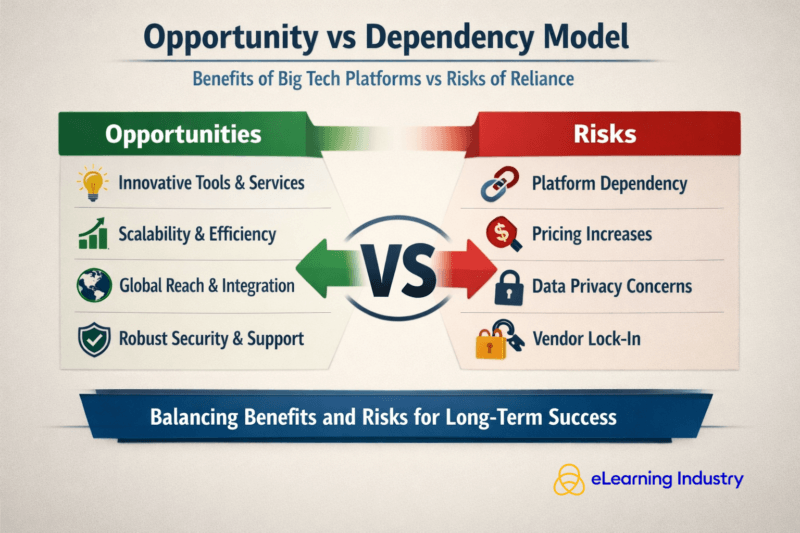
Many eLearning and HR tools now depend heavily on infrastructure provided by tech giants. While this enables scalability and speed, it also creates dependency on external systems for hosting, integrations, and distribution. If platform rules or APIs change, product performance and user experience can be directly affected.
When relying on services from big tech companies, smaller vendors are exposed to shifting pricing structures for cloud storage, APIs, and AI services. Even small increases in usage costs can significantly impact margins, especially for platforms operating at scale with large user bases.
Data is a core asset in eLearning and HR tech, but when stored or processed within external ecosystems, control becomes shared. Access limitations, policy changes, or compliance rules set by infrastructure providers can restrict how learning tech companies use or analyze their own data.
Once a product is deeply integrated into a specific ecosystem, switching becomes difficult. This includes dependencies on APIs, identity systems, analytics tools, and AI models. Over time, this lock-in reduces flexibility and limits architectural freedom for future innovation.
While ecosystems built by major platforms offer speed and efficiency, over-dependence can weaken long-term positioning. Companies that fail to diversify infrastructure risk losing control over key parts of their product stack. A balanced approach ensures resilience while still benefiting from modern cloud and AI capabilities.
The Future Of Big Tech Influence
AI Consolidation
- AI development is becoming concentrated among a small group of dominant players.
- Compute power is a key gatekeeper.
- Foundation models are increasingly centralized.
- This is reshaping tech competition across all digital markets.
Regulation
- Governments are tightening rules on data and AI systems.
- Focus is on transparency and fairness.
- Compliance will shape product design decisions.
- HR tech and learning platforms will be directly affected.
Ecosystem Expansion
- Large platforms continue moving into adjacent industries.
- Education, HR, and productivity tools are key targets.
- Integration with external systems is becoming mandatory.
- Distribution increasingly depends on ecosystem access.
Industry Convergence
- SaaS, HR tech, and learning platforms are merging.
- Unified systems replace standalone tools.
- Analytics and learning are becoming connected.
- This reflects broader innovation in technology trends.
Data Governance Pressure
- Control over data usage is tightening.
- Companies must rethink storage and access models.
- Privacy requirements are increasing globally.
- Data strategy becomes a competitive factor.
AI Infrastructure Dominance
- A few providers control most AI infrastructure.
- Model access is increasingly platform-based.
- Dependency on APIs is rising.
- This influences long-term product roadmaps.
Market Standardization
- Interfaces and workflows are becoming more uniform.
- User expectations are shaped by leading ecosystems.
- Differentiation is harder without AI depth.
- Standards are set by top-tier platforms.
Key Takeaway
Across industries, the influence of dominant platforms continues to reshape how products are built, distributed, and experienced. From SaaS to HR tech and learning ecosystems, the same pattern emerges: scale-driven systems redefine expectations faster than most companies can adapt. This creates a landscape where tech giants not only lead innovation but also set the baseline for what “good” looks like in digital products.
At the same time, competitive advantage is no longer just about features or pricing. It is about alignment with evolving tech industry trends, especially in AI integration, ecosystem connectivity, and user experience design. Companies that fail to adapt to these shifts risk becoming invisible in markets where expectations are constantly rising.
For executives and product leaders, success increasingly depends on strategic marketing for CEOs that goes beyond traditional positioning. It requires understanding ecosystem dynamics, anticipating platform shifts, and building resilience into product and infrastructure decisions. Ultimately, the future will be defined by how well companies respond to this structural shift in power and innovation.
As big tech companies continue to shape innovation and customer expectations, smaller vendors must find ways to differentiate, build credibility, and stay visible in competitive markets. eLearning Industry helps learning and HR tech companies increase their visibility, showcase thought leadership, and reach decision-makers actively exploring new technologies, ensuring they remain competitive in an evolving landscape.
Leading tech giants include Apple Inc., Microsoft Corporation, Alphabet Inc. (Google), Amazon.com, Inc., Meta Platforms, Inc., NVIDIA Corporation, and Tesla, Inc.
They dominate through large-scale ecosystems, massive capital investment, control of platforms, and network effects that make their products and services difficult to replace.
AI strengthens dominance because giants control key resources like data, computing infrastructure, and advanced models, allowing them to scale innovation faster than smaller competitors.
They create integrated platforms where products, services, and tools work seamlessly together, making it costly and inconvenient for users to switch to alternatives.
Smaller companies often face higher competition, dependency on big platforms, and limited market visibility, but they can also benefit from infrastructure and distribution channels.
They can compete by focusing on niche markets, innovating faster, leveraging partnerships, and building differentiated products that avoid direct platform competition.
