Close Menu
KumbhCoinorg
    What's Hot

    Headline Inflation Cooled in April, but Core Pressures Picked Up

    May 14, 2026

    ProV : Makhana Khana

    May 13, 2026

    IPL 2026: Fans go wild as RCB beat KKR to claim top spot courtesy of Virat Kohli’s stunning century

    May 13, 2026
    Facebook X (Twitter) Instagram
    Trending
    • Headline Inflation Cooled in April, but Core Pressures Picked Up
    • ProV : Makhana Khana
    • IPL 2026: Fans go wild as RCB beat KKR to claim top spot courtesy of Virat Kohli’s stunning century
    • Could the Maple Leafs Trade Down to No. 3, and Pleasing Auston Matthews
    • Trump's Fed chair pick Kevin Warsh confirmed by US Senate
    • Senate Confirms Bitcoin Friendly Kevin Warsh As Fed Chair Ahead Of Clarity Act Vote
    • ‘Salman Khan, Shah Rukh Khan should do age-appropriate roles’: Mohan Kapur says it’s unfair to write stars off after flops | Hindi Movie News
    • IPL 2026 points table after Match 57: RCB go top after Kohli masterclass; KKR playoff hopes fade | Cricket News
    Facebook X (Twitter) Instagram
    KumbhCoinorg
    Thursday, May 14
    • Home
    • Crypto News
      • Bitcoin & Altcoins
      • Blockchain Trends
      • Forex News
    • Kumbh Mela
    • Entertainment
      • Celebrity Gossip
      • Movie & TV Reviews
      • Music Industry News
    • Market News
      • Global Economy Insights
      • Real Estate Trends
      • Stock Market Updates
    • Education
      • Career Development
      • Online Learning
      • Study Tips
    • Airdrop News
      • Ico News
    • Sports
      • Cricket
      • Football
      • hockey
    KumbhCoinorg
    Home»Market News»Global Economy Insights»Could a Rule-Bound Fed Constrain Congressional Spending?
    Global Economy Insights

    Could a Rule-Bound Fed Constrain Congressional Spending?

    kumbhorgBy kumbhorgMarch 27, 2026No Comments4 Mins Read
    Facebook Twitter Pinterest LinkedIn Tumblr Email
    Could a Rule-Bound Fed Constrain Congressional Spending?
    Share
    Facebook Twitter LinkedIn Pinterest Email Copy Link

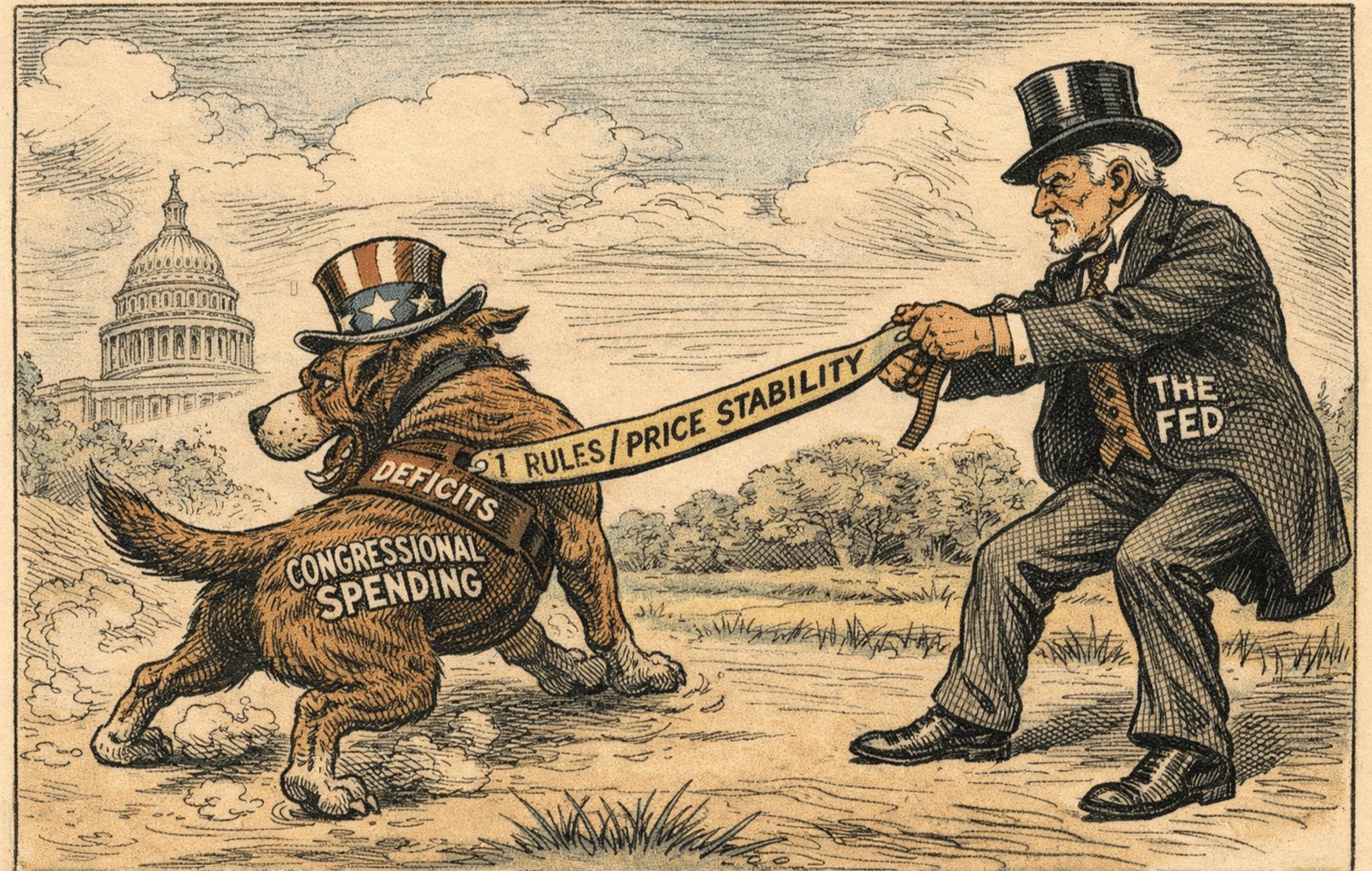
    America’s fiscal and monetary problems look like two separate crises. They aren’t. Runaway government spending and an unruly Federal Reserve are two sides of the same coin. When Congress spends beyond its means, it creates pressure on the central bank to print money and paper over the debt. When the Fed operates without clear rules, it becomes the silent enabler of fiscal recklessness. Fix one without fixing the other and you haven’t solved anything. That is where we find ourselves today.

    As I argued in my first book, the Fed has a rule problem: It doesn’t have one. For decades, monetary policymakers have operated under broad discretionary authority, adjusting interest rates and the money supply based on their judgment about what the economy needs. The results have been disappointing.

    The case against discretionary monetary policy runs along two tracks: one about competence and one about legitimacy.

    Start with competence. Central bankers face serious information problems. The economy is vast and complex, and the signals it sends are noisy. Policymakers receive data that is incomplete, revised, and often contradictory. By the time the Fed diagnoses a problem and adjusts policy, the underlying conditions may have already changed. Discretion sounds like flexibility. In practice, it often means groping in the dark.

    But information problems are only half the story. Incentive problems compound them. Bureaucracies develop institutional interests of their own. The Fed, like any government agency, responds to political pressures, professional norms, and the priorities of its leadership. Monetary economists — the experts who advise the Fed and evaluate its performance — constitute their own interest group. They have professional stakes in a powerful, discretionary central bank. And then there’s perhaps the biggest incentive problem of all: the looming threat of fiscal dominance. It’s time to stop thinking about monetary policy in a vacuum.

    There is a deeper question here, as was recognized almost 50 years ago by economists Thomas Sargent and Neil Wallace: are fiscal policymakers or monetary policymakers in the driver’s seat? When Congress and the Treasury spend freely and accumulate debt, they create pressure on the central bank to monetize that debt. If the fiscal authority “moves first” and the Fed “follows,” then monetary policy becomes an instrument of fiscal control, not an independent check on inflation. That is precisely what happened after 2020. The government spent at wartime levels even as the emergency receded, and the Fed soon accommodated. Inflation naturally followed.

    So the problem is not simply that the Fed made mistakes. It is that the institutional structure invites those mistakes. A discretionary Fed embedded in a debt-heavy fiscal environment will tend to prioritize the short-term over the long-term, accommodation over restraint, and political convenience over monetary discipline.

    The solution is a Fed regime change. We need actual legislation to change the central bank’s mandate. Administrations change. Personnel change. But laws can become, as James Buchanan put it, “relatively absolute absolutes.” If Congress replaces the Fed’s current mandate, which includes employment and interest rate targets alongside price stability, with a single, clear mandate for price stability, the Fed can credibly commit to refrain from underwriting future deficit spending. Congress can’t count on the Fed bailing it out if the Fed’s price level target limits the printing press.

    The goal is not to make the Fed powerless but to make its power legible and therefore predictable. A rule-bound Fed, focused solely on price stability, empowers planning by businesses and households. It rewards saving. It discourages the kind of speculative boom-and-bust cycles that discretionary policy tends to produce. And it will force fiscal policymakers to get their mismanaged affairs in order.

    Other proposed solutions won’t work. First, we should reject presidential control over monetary policy. Giving the executive branch direct authority over interest rates would politicize money even further. Second, simply appointing more “conservative” central bankers offers no durable fix. Hawkish Fed chairs come and go; without a reformed mandate, the institutional logic reasserts itself.

    Inflation has cooled from its recent peaks and deficits are not as high now as during the COVID period, yet the underlying institutional dysfunction remains. The Fed is still improvising, still subject to fiscal pressure, still operating without the kind of clear rules that would make its behavior predictable and its decisions defensible. Monetary policy by bureaucratic fiat is not good enough. To prevent money mischief and fiscal folly, only the discipline of rules will do. The solution is a single mandate: price stability alone.

    Congressional Constrain Fed RuleBound Spending
    Share. Facebook Twitter Pinterest LinkedIn Tumblr Email
    Previous ArticleGold ETFs beat Nifty
    Next Article Shuffling and Whittling and Experimenting: Austin Keeling and Lam T. Nguyen on Editing the Told-on-Screens Film “Mercy”
    kumbhorg
    • Website
    • Tumblr

    Related Posts

    Global Economy Insights

    Headline Inflation Cooled in April, but Core Pressures Picked Up

    By kumbhorgMay 14, 2026
    Market News

    Trump's Fed chair pick Kevin Warsh confirmed by US Senate

    By kumbhorgMay 13, 2026
    Crypto News

    Senate Confirms Bitcoin Friendly Kevin Warsh As Fed Chair Ahead Of Clarity Act Vote

    By kumbhorgMay 13, 2026
    Global Economy Insights

    The Effects of Immigration on Labor Markets

    By kumbhorgMay 13, 2026
    Global Economy Insights

    AIER’s Everyday Price Index Surges, Signaling Renewed Inflation Pressure

    By kumbhorgMay 13, 2026
    Global Economy Insights

    Popokan, Tradisi Lumpur Penuh Makna Yang Menyatukan Warga

    By kumbhorgMay 12, 2026
    Add A Comment

    Comments are closed.

    Don't Miss

    Headline Inflation Cooled in April, but Core Pressures Picked Up

    By kumbhorgMay 14, 2026

    Headline inflation cooled in April, but not enough to give the Federal Reserve much comfort.…

    ProV : Makhana Khana

    May 13, 2026

    IPL 2026: Fans go wild as RCB beat KKR to claim top spot courtesy of Virat Kohli’s stunning century

    May 13, 2026

    Could the Maple Leafs Trade Down to No. 3, and Pleasing Auston Matthews

    May 13, 2026
    Top Posts

    Satwik-Chirag storm into China Masters final with straight-game win over Malaysia | Badminton News

    September 21, 2025176 Views

    SaucerSwap SAUCE Crypto Breaks Key Resistance Amid Nvidia-Hedera Deal

    July 15, 202548 Views

    Unlocking Your Potential with Mubite: The Future of Crypto Prop Trading

    September 17, 202533 Views

    Stablecoins 2025 Exchange Reserves: Insights into DeFi Trends

    September 8, 202532 Views
    Stay In Touch
    • Facebook
    • Twitter
    • Pinterest
    • Instagram
    • YouTube
    • Vimeo
    About Us

    Welcome to KumbhCoin!
    At KumbhCoin, we strive to create a unique blend of cultural and technological news for a diverse audience. Our platform bridges the spiritual significance of the Kumbh Mela with the dynamic world of cryptocurrency and general news.

    Facebook X (Twitter) Pinterest WhatsApp
    Our Picks

    Headline Inflation Cooled in April, but Core Pressures Picked Up

    May 14, 2026

    ProV : Makhana Khana

    May 13, 2026

    IPL 2026: Fans go wild as RCB beat KKR to claim top spot courtesy of Virat Kohli’s stunning century

    May 13, 2026
    Most Popular

    7 things to know before the bell

    January 22, 20250 Views

    Reeves optimistic despite surprise rise in UK borrowing

    January 22, 20250 Views

    Barnes & Noble stock soars 20% as it explores a sale Barnes & Noble stock soars 20% as it explores a sale

    January 22, 20250 Views
    • Terms and Conditions
    • Privacy Policy
    • Contact Us
    • About Us
    © 2026 Kumbhcoin. Designed by Webwizards7.

    Type above and press Enter to search. Press Esc to cancel.