
Close Menu
KumbhCoinorg
    What's Hot

    Crones & Drones

    April 16, 2026

    MI vs PBKS Dream11 Prediction Today Match 24, IPL 2026 Fantasy Cricket Tips, Playing XI, Pitch Report, Injury Update

    April 16, 2026

    Kane hails ‘special night’ after Bayern edge Real Madrid in thriller

    April 16, 2026
    Facebook X (Twitter) Instagram
    Trending
    • Crones & Drones
    • MI vs PBKS Dream11 Prediction Today Match 24, IPL 2026 Fantasy Cricket Tips, Playing XI, Pitch Report, Injury Update
    • Kane hails ‘special night’ after Bayern edge Real Madrid in thriller
    • Maple Leafs Enter Final Day With Fifth-Best Odds In 2026 NHL Draft Lottery
    • UK economy grew faster than expected ahead of Iran war
    • Bitcoin Price Passes $75,000 As Iran War Turns It From ‘Digital Gold’ Into Geopolitical Settlement Bet
    • Love Insurance Kompany: Vignesh Shivan gets emotional at ‘LIK’ event: ‘We have invested almost everything we had to make this film’ |
    • Another injury blow for CSK, Indian international ruled out of IPL 2026 | Cricket News
    Facebook X (Twitter) Instagram
    KumbhCoinorg
    Thursday, April 16
    • Home
    • Crypto News
      • Bitcoin & Altcoins
      • Blockchain Trends
      • Forex News
    • Kumbh Mela
    • Entertainment
      • Celebrity Gossip
      • Movie & TV Reviews
      • Music Industry News
    • Market News
      • Global Economy Insights
      • Real Estate Trends
      • Stock Market Updates
    • Education
      • Career Development
      • Online Learning
      • Study Tips
    • Airdrop News
      • Ico News
    • Sports
      • Cricket
      • Football
      • hockey
    KumbhCoinorg
    Home»Market News»Global Economy Insights»Progressive Taxes May Discourage the Most Productive Work
    Global Economy Insights

    Progressive Taxes May Discourage the Most Productive Work

    kumbhorgBy kumbhorgApril 16, 2026No Comments5 Mins Read
    Facebook Twitter Pinterest LinkedIn Tumblr Email
    Progressive Taxes May Discourage the Most Productive Work
    Share
    Facebook Twitter LinkedIn Pinterest Email Copy Link

    Could income taxes ever encourage someone to switch from a higher-paying to a lower-paying job? Perhaps surprisingly, the answer is yes. I have a recent example of this in my own family.

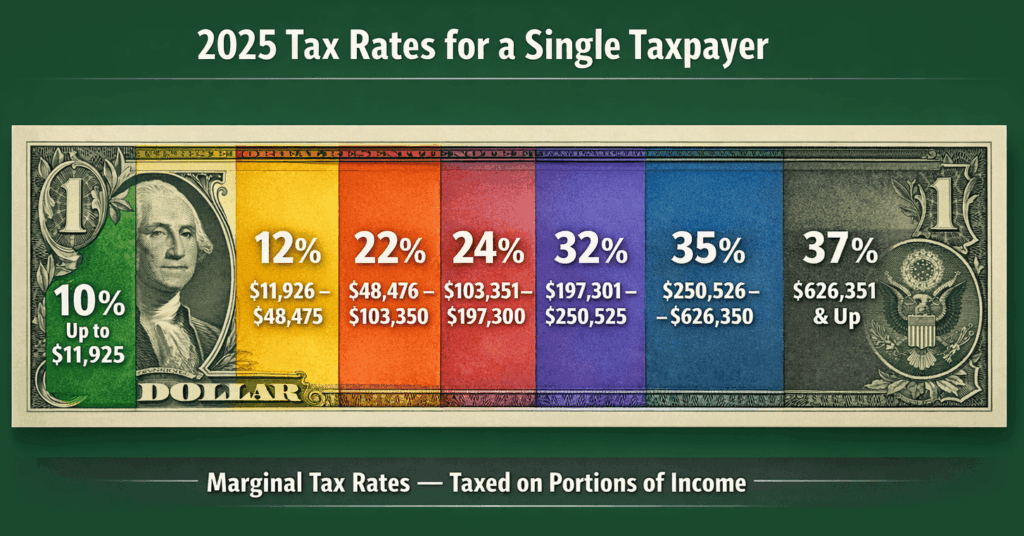
    The marginal nature of the United States’ progressive income tax is supposed to prevent this outcome. You pay a higher tax rate only on income you earn above a certain level, not your entire income. For example, a married couple earning $600,000 a year would pay 10 percent on the first $24,000 they make, 12 percent on the $73,000 they earn between $24,000 and $97,000, and so on, up until they pay 35 percent on the $99,000 they earn above the $501,000 threshold. (Bracket figures are rounded to the nearest thousand.)

    What matters when you’re considering a new income source is the tax you will pay on that additional income. If a new job would pay $50,000 more and you’re already making $600,000 as a married couple, then the job is really only paying you, after tax, $32,500 more.

    And that difference between pre-tax and post-tax pay could make all the difference when deciding on a job that pays more but is less fulfilling or enjoyable. High marginal tax rates discourage productive, paid labor.

    One alternative to paid work is household work. Accordingly, economic research suggests that married women respond to income taxes more strongly than married men, mainly by choosing whether to do paid work at all.
    But another substitute for paid labor is different paid labor — instead of getting paid entirely in money, though, you can get paid partly in job satisfaction and amenities. The economic term “compensating differentials” (see video below) refers to this kind of nonmonetary compensation. More difficult, unpleasant, and unsafe jobs pay higher wages than equivalent jobs that are less difficult, more pleasant, and safer. If they want to attract workers to the tougher jobs, companies have to offer them higher wages. 

    In the popular Paramount TV show Landman, the main character points out that men working the West Texas oil patch make $180,000 a year for the dangers they face. “That’s not enough money to risk your life on,” a young female attorney responds. “For you? Maybe,” he counters. “For a felon with an eighth-grade education, it’s a lottery ticket.” (I’m guessing he means a winning lottery ticket.) The difference between $180,000 and what a felon with an eighth-grade education would make annually in a safe job he’d be qualified for is the compensating differential.

    My wife recently faced a tradeoff of a similar kind. She chose to leave a higher-paying job for a slightly lower-paying job. Her old job had a long commute and required intercontinental travel; her new job has no commute and requires only minimal travel within North America. 

    There were important family reasons for the switch, but part of the logic had to do with taxes. We carefully calculated the value of her time and the wear and tear on the car from the commute, and used them to estimate how much salary she could reasonably give up for a more flexible job. We are in a higher tax bracket, which squeezed the difference in after-tax pay enough that the lower-paying job was a good deal once all other factors were considered.

    How many other families find themselves in a situation similar to ours? I found exactly one study on the question. It found that a 10 percent increase in the net-of-tax rate causes a worker to choose an occupation with a 0.3 percent higher wage, on average. (The “net-of-tax rate” is the rate at which wages are converted into post-tax earnings, so you can think of it as the inverse of a tax rate.) It’s a small effect, but added up across an entire economy could amount to billions of dollars in new wages from a typical tax cut. Moreover, it confirms the theory: people are willing to work harder, better-paid jobs when taxes are lower.

    Income taxes decrease labor supply in other ways too. Economist Michael Keane points out that even if income tax rates have a small effect on labor force participation (particularly men’s) in the short run, the long-run effect could be much larger if work experience builds productivity. Depriving even a small number of potential workers of the incentive to work when they are in their 20s and 30s means they’ll be far less productive than they otherwise could have been in their 40s and 50s.

    Most other countries have “flatter” tax burdens than the US. In other words, the middle class shoulders a larger share of the tax burden in other countries. Perhaps the US could learn something from them in this respect — indeed, it may be that they are only able to raise the revenue to sustain a bigger government by keeping their tax structure flat and disincentivizing paid work less. If they want to avoid hiking taxes on the middle class, Congress could have no choice in the future but to cut spending drastically. Hiking already-high marginal tax rates on the most productive workers will do too much economic damage.

    Discourage Productive Progressive Taxes Work
    Share. Facebook Twitter Pinterest LinkedIn Tumblr Email
    Previous ArticleSpaceX Valuations Blast Off
    Next Article Miroirs No. 3 review – no one is doing it like…
    kumbhorg
    • Website
    • Tumblr

    Related Posts

    Global Economy Insights

    Inovasi Digital Terbaru Tahun Ini Yang Wajib Kamu Tahu!

    By kumbhorgApril 15, 2026
    Global Economy Insights

    Dedollarization: Causes, Constraints, and Consequences

    By kumbhorgApril 15, 2026
    Global Economy Insights

    Pesona Romantis Dan Sejarah Abadi

    By kumbhorgApril 14, 2026
    Global Economy Insights

    AIER’s Everyday Price Index Rockets 2.5 Percent in March 2026

    By kumbhorgApril 14, 2026
    Global Economy Insights

    Pesona, & Kisah Inspiratif Sang Aktris Hollywood

    By kumbhorgApril 13, 2026
    Global Economy Insights

    Can Trump’s Maritime Plan Save America’s Struggling Shipyards?

    By kumbhorgApril 13, 2026
    Add A Comment

    Comments are closed.

    Don't Miss

    Crones & Drones

    By kumbhorgApril 16, 2026

    Source: Financial Times

    MI vs PBKS Dream11 Prediction Today Match 24, IPL 2026 Fantasy Cricket Tips, Playing XI, Pitch Report, Injury Update

    April 16, 2026

    Kane hails ‘special night’ after Bayern edge Real Madrid in thriller

    April 16, 2026

    Maple Leafs Enter Final Day With Fifth-Best Odds In 2026 NHL Draft Lottery

    April 16, 2026
    Top Posts

    Satwik-Chirag storm into China Masters final with straight-game win over Malaysia | Badminton News

    September 21, 2025165 Views

    SaucerSwap SAUCE Crypto Breaks Key Resistance Amid Nvidia-Hedera Deal

    July 15, 202546 Views

    Unlocking Your Potential with Mubite: The Future of Crypto Prop Trading

    September 17, 202533 Views

    Stablecoins 2025 Exchange Reserves: Insights into DeFi Trends

    September 8, 202532 Views
    Stay In Touch
    • Facebook
    • Twitter
    • Pinterest
    • Instagram
    • YouTube
    • Vimeo
    About Us

    Welcome to KumbhCoin!
    At KumbhCoin, we strive to create a unique blend of cultural and technological news for a diverse audience. Our platform bridges the spiritual significance of the Kumbh Mela with the dynamic world of cryptocurrency and general news.

    Facebook X (Twitter) Pinterest WhatsApp
    Our Picks

    Crones & Drones

    April 16, 2026

    MI vs PBKS Dream11 Prediction Today Match 24, IPL 2026 Fantasy Cricket Tips, Playing XI, Pitch Report, Injury Update

    April 16, 2026

    Kane hails ‘special night’ after Bayern edge Real Madrid in thriller

    April 16, 2026
    Most Popular

    7 things to know before the bell

    January 22, 20250 Views

    Reeves optimistic despite surprise rise in UK borrowing

    January 22, 20250 Views

    Barnes & Noble stock soars 20% as it explores a sale Barnes & Noble stock soars 20% as it explores a sale

    January 22, 20250 Views
    • Terms and Conditions
    • Privacy Policy
    • Contact Us
    • About Us
    © 2026 Kumbhcoin. Designed by Webwizards7.

    Type above and press Enter to search. Press Esc to cancel.