


Task Analysis For Instructional Designers: Types, Examples, Guides
Task analysis is often the missing piece in learning programs that do not lead to real performance improvements. This is because many programs focus on content without fully understanding what people need to do in their jobs. This makes it important to ask, “What is task analysis?” At its core, it breaks down tasks into clear, actionable steps. This makes it easier to create learning materials that support job performance.
So, it is more than just a method; it is a key tool used in Instructional Design, User Experience (UX), and workforce performance. It helps teams replace assumptions with a clear understanding, ensuring that every learning experience matches real job tasks. In practice, it helps identify skill gaps, simplify complex tasks, and improve learning and user outcomes. This guide will provide practical frameworks, examples, and strategies to help you use task analysis effectively in real-world situations.
Table Of Contents
What Is Task Analysis?
Task analysis is the process of breaking a task into smaller parts to understand how it is done and how it can be taught or improved. In simple terms, it focuses on the actions, decisions, and sequence of steps needed to complete a task successfully. So, it’s more than just listing steps; it looks at how work is done in real situations and involves identifying visible actions as well as the thinking behind them.
Today, this analysis is crucial for addressing performance gaps, not just knowledge gaps. It helps Instructional Designers connect learning with real job results, especially in AI-driven environments and skills-focused organizations, where accuracy and relevance greatly affect performance.
What Is Task Analysis Used For?
Task analysis is used for breaking complex activities into clear, actionable steps so professionals can design, improve, and scale performance. In Instructional Design, it supports curriculum structuring by aligning learning objectives with real tasks rather than abstract knowledge. In UX and product design, UX task analysis helps teams understand how users interact with systems, making it more intuitive and efficient.
It should be used when outcomes are unclear, processes vary across teams, or performance gaps persist. In workforce management, job task analysis ensures employees are trained on what actually matters in their roles. It is also essential in compliance training, where precision and consistency are critical. Finally, organizations use it to optimize processes, identify inefficiencies, and simplify workflows.
Four Types Of Task Analysis (And When To Use Each)
There are four types of task analysis, each designed to solve a different kind of performance problem. Understanding them helps Instructional Designers choose the right approach rather than relying on generic content breakdowns.
1. Hierarchical Task Analysis
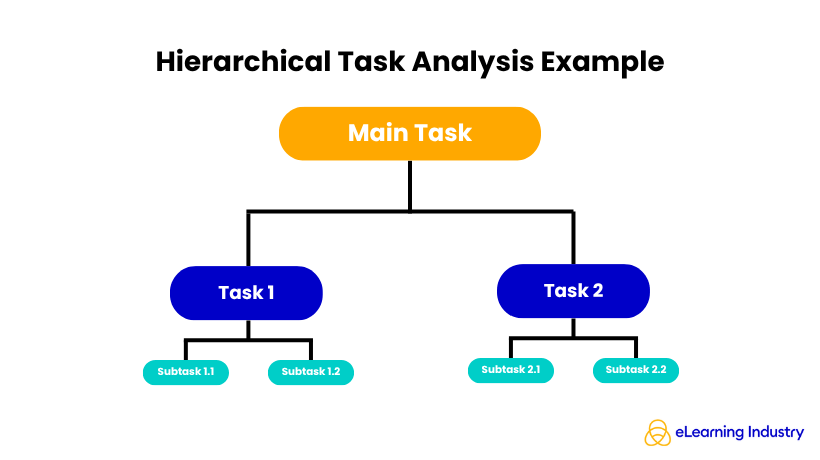
Hierarchical task analysis focuses on structure. It breaks a complex task into smaller subtasks and organizes them into a logical hierarchy.
Use it when you need to:
- Map out complex processes.
- Design structured learning paths.
- Identify dependencies between steps.
This is especially useful in onboarding, compliance training, or any scenario where clarity and sequence matter.
2. Cognitive Task Analysis
Cognitive task analysis goes beyond observable steps and focuses on how people think while performing a task. It captures decision-making, judgment, and problem-solving.
Use it when:
- Tasks involve expertise or intuition.
- Learners must make decisions under pressure.
- You are designing simulations or scenario-based learning.
This type is critical for leadership training, customer support, and high-stakes environments.
3. Procedural Task Analysis
Procedural task analysis documents step-by-step execution. It answers the question: “What exactly should someone do and in what order?”
Use it when:
- Consistency is essential.
- Tasks must be performed the same way every time.
- You are creating SOPs, checklists, or system training.
It is often the fastest way to translate tasks into clear instructional content.
4. Performance (Or Job) Task Analysis
Job task analysis (or performance task analysis) focuses on real-world job tasks and outcomes. It connects what people do with measurable performance.
Use it when:
- Aligning training with business goals.
- Identifying skill gaps.
- Designing role-based learning programs.
This approach ensures learning is not just informative but directly tied to performance.
Comparison Of The Four Types Of Task Analysis
Type |
Focus |
Best Use Case |
Output |
Hierarchical Task Analysis |
Task structure & breakdown | Complex processes | Task hierarchy/diagram |
Cognitive Task Analysis |
Thinking & decisions | Expert tasks, problem-solving | Decision maps, scenarios |
Procedural Task Analysis |
Step-by-step actions | SOPs, system training | Checklists, instructions |
Performance/Job Task Analysis |
Real-world performance | Role-based learning, skill gaps | Task-performance alignment |
Task Analysis In Instructional Design And Education
Task analysis in education is a critical process that helps Instructional Designers and educators understand how learners perform tasks and acquire skills. Basically, it means breaking down a learning task into smaller, easier parts. This helps teachers create lessons that meet students’ real-world needs. By using these methods, educators can focus on both the skills students need to learn and the important knowledge required for success.
Importance
Task analysis is important because it helps make learning programs more effective. By connecting learning goals to real-world skills, teachers ensure students can apply what they learn in everyday situations. Instead of teaching a concept alone, this process shows the step-by-step actions needed to complete a task successfully. It also helps avoid overwhelming students by focusing on the most important steps and breaking down complex skills into smaller, manageable parts. This method improves memory retention, reduces mental strain, and allows students to advance confidently.
Examples In The Classroom
In K–12 settings, classroom task analyses might include teaching math skills, such as fractions. For example, a teacher could break down the topic into micro-skills: recognizing fractions, comparing fractions, performing basic operations, and applying fractions in word problems.
Similarly, for elementary students, this could include science experiments, reading comprehension exercises, or daily routines like classroom procedures. By breaking down each step, teachers can give clear guidance, regular assessments, and specific feedback. This support helps learners master the material more effectively.
Task Analysis Examples
Task analysis is a versatile tool that can be applied across industries to improve learning, performance, and workflow efficiency. Below are practical task analysis examples that show how breaking down tasks into smaller components can drive measurable results.
Example 1: Employee Onboarding
An example for onboarding might include breaking down the steps for completing new-hire paperwork, accessing company systems, and understanding compliance requirements. Each step is analyzed to identify potential knowledge gaps and streamline the process for faster employee ramp-up.
Example 2: Customer Support Workflow
In customer support, an example could involve mapping out how agents handle common issues, from ticket creation to resolution. By detailing each action, organizations can standardize responses, reduce errors, and train staff more effectively.
Example 3: Software Training
For software training, an example might focus on teaching employees to use a new platform. Tasks are broken down into steps such as logging in, navigating the dashboard, performing key functions, and troubleshooting common errors. This ensures learners gain competence efficiently and confidently.
Example 4: Classroom Learning Task
In an educational setting, an example could involve teaching a math skill. The instructor breaks the task into sequential steps, such as introducing the concept, modeling the solution, guided practice, and independent application. This method allows educators to assess understanding at each stage and provide targeted support.
How To Conduct A Task Analysis
Conducting a task analysis is essential for Instructional Designers and other professionals who want to create effective, performance-driven learning experiences. If you’re wondering how to conduct one, here’s a structured step-by-step framework you can follow.
Step 1: Define The Task
Begin by clearly identifying the task you want to analyze. Ask: What is the task’s purpose, and who performs it? This foundational step ensures your task analysis is focused and relevant. Defining the task properly sets the stage for meaningful insights.
Step 2: Identify End Goals
Next, outline the desired outcomes. Understanding what a successful completion of the task looks like helps you align the process with business objectives or learning outcomes. This step answers the critical question of why the task matters.
Step 3: Break Into Subtasks
Divide the main task into smaller, observable subtasks. Each subtask should be actionable and measurable. Breaking tasks down in this way makes it easier to identify skills, knowledge, and potential obstacles.
Step 4: Sequence And Dependencies
Organize the subtasks in the correct order and highlight dependencies. Some steps must occur before others, while some can happen simultaneously. This sequencing ensures your task analysis reflects real-world execution.
Step 5: Validate With SMEs
Engage Subject Matter Experts (SMEs) to review your analysis. SMEs can confirm accuracy, suggest missing steps, and provide context that might not be apparent from observation alone. Validation ensures your analysis is reliable and actionable.
Step 6: Map To Learning Outcomes
Finally, connect the subtasks to learning objectives, training content, or improvements. This step ensures that the task analysis translates into practical, measurable outcomes.
Creating a task analysis can be enhanced by leveraging AI tools, analyzing user data, and reviewing performance analytics. These resources help uncover patterns, optimize workflows, and ensure the analysis delivers maximum impact for learners or users.
Following these steps for task analysis helps professionals understand their tasks clearly and in an organized way. If you’re looking to conduct a task analysis or create one from scratch, this framework offers the clarity and structure needed for effective learning.
Conclusion
Task analysis is more than just a checklist; it’s a clear way of thinking. By breaking down tasks into their main parts, learning leaders and Instructional Designers can understand what is truly important for performance. This process connects learning design, learner experience, and real-world results, making sure that programs are effective and support organizational goals. When done thoughtfully, task analysis turns complex issues into clear steps, helping to improve training, workflows, and employee performance. Ultimately, it enables professionals to create smarter solutions instead of just listing tasks.
Frequently Asked Questions (FAQ) About Task Analysis
Creating a task analysis can be enhanced by leveraging Subject Matter Expertise, reviewing performance data, integrating user feedback, and using visual tools like task analysis diagrams. AI and workflow analytics can further improve accuracy and efficiency, ensuring tasks are broken down meaningfully for learning, UX, or performance design.
A task analysis is the systematic process of breaking down a task into smaller components to understand how it is performed, taught, or optimized. It helps Instructional Designers, UX professionals, and managers align training with real-world performance.
In education, task analysis identifies the step-by-step skills or knowledge students need to complete a learning activity. It supports lesson planning, scaffolding, and assessments to improve learning outcomes.
Task analysis means examining a task in detail to understand its steps, required skills, and outcomes. Its purpose is to make learning, workflows, or processes more efficient and measurable.
The five steps are:
- Define the task and goals.
- Identify subtasks or actions.
- Sequence tasks and dependencies.
- Validate with Subject Matter Experts.
- Map outcomes to learning or performance objectives.
The four main types are:
- Hierarchical task analysis: Breaking tasks into subtasks.
- Cognitive task analysis: Focusing on decision-making.
- Procedural task analysis: Detailing step-by-step actions.
- Job/performance task analysis: Analyzing real-world job tasks.
An example is analyzing the onboarding process for a new employee: breaking it down into tasks such as setting up accounts, completing training modules, meeting team members, and performing first job responsibilities. Each step is documented for clarity and optimization.
