


Why Skills-Based Hiring Is Reshaping Talent Strategy
Skills-based hiring is changing how HR leaders and professionals think about finding talent. It focuses on real skills instead of formal degrees. Organizations now prioritize what candidates can do rather than relying solely on traditional credentials. This change is happening because job requirements are evolving quickly, and degree-based models no longer keep pace with the fast pace of modern work.
HR leaders are changing how they recruit because traditional methods often miss strong candidates who lack formal qualifications but possess important skills. As competition for talent increases, skill-based recruitment helps organizations find more talent and make better hiring decisions. This approach is especially important for jobs where adaptability and a willingness to learn matter more than a specific degree.
From a business perspective, skills-based hiring directly supports agility, stronger retention, and a more adaptable workforce. When employees are selected based on proven abilities, they tend to perform more quickly and better align with evolving job demands, reducing turnover and improving productivity.
At the same time, AI-driven hiring technologies are accelerating this transformation by enabling better skills matching, automated assessments, and data-driven decision-making. This article provides strategic clarity for HR leaders by breaking down what skills-based hiring means, why it matters now, and how to apply practical frameworks to improve recruitment outcomes.
What Is Skills-Based Hiring?
Skills-based hiring is a recruitment approach that prioritizes a candidate’s demonstrable skills and competencies over formal education or job titles. In simple terms, it focuses on what people can actually do, rather than where they studied or the positions they previously held. This shift is central to understanding skills-based hiring in today’s workforce, where job requirements are evolving faster than traditional education paths.
The skills-based hiring definition is a way to evaluate job candidates based on their actual abilities. Instead of primarily considering degrees or years of experience, companies focus on how candidates perform in real situations. They use tests, simulations, portfolios, and structured interviews to see what candidates can really do. This method is more practical and evidence-based than traditional hiring, which relies on credentials.
Traditional hiring often values academic qualifications as a quick way to judge someone’s skills. In contrast, skills-based hiring focuses on what a candidate can actually do. For example, a person without a formal degree might perform better than others if they can show their relevant technical or soft skills during tests. This difference is important in today’s skills-based recruitment methods.
Skills-based hiring focuses on three main ideas: clear job skills, structured assessments of those skills, and evaluations based on tasks. These ideas help hiring teams reduce bias and make fairer decisions. They also ensure that job requirements better match actual job performance.
Why Skills-Based Hiring Is Gaining Momentum
Skills Gap
Skills-based hiring is becoming more popular because companies need to fill talent gaps quickly and hire people who can produce results sooner. The skills gap is growing as job requirements change faster than traditional education can keep pace, making it hard to fill many roles solely with degree requirements.
Digital Transformation And AI
Digital transformation and AI adoption are reshaping how work is done across industries. Many roles now require hybrid capabilities, combining technical literacy, problem-solving, and adaptability, rather than academic credentials. This shift is making skill-based hiring a more practical approach for identifying candidates who can perform in modern, fast-changing environments.
Decline Of Degree Relevance
Employers are increasingly finding that formal education does not always reflect job readiness, especially in tech-enabled and operational roles. As a result, skill-based recruitment is becoming more common as organizations prioritize verified competencies over traditional qualifications.
Demand For Adaptability
Businesses need employees who can learn quickly, shift roles, and respond to change without long retraining cycles. This is closely tied to internal mobility and reskilling pressures, in which companies are investing in developing existing employees rather than relying solely on external hiring.
Skill-Based Hiring Vs. Traditional Hiring Models
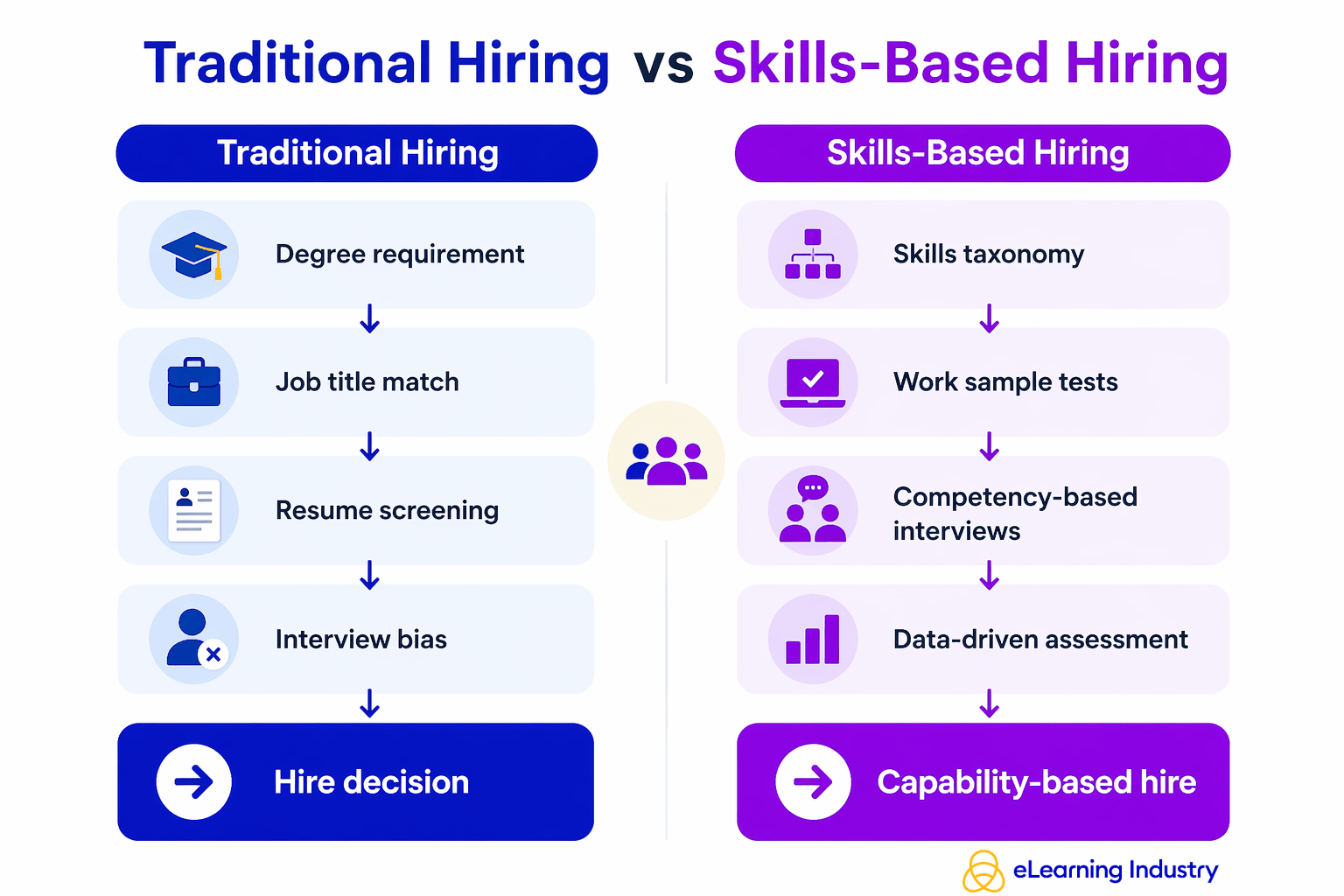
Skill-based hiring and traditional hiring models differ mainly in how they assess a candidate’s ability to succeed in a role. Traditional hiring has long focused on education, job titles, and past employers. In contrast, skill-based hiring focuses on what a person can actually do, using evidence of skills and competencies.
Education Vs. Skills
Traditional hiring often treats degrees and certifications as proof of ability. But skill-based recruitment prioritizes real-world performance. For example, instead of asking where someone studied, employers assess whether they can complete job-related tasks or solve relevant problems.
Resume Screening Vs. Competency Assessment
In traditional hiring, resumes act as the main filter. This can miss strong candidates who gained experience through non-linear career paths. With skills-based recruiting, employers use structured assessments, work samples, and scenario-based interviews to evaluate actual capability rather than surface-level credentials.
Job Title Matching Vs. Capability Mapping
Traditional models rely on previous job titles as indicators of fit. However, job titles can vary widely between companies and industries. Skill-based hiring replaces this with capability mapping, where candidates are evaluated based on the specific skills required for the role, regardless of their previous title.
Static Roles Vs. Dynamic Skill Profiles
Traditional hiring assumes roles stay fixed over time. In reality, modern jobs evolve quickly. Skill-based hiring supports dynamic skill profiles that can adapt as business needs change, making organizations more flexible and resilient.
Core Components Of A Skill-Based Recruitment Strategy
A strong skills-based hiring approach depends on building a structured recruitment system that focuses on real capability rather than assumptions based on titles or degrees. For HR leaders and HR pros, this requires redesigning how roles are defined, how candidates are assessed, and how hiring decisions are made. A well-designed skill-based recruitment strategy usually rests on four key components.
1. List Of Required Skills
To start, create a clear list of skills needed for each job. This includes specific skills tied to the role and general skills that can apply to many jobs, like communication and problem-solving. These skills should align with the organization’s overall goals. This ensures that hiring supports long-term workforce planning and company objectives. Without a clear structure, skill-based recruitment can become inconsistent and difficult to manage.
2. Skills Assessment Methods
Traditional interviews are not enough. Instead, organizations use work-sample tests, simulation-based hiring, and structured competency-based interviews. These methods help evaluate how candidates actually perform tasks, not just how they describe them. This makes skills-based recruiting more objective and predictive of real job performance.
3. Rewriting Job Descriptions
Instead of listing degrees or years of experience in job descriptions, HR teams focus on measurable capabilities and outcomes. Removing degree bias opens access to a wider talent pool and improves fairness. Clear skill-based job descriptions also make it easier for candidates to understand expectations and self-assess fit.
4. Data-Driven Talent Matching
Finally, organizations increasingly rely on data to improve hiring decisions. AI tools and ATS platforms can map candidate skills to job requirements more accurately. This supports smarter matching, reduces hiring time, and improves the quality of hire. In advanced systems, skills-based hiring becomes a continuous process powered by real-time skills intelligence.
Benefits Of Skills-Based Hiring For Organizations
Skills-based hiring helps organizations make better hiring decisions. It focuses on what candidates can actually do instead of just their degrees, job titles, or past employers. This improves the quality of hiring by evaluating candidates based on their proven abilities, not on assumptions.
Better Hiring Accuracy
When organizations assess real skills through structured tests, work samples, or scenario-based interviews, they reduce the risk of mismatched hires. This leads to stronger performance and fewer early-stage hiring mistakes.
Improved Retention Rates
Employees hired based on their actual skills tend to feel more confident in their roles. They are more likely to succeed early, grow faster, and stay longer because the role fits their true capabilities. This directly reduces turnover costs and strengthens workforce stability.
Reduced Time-To-Hire
With a clear focus on skills-based recruitment, HR teams can quickly filter candidates based on relevant competencies instead of manually reviewing long, credential-heavy resumes. This streamlines decision-making and speeds up the hiring process.
Wider Talent Pools
By removing strict degree requirements, companies can access candidates from non-traditional backgrounds, career changers, and self-taught professionals. This is especially valuable in competitive or high-skill labor markets.
Increased Diversity And Inclusion
Skills-based recruitment naturally reduces bias tied to education, prestige institutions, or career paths. This creates fairer opportunities for a broader range of candidates and improves workforce diversity in a meaningful way.
How To Implement Skills-Based Hiring: A Practical Guide For HR Leaders
Moving from traditional recruitment to skills-based hiring requires more than a mindset shift. It requires a structured approach that HR leaders can implement step by step. This skills-based hiring guide is designed to help HR professionals translate strategy into execution in a practical, repeatable way.
Step 1: Define Hireable Skills
The first step is to clearly identify the hireable skills required for success in each role. This includes both technical and behavioral competencies.
Technical skills are job-specific abilities such as data analysis, coding, project management, or financial forecasting. Behavioral skills include communication, adaptability, problem-solving, and collaboration.
Instead of using broad job titles, break down roles into specific skills. This helps hiring teams understand what is needed and makes it easier to evaluate candidates. It also ensures that hiring decisions are based on real abilities, not just resumes or degrees.
Step 2: Redesign Job Architecture
Traditional job descriptions are often title-focused and rigid. In skill-based recruitment, job architecture should shift toward skill clusters and outcomes.
This means defining roles based on what a person must be able to do, not just on their title. For example, instead of “Marketing Manager,” define the role by skills such as campaign strategy, analytics interpretation, and digital content execution. This enables more flexible hiring and opens access to a wider talent pool, especially candidates from non-traditional backgrounds.
Step 3: Build Assessment Frameworks
To make skills-based hiring effective, HR teams need structured assessment systems. This includes work simulations, case studies, skill tests, and structured interview questions aligned with specific competencies. Standardized evaluation criteria ensure fairness and consistency across candidates. Without this step, skill-based recruitment can become subjective, which undermines its value.
Step 4: Train Hiring Managers
Hiring managers play a critical role in executing a skills-based hiring strategy. However, many are still influenced by traditional bias toward education or previous job titles.
Training should focus on evaluating skills objectively, using assessment tools effectively, and avoiding unconscious bias. This step is essential for ensuring consistency across teams and improving hiring accuracy.
Step 5: Integrate HR Tech Systems
Modern skills-based hiring depends heavily on technology. Applicant Tracking Systems (ATS) and skills intelligence platforms help map candidate skills to job requirements.
These systems can also identify transferable skills and suggest better candidate matches. Integration ensures that skills data is centralized, not scattered, and actionable.
Step 6: Continuously Refine Skills Data
A skills-based hiring guide is not complete without continuous improvement. HR leaders should use performance data and employee outcomes to refine their skills models over time.
Feedback loops help identify which skills truly predict success in a role. This ensures the hiring framework becomes more accurate and aligned with business needs over time.
Conclusion
Skills-based hiring is becoming vital for HR leaders and professionals as they seek to transform the workforce. This approach focuses on real skills and proven performance rather than just degrees and job titles. By doing this, organizations can make better hiring decisions that prepare them for the future. However, change should be gradual and not disruptive. HR teams should start small by testing skill-based hiring methods and improving them over time. This step-by-step approach lowers risks and helps everyone in the organization adapt.
