

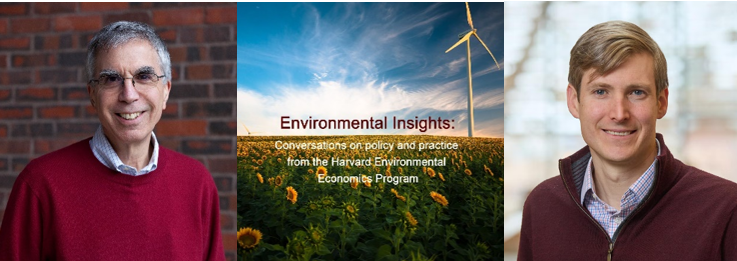
Given the recent history of the Biden administration with its reliance on subsidies in its massive climate legislation, the Inflation Reduction Act, it is natural to ask whether liberal climate policy has moved beyond carbon-pricing instruments, at least in the United States. To discuss this and related issues, I was fortunate to be joined in the latest episode of my podcast series, “Environmental Insights: Discussions on Policy and Practice from the Harvard Environmental Economics Program,” by Kenneth Gillingham, Professor of Economics at the Yale School of the Environment. Please listen to our full conversation here.

With experience as a senior staff economist at the White House Council of Economic Advisers, Gillingham is a leading energy and environmental economist whose research draws from the fields of applied microeconomics, behavioral economics, industrial organization, and integrated assessment modeling of climate change. Prior to joining the faculty at Yale, he spent two years as a research assistant at Resources for the Future.
“The tools of economics are incredibly powerful for helping you understand how to appropriately manage the environment and also the effects of many different policies, actions, technologies… both on the environment but also more broadly on human wellbeing,” Gillingham says in our conversation.
Much of Ken’s work has focused on carbon pricing mechanisms, which many economists believe must be leveraged appropriately to reduce emissions and mitigate the impacts of climate change. In our chat, I ask him whether consideration and implementation of carbon-pricing in the United States has peaked, with recent attention from the Biden administration having focused almost exclusively on the use of subsidies.
He responds: “I do recognize there are real and very strong political forces that work against carbon pricing, but I don’t believe that it’s a foregone conclusion that we will never have carbon pricing. I do recognize that it’s somehow often politically easier to give subsidies than it is to tax someone, but as we’ve seen with the [Trump administration’s] One Big Beautiful Bill, those subsidies may not be that durable either. And at the end of the day, the logic of carbon pricing is so powerful and so strong and the evidence behind it where we’ve seen it working in so many places that it has to remain on the table.”
Ken Gillingham believes that carbon pricing mechanisms will become more politically viable when they are perceived as revenue generators with potentially important health benefits.
“You need to build a coalition, and you’re going to have a set of people who say, ‘Look, this is going to help us address climate change.’ It may also have co-benefits and help us address a set of other co-pollutants, reduce asthma cases, et cetera. And of course it’s not the direct way to do that, but it will do that as a co-benefit,” he says. “You put all of that together along with those who say, ‘We’re desperate, we need new revenues, we are in a tight budget situation.’ It’s possible, I believe, to build that coalition.”

Gillingham also addresses questions related to the distributional implications of climate policies, specifically the impacts of carbon pricing on lower-income households.
“You can make an argument… that carbon pricing is hurting poor people,” he remarks. “You raise fuel prices, you really do cause quite a bit of unrest. And I think that that has to be addressed, but the key thing for carbon pricing to work, you maintain the price… You would have to find ways in which there’s still an incentive for everyone – low income, middle income, high income – to reduce emissions. They still face that price, but you can redistribute some of that revenue back in a way that is means tested or related otherwise to income.”
At the end of our conversation, Ken Gillingham offers some sage advice to young people considering studying environmental economics.
“It is a fascinating, amazing field that draws together knowledge across a broad range of disciplines. It is an economics field but it’s not just economics. You need to know much more, and that just keeps it incredibly interesting,” he states. “There are an endless number of tradeoffs that will always be made. This field will always be relevant. And so, if you’re interested in the environment and if you’re interested in thinking carefully about tradeoffs and understanding how policies actually work in the real world and influence wellbeing and welfare, I would say that environmental economics is a great path to take.”
For this and much, much more, I encourage you to listen to this 75th episode of the Environmental Insights series, with future episodes scheduled to drop each month. You can find a transcript of our conversation at the website of the Harvard Environmental Economics Program. Previous episodes have featured conversations with:
- Gina McCarthy, former Administrator of the U.S. Environmental Protection Agency
- Nick Stern of the London School of Economics discussing his career, British politics, and efforts to combat climate change
- Andrei Marcu, founder and executive director of the European Roundtable on Climate Change and Sustainable Transition
- Paul Watkinson, Chair of the Subsidiary Body for Scientific and Technological Advice (SBSTA) within the United Nations Framework Convention on Climate Change
- Jos Delbeke, professor at the European University Institute in Florence and at the KU Leuven in Belgium, and formerly Director-General of the European Commission’s DG Climate Action
- David Keith, professor at Harvard and a leading authority on geoengineering
- Joe Aldy, professor of the practice of public policy at Harvard Kennedy School, with considerable experience working on climate change policy issues in the U.S. government
- Scott Barrett, professor of natural resource economics at Columbia University, and an authority on infectious disease policy
- Rebecca Henderson, John and Natty McArthur University Professor at Harvard University, and founding co-director of the Business and Environment Initiative at Harvard Business School.
- Sue Biniaz, who was the lead climate lawyer and a lead climate negotiator for the United States from 1989 until early 2017.
- Richard Schmalensee, the Howard W. Johnson Professor of Management, and Professor of Economics Emeritus at the Massachusetts Institute of Technology.
- Kelley Kizier, Associate Vice President for International Climate at the Environmental Defense Fund.
- David Hone, Chief Climate Change Adviser, Shell International.
- Vicky Bailey, 30 years of experience in corporate and government positions in the energy sector.
- David Victor, professor of international relations at the University of California, San Diego.
- Lisa Friedman, reporter on the climate desk at the The New York Times.
- Coral Davenport, who covers energy and environmental policy for The New York Times from Washington.
- Spencer Dale, BP Group Chief Economist.
- Richard Revesz, professor at the NYU School of Law.
- Daniel Esty, Hillhouse Professor of Environment and Law at Yale University.
- William Hogan, Raymond Plank Research Professor of Global Energy Policy at Harvard.
- Jody Freeman, Archibald Cox Professor of Law at Harvard Law School.
- John Graham, Dean Emeritus, Paul O’Neill School of Public and Environmental Affairs, Indiana University.
- Gernot Wagner, Clinical Associate Professor at New York University.
- John Holdren, Research Professor, Harvard Kennedy School.
- Larry Goulder, Shuzo Nishihara Professor of Environmental and Resource Economics, Stanford University.
- Suzi Kerr, Chief Economist, Environmental Defense Fund.
- Sheila Olmstead, Professor of Public Affairs, LBJ School of Public Affairs, University of Texas, Austin.
- Robert Pindyck, Bank of Tokyo-Mitsubishi Professor of Economics and Finance, MIT Sloan School of Management.
- Gilbert Metcalf, Professor of Economics, Tufts University.
- Navroz Dubash, Professor, Centre for Policy Research, New Delhi.
- Paul Joskow, Elizabeth and James Killian Professor of Economics emeritus, MIT.
- Maureen Cropper, Distinguished University Professor, University of Maryland.
- Orley Ashenfelter, the Joseph Douglas Green 1895 Professor of Economics, Princeton University.
- Jonathan Wiener, the William and Thomas Perkins Professor of Law, Duke Law School.
- Lori Bennear, the Juli Plant Grainger Associate Professor of Energy Economics and Policy, Nicholas School of the Environment, Duke University.
- Daniel Yergin, founder of Cambridge Energy Research Associates, and now Vice Chair of S&P Global.
- Jeffrey Holmstead, who leads the Environmental Strategies Group at Bracewell in Washington, DC.
- Daniel Jacob, Vasco McCoy Family Professor of Atmospheric Chemistry & Environmental Engineering at Harvard.
- Michael Greenstone, Milton Friedman Distinguished Service Professor of Economics, University of Chicago.
- Billy Pizer, Vice President for Research & Policy Engagement, Resources for the Future.
- Daniel Bodansky, Regents’ Professor, Sandra Day O’Connor College of Law, Arizona State University.
- Catherine Wolfram, Cora Jane Flood Professor of Business Administration, Haas School of Business, University of California, Berkeley, currently on leave at the Harvard Kennedy School.
- James Stock, Harold Hitchings Burbank Professor of Political Economy, Harvard University.
- Mary Nichols, long-time leader in California, U.S., and international climate change policy.
- Geoffrey Heal, Donald Waite III Professor of Social Enterprise, Columbia Business School.
- Kathleen Segerson, Board of Trustees Distinguished Professor of Economics, University of Connecticut.
- Meredith Fowlie, Professor of Agricultural and Resource Economics, U.C. Berkeley.
- Karen Palmer, Senior Fellow, Resources for the Future.
- Severin Borenstein, Professor of the Graduate School, Haas School of Business, University of California, Berkeley.
- Michael Toffel, Senator John Heinz Professor of Environmental Management and Professor of Business Administration, Harvard Business School.
- Emma Rothschild, Jeremy and Jane Knowles Professor of History, Harvard University.
- Nathaniel Keohane, President, C2ES.
- Amy Harder, Executive Editor, Cypher News.
- Richard Zeckhauser, Frank Ramsey Professor of Political Economy, Harvard Kennedy School.
- Kimberly (Kim) Clausing, School of Law, University of California at Los Angeles
- Hunt Allcott, Professor of Global Environmental Policy, Stanford Doerr School of Sustainability.
- Meghan O’Sullivan, Jeane Kirkpatrick Professor of the Practice of International Affairs at Harvard Kennedy School.
- Robert Lawrence, Albert Williams Professor of International Trade and Investment, Harvard Kennedy School.
- Charles Taylor, Assistant Professor of Public Policy, Harvard Kennedy School.
- Wolfram Schlenker, Ray Goldberg Professor of the Global Food System, Harvard Kennedy School.
- Karen Fisher-Vanden, Professor of Environmental & Resource Economics, Pennsylvania State University
- Max Bearak, climate and energy reporter, New York Times
- Vijay Vaitheeswaran, global energy and climate innovation editor, The Economist
- Joseph Aldy, Teresa & John Heinz Professor of the Practice of Environmental Policy, Harvard Kennedy School
- Nicholas Burns, Roy and Barbara Goodman Family Professor of the Practice of Diplomacy and International Relations, Harvard Kennedy School
- Elaine Buckberg, Senior Fellow, Salata Institute for Climate and Sustainability, Harvard University
- Anna Russo, Junior Fellow, Harvard University
- John Podesta, Advisor to Presidents Clinton, Obama, and Biden
- Catherine Wolfram, William Barton Rogers Professor of Energy Economics, MIT Sloan School of Management
- Jody Freeman, Archibald Cox Professor of Law at Harvard Law School.
- Matthew Kahn, Provost Professor of Economics, University of Southern California
“Environmental Insights” is hosted on SoundCloud, and is also available on iTunes, Pocket Casts, Spotify, and Stitcher.

