

Even when a central bank does nothing, traders can still buy everything.
It be like dat sometimes.
Today, New Zealand’s central bank kept its key rate unchanged, but a divided committee and a Governor with something to say sent the New Zealand dollar sharply higher across the board.
So… What Actually Happened?
The Reserve Bank of New Zealand (RBNZ) just announced that it would leave its Official Cash Rate (OCR), basically New Zealand’s benchmark interest rate that helps anchor everything from home loans to currency prices, unchanged at 2.25%.
On the surface, that sounds simple enough. No change, no drama, move along.
Except the market definitely did NOT move along.
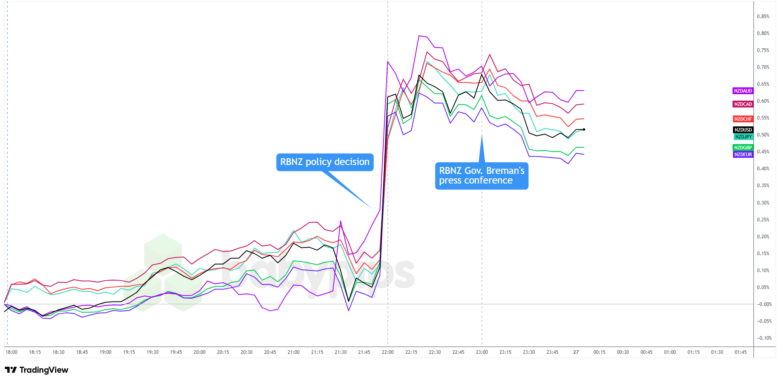
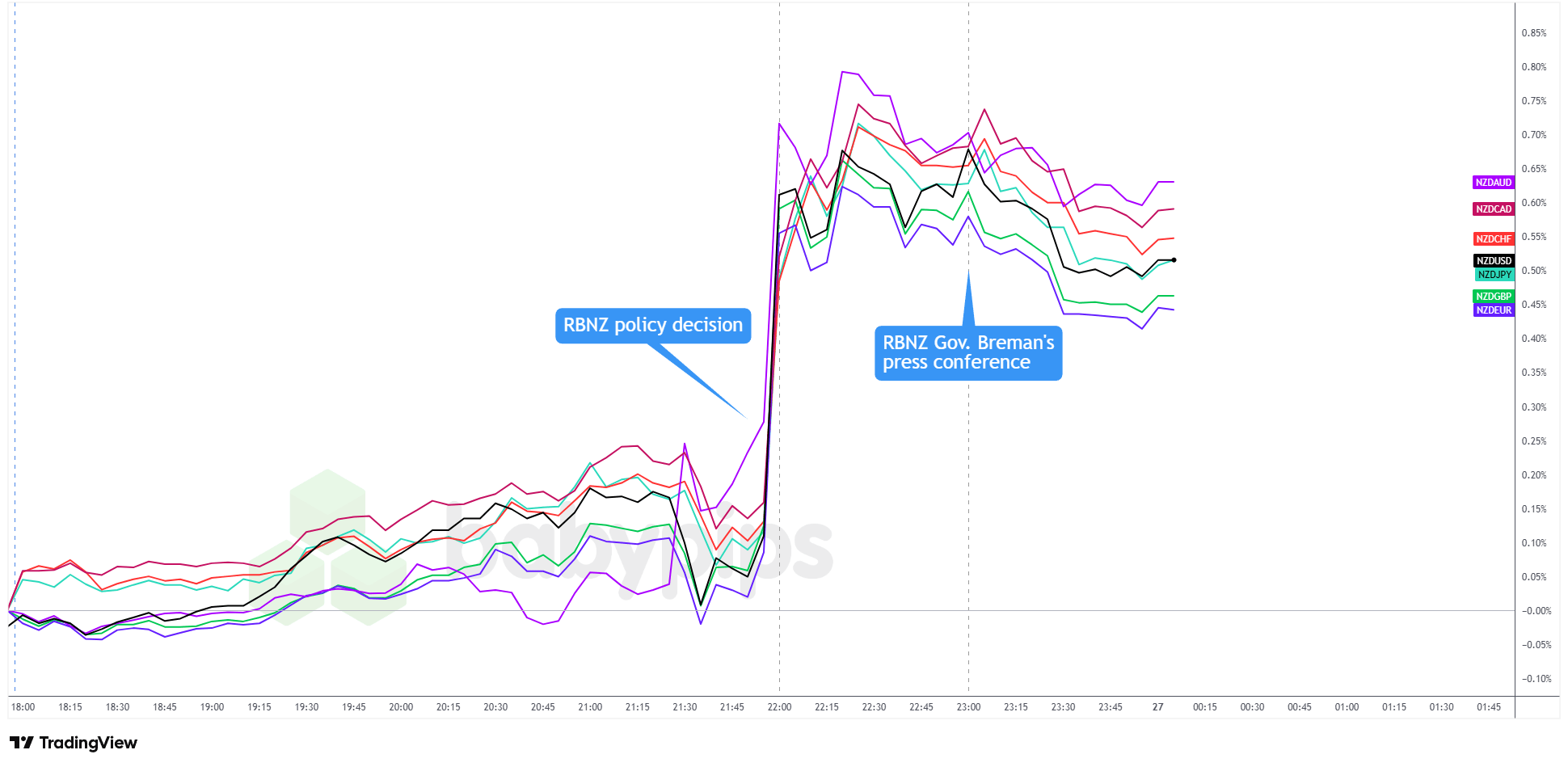
The New Zealand dollar shot up, and quickly. Just about every other Kiwi cross jumped 0.6% to 0.8% as soon as the decision hit!
So why the sharp move?
Because this was not really about what the RBNZ did, it was about what the RBNZ said, and how close policymakers came to doing something else entirely.
See, the Monetary Policy Committee (MPC) split 3-3 on whether to hold or hike, and Governor Anna Breman’s casting vote was the only thing that stood between today’s hold and New Zealand’s first rate increase in this new cycle.
A central bank that almost hiked is a very different beast from one that calmly and unanimously decided to sit on its hands.
What’s Behind the Hawkish Tone?
To understand why half the committee wanted to raise rates today, we need to look at what’s been happening with New Zealand’s inflation picture and the global headwinds making it worse.
New Zealand consumer prices rose 3.1% in the most recent quarter, pushing inflation above the top of the RBNZ’s 1% to 3% target band. That alone would be enough to have central bankers reaching for the antacids.
The bigger worry is what may come next: the RBNZ’s own forecasts now show inflation climbing to roughly 4.2% by the June quarter, driven largely by oil trading above $100 per barrel, thanks in large part to the ongoing conflict in the Middle East.
This is the stagflation trap central banks hate. The RBNZ also published updated forecasts showing 2026 GDP at roughly 1.8% to 2.0%, down from the 2.8% projection it made just three months ago. So the economy is slowing while prices are rising. Lovely combo… said absolutely no central banker ever.
Governor Breman also didn’t mince words at the post-decision press conference. She said the MPC had discussed the possibility of raising rates at both the April and May meetings, and made it clear that if inflation expectations begin to “de-anchor,” meaning if households and businesses stop believing inflation will come back down, the committee is ready to deliver “decisive and timely” increases.
She even said rate hikes could come “every meeting or every second meeting” if conditions call for it.
In central bank speak, that’s about as subtle as using a megaphone when hinting at future policy decisions.
Promoted: When the RBNZ holds rates but sounds one vote away from hiking, Kiwi traders need more than a quick read on the headline.
Maven Trading provides simulated funding challenges starting as low as $15, allowing you to trade major pairs with professional-sized capital. No time limits mean you can wait for cleaner setups around central bank tone, press conference clues, and NZD-driven moves without the pressure of a ticking clock.
Learn More About Maven Trading Today!
Disclosure: We may earn a commission from our partners if you sign up through our links, at no extra cost to you.
Why Did NZD Jump If Nothing Changed?
This is the key lesson, and it trips up a lot of newer traders: forex markets don’t just react to what a central bank does. They react to what traders think the central bank will do next.
Before today, markets were pricing in roughly a 51.5% chance of a 25 basis point hike at the RBNZ’s July 8 meeting.
After Breman’s press conference, that number likely moved higher, raising Kiwi’s appeal as traders priced in the chance of higher returns from New Zealand assets.
NZD 5-Minute Forex Chart Faster With TradingView
The New Zealand dollar, which had already been supported by optimism around U.S. Iran negotiations, pulled back before the RBNZ event but then shot sharply higher across the board after the central bank’s surprise 3-3 split.
Kiwi held most of its intraday gains into Gov. Breman’s hawkish presser, though confirmation of the RBNZ’s hawkish tone may have encouraged some profit-taking ahead of the London session open. Still, a governor basically signaling that the hiking cycle has already started in spirit, even if it hasn’t officially started on paper, helped limit NZD’s losses.
There’s also a second factor worth noting. Reports of progress in U.S.-Iran negotiations pushed oil prices lower, which also helped NZD in a roundabout way because cheaper oil eases one of the key inflation pressures threatening to force the RBNZ’s hand.
This is a good reminder that in forex, a single candle is rarely the result of a single cause.
Quick Takeaways
- The RBNZ held the OCR at 2.25% on May 27, 2026, as expected — but a 3-3 committee vote made it anything but routine.
- Governor Breman’s hawkish press conference, signaling potential rate hikes at upcoming meetings, likely contributed to NZD strengthening 0.6–0.8% across major pairs.
- “Hawkish hold” means rates didn’t move, but the language signals they probably will — and forex markets price that expectation immediately.
- Inflation above target (3.1% vs. the 1–3% band) and the RBNZ’s own forecast of 4.2% in Q2 are the core drivers of the hawkish pivot.
- When trading central bank events, tone and forward guidance often matter more than the rate decision headline.
What to Watch Next
July 8, 2026, RBNZ next OCR decision, Wellington, 2pm NZST / 02:00 GMT: With markets pricing in a coin flip chance of a hike, this is now a live meeting. Watch for any MPS commentary or speeches from RBNZ Governor Breman in the weeks ahead for clues on where the committee is leaning.
Also worth watching: New Zealand’s Q2 CPI release, due in late July, since it’ll be the key data point that either backs up or challenges the RBNZ’s 4.2% inflation forecast.
The RBNZ held rates today, but the New Zealand dollar surged anyway. If you’re not sure why a central bank’s tone and language can move a currency more than the actual rate decision, Premium members can read our lesson:
📖 Hawkish vs. Dovish: How to Read Central Bank Language
Reading this helps you understand what “hawkish hold” actually means, how to decode the language central banks use to signal future policy, and why forward guidance often moves currencies more than the rate change itself.
And if you’re not a Premium subscriber yet, now’s a good time to sign up.
With Babypips Premium, you get full access to School of Pipsology lessons that help you understand not just what a central bank decided, but what their words are signaling about where rates are headed next.
