


Many corporate leaders share an automatic reflex when performance dips. They assume a skills gap exists and immediately spend a massive portion of the budget on buying more training programs.
There’s a glaring disconnect in corporate learning. Most enterprises already provide AI training to their teams. Despite that heavy investment, almost half of those same companies still report an AI skills gap.
Clearly, spending the money is not the same as closing the skills gap. The real issue isn’t the amount of cash in your budget. The problem is that organizations are misdiagnosing what is actually wrong in the first place.
Why the default view of skills gap fails
When leadership notices a performance drop, they treat training as an immediate cure-all. But this assumes employees actually rely on formal corporate programs to improve.
In reality, a massive disconnect exists between how organizations deliver education and how professionals actually build competence on the job.
Several key factors explain why the traditional “more training” strategy misses the mark:
- Irrelevant content: Employees feel that the training provided doesn’t match their real, day-to-day job needs.
- Alternative learning habits: Most skill-building happens completely outside formal L&D platforms as employees learn by doing and directly from colleagues.
- Slow deployment: Employees feel that training programs take far too long to develop and roll out.
When these issues combine, you end up funding a traditional solution that your team is already actively routing around to get their work done.

The four skills gaps wearing one label
Labeling every operational challenge as a generic skills gap forces companies to treat different problems with the exact same remedy. In reality, training only addresses a single piece of the puzzle, while the remaining issues require different investments.
To stop wasting budget, organizations must separate this single label into four distinct skills development problems.
1. Skills visibility gap
Organizations frequently waste their L&D budgets building redundant training or recruiting externally for capabilities that already exist in-house. This mismatch happens because traditional tracking systems log rigid job titles and course completions rather than actual day-to-day talent.
As discussed in the Talent Talks podcast episode, L&D in 2026: Learning debt, AI, and transformation, managing by static spreadsheets leaves a massive amount of real-world capability completely invisible to leadership.
2. Skills prediction gap
Organizations struggle to forecast the capabilities they’ll actually need down the road. This forecasting blind spot is widespread, with 38% of managers completely unable to predict their operational needs over a 12-month period.
When a business can’t project its future needs, it defaults to a rigid, reactive corporate planning cycle. L&D teams spend months building out content based on a static snapshot of past needs. By the time that training is finally deployed, the market has moved, leaving teams to figure out new operational demands completely on the fly.
3. Skills practice gap
Even if you predict exactly what your team needs to know, handing them a stack of courses rarely solves the problem. Employees often absorb the information but freeze when it comes time to actually use it on the job. The missing link is application.
Twenty-four percent of workers have absolutely no safe environment to practice new techniques before testing them on live projects. Expecting someone to master a concept without hands-on trial and error sets them up for failure. You end up paying for training while your team remains too nervous to apply it in the real world.
4. Skills ownership gap
A lack of practical application naturally points to a larger structural issue about who is actually responsible for team development. You might assume management handles it, but 21% of professionals report that absolutely nobody owns the process of identifying these gaps in the first place.
When everyone assumes someone else is taking care of the problem, the system stalls entirely.
What happens when you treat the wrong skills gap
When you misdiagnose a performance drop, you trigger a compounding cycle of financial waste. You end up throwing more budget at a persistent problem because you’re treating a generic label instead of the real root cause.
Think about how these individual failures stack up to drain your resources. You have 38% of managers who can’t predict what skills they need colliding with 28% of employees who say their training completely misses their daily reality. You’re budgeting against a blind guess and then building content that still misses the mark.
Every time you force your team through that irrelevant material, you accumulate learning debt. Your employees waste hours watching videos or taking modules they’ll never actually use on the job. That lost time directly drains productivity and pulls focus away from actual revenue-generating tasks.
Eventually, the company pays for that wasted time twice through lower output and employee burnout.
The cycle simply repeats itself as your team ignores the irrelevant courses and performance stays flat. Leadership assumes they just need to buy even more training, but the real danger is the frustration building within a team that just wants the right tools to do their work.
Match the fix to the gap
To solve this problem, you have to stop defaulting to standard training and start matching the exact fix to the specific problem.
Breaking your strategy down into targeted actions stops the financial drain immediately:
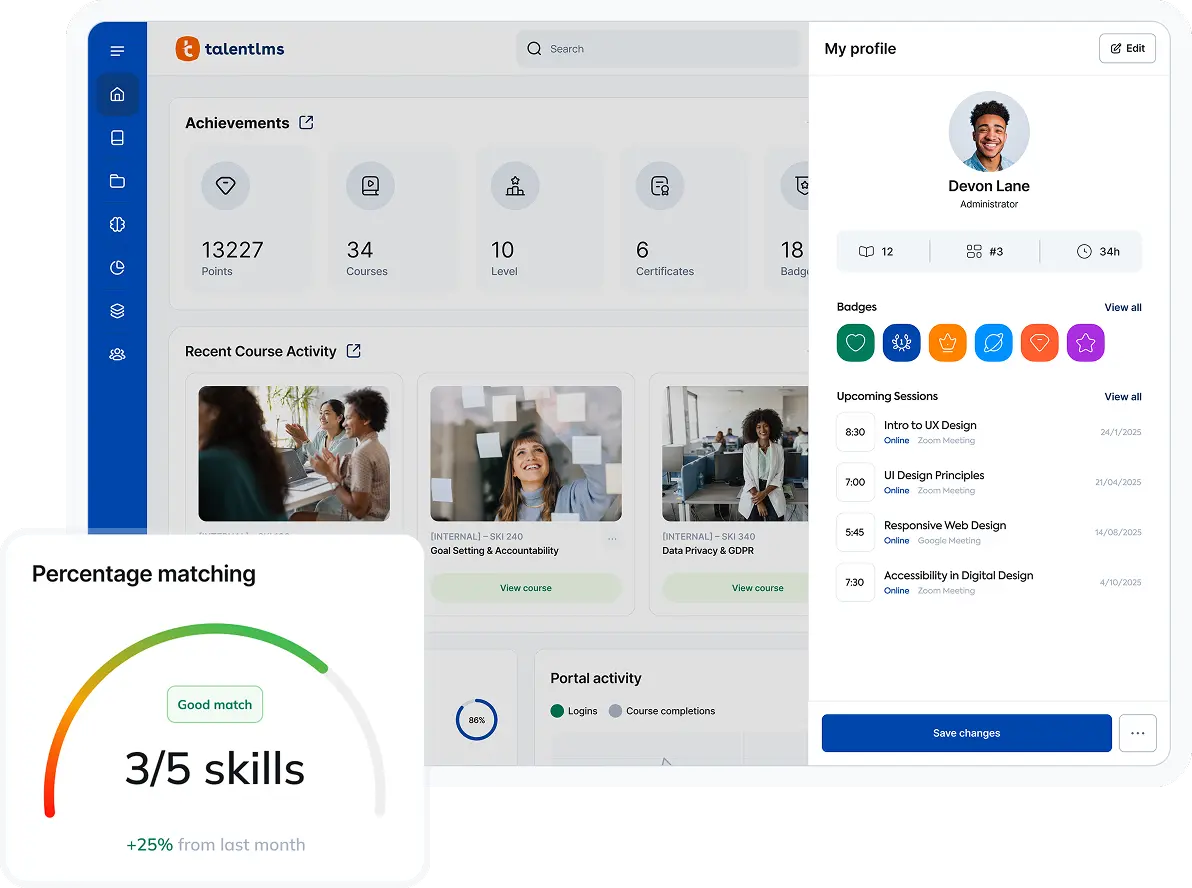
- Skills visibility: Use skills mapping and real-time tracking with TalentLMS Skills to uncover the talent already sitting inside your organization. When you can see what your teams already know, you stop paying to teach what they’ve already mastered.
- Skills prediction: Ditch the static annual planning sessions and build continuous feedback loops to catch emerging needs early.
- Skills practice: Provide safe environments like TalentLMS Learning Playground, simulations, and applied exercises so workers can fail safely before touching live projects.
- Skills ownership: Create crystal-clear roles where managers define the real needs and L&D provides the structural support.
Ownership changes how your team approaches development. While managers highlight what the business requires, your L&D department builds the training structure using customized Learning Paths. You then give your team access to a broad repository of ready-made content like TalentLibrary. Direct access hands them the power to pull the resources they need the moment they face a challenge.
Even with a great strategy, anticipating every future requirement perfectly is basically impossible. The real answer isn’t achieving a flawless diagnosis every single time. The solution is building faster, more adaptive systems that self-correct when your initial guess is inevitably wrong. Your business needs the agility to shift focus the moment a new gap appears.
Waiting months to develop new material leaves your team exposed and underprepared. When your system needs to adapt on the fly, using an AI course creator allows your L&D team to pivot instantly. You can spin up highly targeted training in minutes rather than waiting on a long, slow development cycle. Your budget finally goes toward rapid execution instead of slow guesses.
Stop funding blind guesses
Building an adaptive system brings us to a final reality check. The skills gap is a very real challenge. However, assuming it’s just one big gap and buying more training is never the right answer.
The companies wasting the least amount of money are the ones that stopped treating every performance drop as a single problem. Stop funding blind guesses. Start by running a skills gap analysis and template, and build systems that adapt instantly to give your team the exact support they need.
