

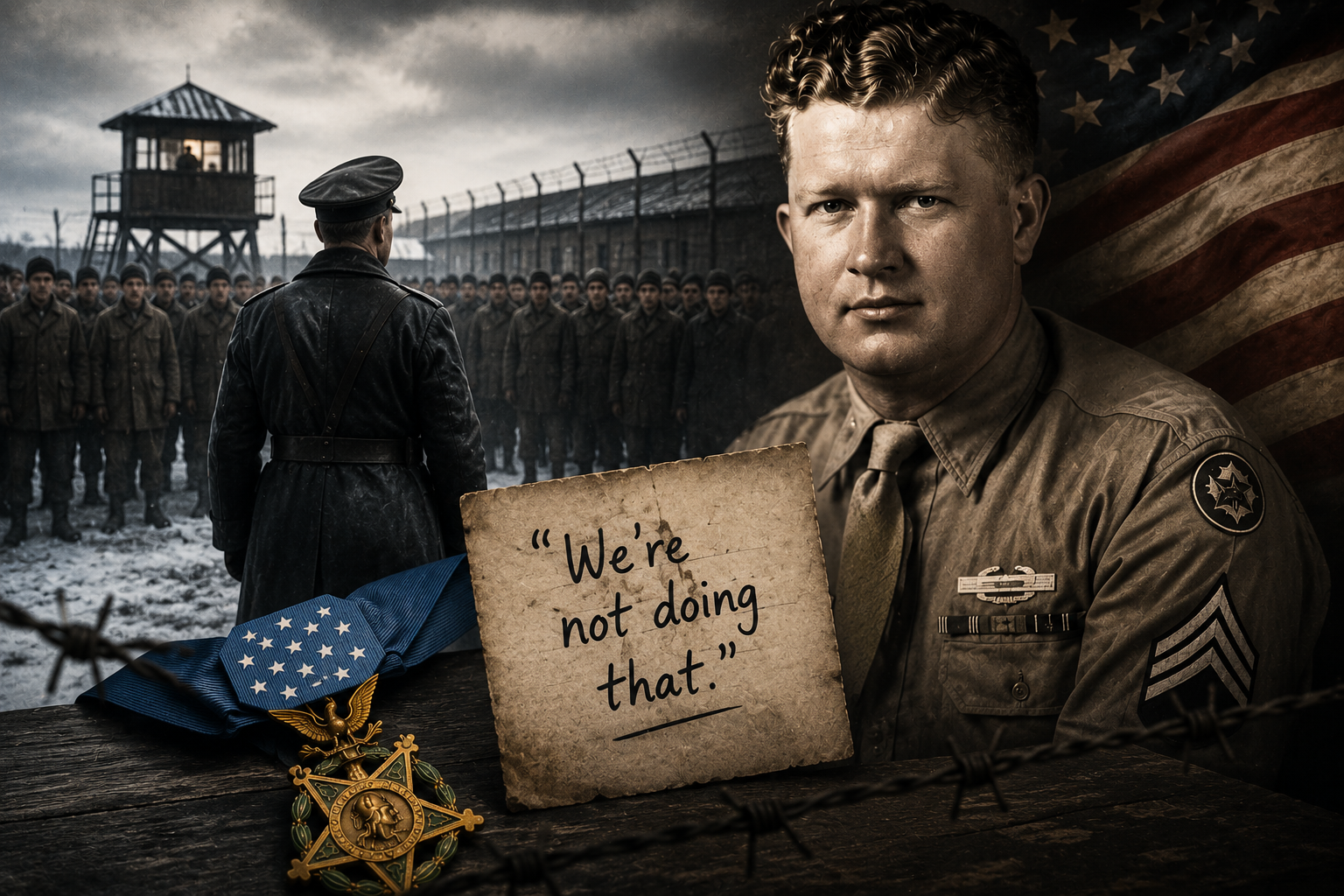
The newest Medal of Honor recipient, the late Master Sergeant Roddie Edmonds, was honored because he said no.
So much goodness in our lives, including the defense of liberty, begins with saying no.
It was January 1945. The war was months from ending, and Edmonds was the highest-ranking soldier among 1,292 American prisoners at a German stalag. The camp commandant ordered all Jewish soldiers — around 200 men — to fall out the next morning. Anyone who disobeyed would be shot.
Through a sleepless night, Edmonds instructed his men: “We’re not doing that.” Everyone would fall out — the sick, the infirm, all of them. They would tell the Germans they were all Jews. There would be no breaks in their ranks.
The next morning, the commandant was enraged when all 1,292 soldiers fell out. With a luger pressed to his head, Edmonds told the commandant, “We are all Jews here.” The commandant backed down. Two hundred lives were saved by a no.
In Edmonds’s case, his inspired courage was rooted in his deeply held Christian beliefs and commitment to the Golden Rule. The natural pull towards self-preservation gave way to a higher moral law.
Cicero instructed, “We are all servants of the laws, for the very purpose of being able to be freemen.”
In his classic book Flow, psychologist Mihaly Csikszentmihalyi drew on Cicero’s insight that “accepting limitations is liberating.” He used the example of monogamous marriage, arguing that commitment frees people from the exhausting task of constantly maximizing emotional returns.
The benefit of saying no to seemingly infinite possibilities, Csikszentmihalyi argued, is that “a great deal of energy gets freed up for living, instead of being spent on wondering about how to live.”
Edmonds did not have to wonder what the right thing to do was. His chosen constraints had already made the decision. His job was to show up and be the vehicle for a historic no.
Oliver Burkeman generalizes Csikszentmihalyi’s lesson in his book, Four Thousand Weeks. He urges readers to resist “the seductive temptation to ‘keep your options open’” in favor of “big, daunting, irreversible commitments.”
Doing so requires standing firm against FOMO — the fear of missing out — and recognizing that missing out on most things is inevitable. As Burkeman notes, “‘Missing out’ is what makes our choices meaningful in the first place.”
Understanding the necessity of constraints in our personal lives prepares us to defend liberty in public life. The person who never practices saying no to himself is poorly equipped to say no to those who would govern him.
A free society depends on our willingness to reject the claims of would-be masterminds who believe they can redesign complex social orders from above.
In his essay “Individualism: True and False,” Friedrich Hayek warned against the belief that society can be successfully directed by designing minds. True individualism, he argued, requires “an acute consciousness of the limitations of the individual mind.” False individualism, by contrast, rests on an “exaggerated belief in the powers of individual reason.”
True individualism fosters humility toward “the impersonal and anonymous social processes by which individuals help to create things greater than they know.” False individualism produces contempt for anything “which has not been consciously designed.”
In other words, false individualists are unwilling to restrain their own designs for society.
Hayek also rejected the myth of the good ruler. A free society, he argued, should not depend on finding wise or virtuous people to run it. Because individual knowledge is limited, any social order capable of sustaining broad human cooperation requires “strict limitation of all coercive or exclusive power.”
While free people say no to masterminds, they say yes to evolved rules, norms, and traditions — including the rule of law — that preserve liberty even when their origins and full effects cannot be fully understood. As Hayek observed, “Our submission to general principles is necessary because we cannot be guided in our practical action by full knowledge and evaluation of all the consequences.”
Hayek would also have us reject political expediency disguised as “the interests of society.” Why object to deciding every case on its merits? Because in practice, expediency untethers society from principle. The belief that wise leaders can improvise solutions case-by-case may be among the greatest threats to liberty.
Still, why do good-hearted people continue accepting these mistaken ideas? Economic and historical illiteracy explain part of it. But the Stoic philosophers asked a deeper question: Why do we say yes when we should say no?
The Stoics believed people surrender their inner freedom by accepting false impressions — mistaken judgments about reality. My manager criticized my work, so I’m going to be fired. That driver cut me off, so my anger is justified. The political version is the most dangerous of all: This emergency is different. This leader can be trusted. This time the designing mind will succeed.
Because people rarely practice withholding assent from their impressions, they accept them at face value. Epictetus urged his students: “Take up the practice right now of telling every disagreeable impression, ‘You’re an impression, and not at all what you appear to be.’” (Handbook, 1.5)
Unchecked habits weaken our ability to think clearly and act deliberately. As Epictetus warned, every angry reaction strengthens the habit of anger itself. (Discourses, 2.18) False impressions do not announce themselves as false. The discipline is learning to pause and ask: Is this really what it appears to be?
In Letter 95 of his Letters on Ethics, Seneca argued that principles are indispensable because judgments otherwise become captive to whatever emotion or circumstance is most vivid in the moment. “It is principles,” he wrote, “that can fortify us, maintain us in safety and tranquility.”
Because people often “don’t know what it is they want, except in the very moment when they want it,” as Seneca observed elsewhere, examining our impulses helps reveal the fears, desires, and false judgments that distort our thinking.
That wintry day in the stalag, Edmonds did not deliberate. His principles, not his impressions, had already made the decision. The only question was whether he would act on them.
That is the same question each of us faces — thankfully not in a German prison camp, but here and now. Will we stand firmly enough on principle to say no to the mistaken beliefs that threaten liberty?
