


Why Instructional Design Is Entering A New Era
Instructional Design trends are shaping a new era where Instructional Design is no longer viewed as simple content creation, but as a strategic business function that directly supports performance, skills development, and organizational growth. Today, L&D leaders and Instructional Designers are shifting from traditional eLearning to adaptive, data-driven learning systems that respond to how people learn, what the business needs, and real-time results.
Several big changes are driving this shift. Faster AI development is changing how we design, deliver, and improve learning content. At the same time, companies are focusing more on building skills instead of just offering courses. As digital learning grows quickly across industries, organizations need flexible and scalable learning solutions to stay competitive. Because of these changes, keeping up with Instructional Design trends is important for anyone in charge of learning strategy.
A key issue in this change is the balance between automation and human expertise. AI can make development faster and personalize learning for many people, but human Instructional Designers are still needed for their knowledge of learning science, context, and experience design. The future of Instructional Design will be about people and smart systems working together, not one replacing the other.
In this article, we will look at new trends in Instructional Design, the future of instructional technology, and changes in online learning and eLearning innovation. We will also discuss whether AI could replace Instructional Designers and what the job outlook is as the field moves toward learning experience engineering.
The State Of Instructional Design Today
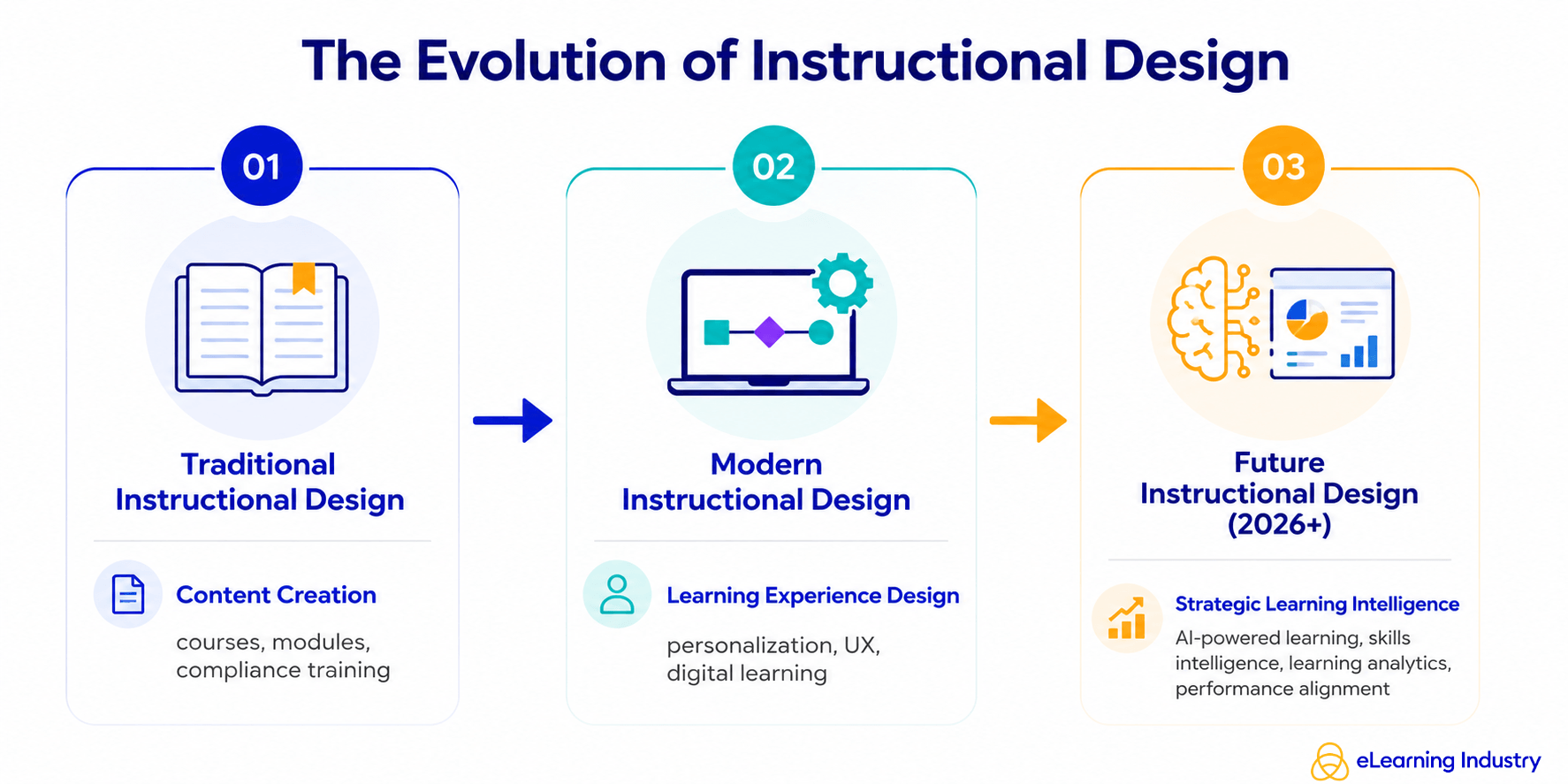
Instructional Design trends are currently being shaped by major shifts in technology, business expectations, and how organizations approach learning at scale. Instructional Design is no longer limited to building courses. Instead of just building courses, Instructional Designers now create complete learning experiences that help improve performance, productivity, and business results.
- In recent Instructional Design news, one of the biggest developments is the rapid adoption of AI tools by teams.
These tools help create content faster, summarize information, build assessments, and personalize learning paths. Because of this, Instructional Designers now spend more time reviewing and improving AI-generated content rather than creating everything from scratch. - Rapid content development platforms are also changing how teams create training.
With these tools, organizations can build training modules in just a few days instead of weeks, raising expectations for speed and flexibility. At the same time, Learning Experience Platforms (LXPs) are putting more focus on learner-driven discovery, letting employees find personalized content based on their roles, skills, and behaviors. - L&D leaders now expect more in three main areas.
First, delivering content quickly is a basic requirement. Second, it is important to measure learning impact by looking at performance data, not just completion rates. Third, large organizations now see personalized learning at scale as a standard need, not just a bonus. - These changes are also affecting the job outlook for Instructional Designers.
Instead of just building courses, they are now seen as learning strategists. Today’s Instructional Designers need to understand business goals, use data insights, and create learning systems that can adapt as workforce needs change. This shift shows where eLearning is headed and highlights why it is important to keep up with new trends in online learning across different industries.
Top Instructional Design Trends Shaping 2026
Instructional Design trends in 2026 show a big change in how organizations view learning. Instead of treating it as a separate task, learning is now seen as part of daily work, performance, and business goals. Instructional Designers are moving beyond building courses to creating systems that shape behavior, skills, and results across organizations. Five main trends are now guiding how learning is designed, delivered, and measured.
1. AI-Augmented Instructional Design
A common question in Instructional Design news is whether AI will replace Instructional Designers. The answer is no, but AI will change their roles in important ways. AI is now working alongside Instructional Designers. Rather than starting from scratch, designers use AI to help draft learning goals, outline courses, write quiz questions, and suggest teaching methods. This makes development faster and lets teams spend more time on quality and alignment.
AI tools also help with analysis and personalization. For example, it can review learner data to find knowledge gaps, suggest changes to content, or predict where learners might have trouble. This makes Instructional Design more proactive, moving beyond just reacting to problems.
But people are still essential. Instructional Designers are taking on more responsibility for strategy, teaching methods, and ethical choices. They make sure learning content is correct, inclusive, and matches business goals. While AI can create content, it cannot set meaningful learning goals or fully understand a company’s culture.
Because of these changes, new ways of working are appearing in Instructional Design. These include using AI to help with storyboarding, quickly updating content, and reviewing designs based on data. The future is not about AI replacing people, but about people and AI working closely together.
2. Skills-Based Learning
Another major shift in eLearning trends is the move away from course-centric design toward skills-based learning models. Instead of organizing learning around modules or lessons, organizations are aligning learning experiences to specific skills and competencies. This change is linked to business results. Leaders now ask, “Can employees show the skills they need to do better?” instead of just, “Did they finish the training?” This affects how Instructional Designers build and assess content.
Skills-based frameworks also change how learning is created and shared. Instructional Designers now work closely with HR, talent platforms, and performance tools to match learning with workforce needs. This is a key part of broader eLearning technology trends, where learning platforms are integrated with skills intelligence systems.
The result is a more flexible learning system. Content is always being updated as skill needs change. This makes Instructional Design more strategic and better connected to company planning than before.
3. Hyper-Personalized Learning Experiences
Personalization is becoming a defining feature of online learning trends. In 2026, learners expect content that fits their needs, experience, and job role. Hyper-personalized learning uses adaptive learning paths powered by data and AI. Instead of every learner following the same path, systems adjust content based on performance, behavior, and preferences. If a learner struggles with a concept, the system can automatically provide additional resources or alternative explanations.
Learner analytics is important here. Instructional Designers can now see what parts learners skip, where they pause, and what they review. This information helps improve course design and keep learners engaged. AI-powered recommendation tools also make learning more personal by suggesting courses, short lessons, or support materials that fit each learner. This matches the growing trend of making learning ongoing, relevant, and part of everyday work.
For Instructional Designers, this means creating not just content but also paths that guide how learners move through material based on real-time data.
4. Immersive And Experiential Learning Design
Immersive learning is now more practical and easier to use, thanks to new AR, VR, and simulation tools. These methods used to be experimental, but now they are common trends in eLearning for important training areas like leadership, compliance, healthcare, and technical skills.
Scenario-based learning is changing, too. Instead of just simple choices, organizations now create complex simulations that mirror real workplace problems. This lets learners practice making decisions in safe but realistic settings.
Gamification is also growing. It is not just about points and badges anymore. New methods focus on motivation, behavior, and emotional involvement. Engagement science is becoming more important in Instructional Design, helping us understand how attention, memory, and motivation affect learning.
This means learners are moving from simply watching content to actively participating in experiences similar to real job situations.
5. Learning In The Flow Of Work
One of the most practical eLearning technology trends is the rise of learning in the flow of work. Instead of pulling employees away from their tasks to complete long courses, learning is being embedded directly into the tools they already use. This includes short lessons sent via platforms such as Slack, CRM systems, or company dashboards. It also covers support tools that give employees help right when they need it.
This approach highlights the difference between performance support and traditional learning. Traditional courses aim to teach knowledge, while learning in the flow of work focuses on using skills right away. Instructional Design is now putting productivity first.
For organizations, this means learning is less about formal training and more about ongoing support built into daily work. It also shows that the future of Instructional Design is closely linked to job performance, not just teaching.
The Future Of Instructional Design And Technology
The future of Instructional Design and technology is shifting from building individual courses to designing connected, intelligent learning ecosystems. Instructional Design is not just about structured training modules anymore. It is becoming a strategic role that links data, technology, and how people learn to improve performance across organizations.
This change is driven by the coming together of AI systems, analytics platforms, Learning Experience Platforms (LXPs), and Learning Record Stores (LRSs).
- AI now helps create content, personalize learning, and guide learners as they go.
- Analytics platforms show L&D teams what works, what does not, and where skills are missing.
- LXPs offer a personalized, user-focused learning experience.
- LRSs collect detailed learning data from different systems.
This coming together of tools is changing how organizations approach design. Instructional Designers are shifting from just making courses to building learning ecosystems. Now, they design experiences that are ongoing, use data, and fit into daily work. This matches the bigger goals for eLearning, where learning should be flexible, easy to access, and connected to business results.
As these systems grow, Instructional Designers’ roles are changing, too. They now need to use data more, learn to work with AI tools, and design for different learning settings simultaneously. This leads to an important question: “What new skills will Instructional Designers need?”
The answer is a mix of skills. Instructional Designers will need to be better with data, understand AI, think in systems, and create personalized learning paths. Keeping up with online learning trends and new ideas in eLearning will also be important, as the field continues to change quickly.
Challenges And Issues In Instructional Design Today
Even as Instructional Design trends continue to evolve, the field is facing challenges that affect how organizations create and deliver learning. These issues are linked to bigger trends in Instructional Design and technology, especially as AI, digital platforms, and content ecosystems grow faster than most teams can keep up with.
Bias In AI Content
A common concern is the quality and bias of AI-generated learning content. AI tools help speed up content creation and make it more personal, but they also bring risks. The results can be uneven, lack teaching depth, or show bias. Because of this, human review is key to keeping learning materials high-quality and aligned with goals.
Content Overload
Organizations are making more learning materials than ever, but learners often have trouble finding what matters to them. This can cause confusion, lower engagement, and scattered learning experiences. Often, the real issue is not too little content, but not enough curation and structure.
Lack Of Consistency In Measuring Learning
Even though eLearning now focuses on analytics and data, many organizations still use old metrics like course completion rates. This makes it hard to see the real effect on performance, skill growth, or business results.
Skills Gaps In L&D
L&D teams are also facing broader skill gaps, especially in areas such as AI, learning analytics, and modern experience design. Instructional Designers are now expected to act as strategists, technologists, and data-driven designers, often without formal training in these skills.
Conclusion
Instructional Design has moved beyond simply creating courses. It now plays a key role in how organizations adapt and grow. The latest trends show that changes in Instructional Design reflect bigger shifts happening across organizations, not just updates to learning materials. The main takeaway is clear: organizations that update their learning strategies now will be better prepared and more flexible than those that don’t.
Instructional Design is no longer defined by content creation alone. It is becoming the intelligence layer of organizational learning, where AI, skills data, and learning analytics come together to shape how businesses build capability at scale.
-Christopher Pappas, CEO of eLearning Industry
