

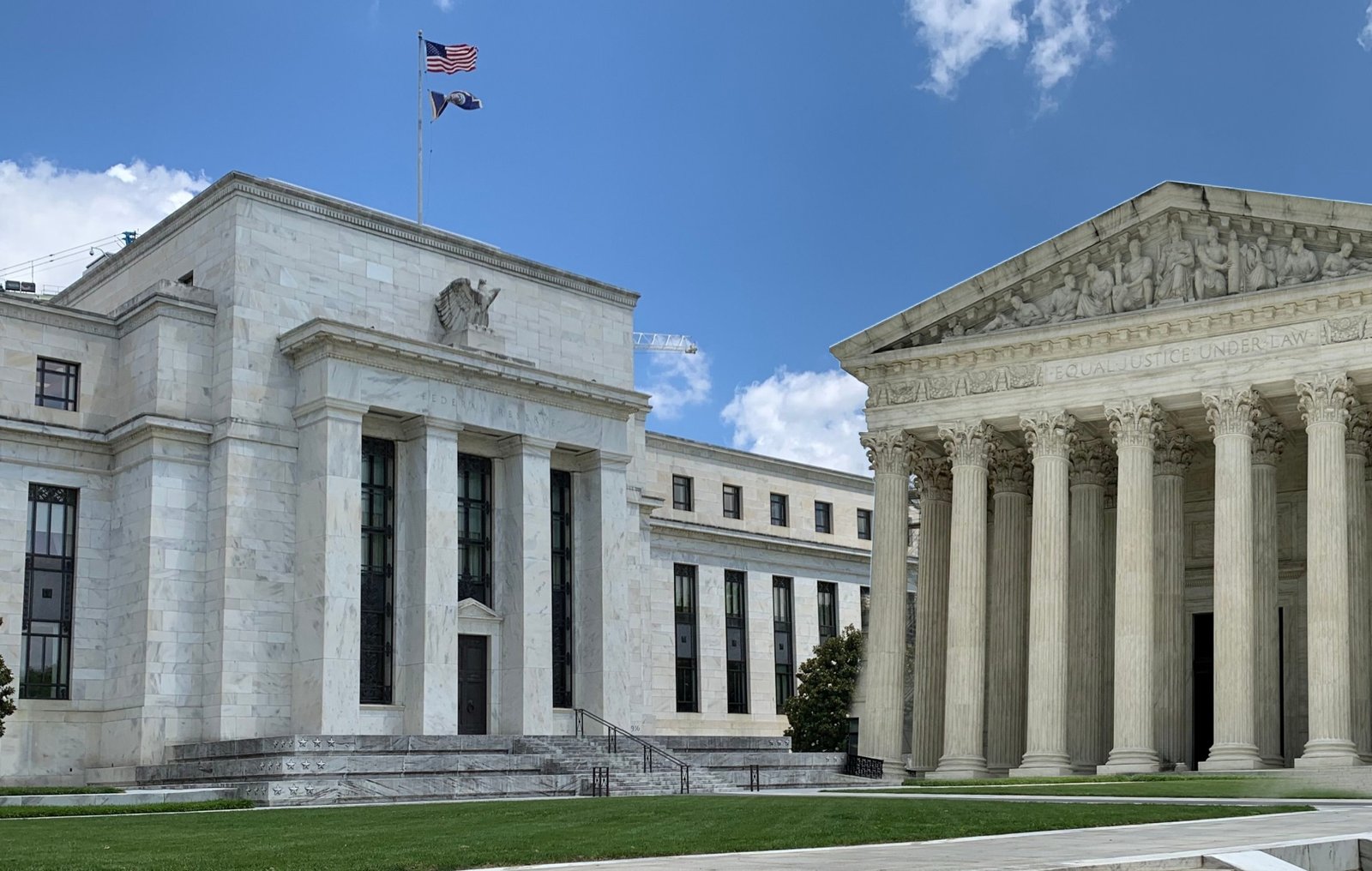
The Supreme Court denied the President’s stay application in Trump v. Cook on June 29, allowing Governor Lisa Cook to keep her seat. This was a 5–4 decision on an emergency-docket stay, not a final ruling on the merits, and it resolved far less than the headlines suggest.
What The Ruling Settled, and What It Did Not
The Court held that the President’s removal of Cook failed on narrow procedural grounds. He gave her no notice and no chance to respond before firing her. Nothing stops him from trying again. If he does, the underlying question of whether alleged pre-office mortgage fraud constitutes “cause” to remove a sitting Fed governor remains completely open, because the Court declined to spell out precisely what “cause” requires, leaving that question to be litigated the next time a president wants a governor gone.
The coalition that produced even this narrow holding is also not built to last. Chief Justice Roberts and Justice Kavanaugh joined the three liberal justices to form the majority.
The three dissents don’t agree with each other any more than they agree with the majority: Justice Thomas would eliminate for-cause protection for the Fed as unconstitutional; Justice Barrett objected mainly to the Court reaching a constitutional question the government never raised; Justice Alito (joined by Gorsuch) objected to deciding this much on an emergency-docket record the lower courts barely developed.
A 5–4 majority that fragile, on a question this narrow, is not the kind of precedent that survives a change in the Court’s composition unscathed.
Independent of What, Exactly?
The majority’s defense of Fed independence leans on the Fed being “a uniquely structured, quasi-private entity” with a “distinct historical tradition,” language that treats independence as a kind of institutional mystique. Justice Thomas takes the opposite extreme view: the Fed wields executive power, so it should answer to the President like any other agency.
Yet the Federal Reserve was never independent of the government in any general sense. Congress created the Board; Congress alone can rewrite the statute that defines its powers. And the Fed chair testifies to Congress, not to the President, as a matter of statutory design. The President’s role was always a narrow one: nominate governors and remove them only for cause. In other words, execute Congress’s will. “For cause” protection is intended to insulate monetary policy decisions from a specific pressure: the incentive an elected official has to lean on monetary policy for short-term gain ahead of an election. That is a narrower and more defensible claim than either “the Fed is special” or “no agency should ever be insulated from anything.”
The Case for Insulating That One Thing
The dilemma is structural, not personal. You can have a skilled central banker serving under a president inclined to misuse monetary policy, or a poor central banker serving under a president who would never try to misuse it. The Constitution vests executive power in one person, by design, a single point of accountability, but also a single point of failure.
Monetary policy, by contrast, is set by a committee whose members, in theory, have smaller, less coordinated, and mutually offsetting incentives to politicize decisions than a single elected official seeking reelection. Insulating that committee’s decisions from removal-by-displeasure doesn’t guarantee good policy. But it bounds how much damage one bad political actor can do to it. That is a more modest claim than the one usually made for central bank independence.
This ideal deserves a real-world caveat. A committee that votes together as often as the FOMC does is not perfectly diversified against shared error. The near-unanimous “transitory inflation” call of 2021–22 is a reminder that groupthink can exist in a body such as the FOMC as well. Insulation reduces correlated political risk. It does not eliminate correlated forecasting risk.
What Does This Mean for Monetary Policy?
The ambiguity Trump v. Cook leaves unresolved exacts a direct cost on the very thing insulation was built to protect: the credibility of monetary policy itself.
Modern central banking depends heavily on expectations (through forward guidance or otherwise): the Fed signals its future policy intentions to shape market expectations today. That only works if markets trust that the Fed’s signals reflect economic analysis rather than political accommodation. A Fed whose governors know they can be removed under a standard no court has defined, for reasons no statute limits, is a Fed whose forward guidance is conditional to presidential approval. The interest-rate path the Fed projects carries weight only if markets believe the governors on the Fed Board who help set it won’t be replaced the moment that path displeases the White House. Trump v. Cook does nothing to remove that asterisk. And the split vote is not very reassuring.
The Underlying Problem
Why did a case about an old mortgage application make its way to the Supreme Court?
The Federal Reserve Board, which Congress insulated in 1913, set short-term interest rates, supervised member banks, and designed and executed monetary policy. That’s it. The Board that Cook serves on does much more.
The Dodd-Frank Act, passed in 2010, gave the Fed consolidated supervisory authority over nonbank financial firms designated “systemically important” by the Financial Stability Oversight Council, and imposed enhanced prudential standards on every bank holding company above a statutory asset threshold. The same Board sets emergency lending policy under Section 13(3) of the Federal Reserve Act — an authority that let the Fed extend credit peaking at $710 billion in 2008 to keep firms like AIG and Bear Stearns from collapsing, and that backed a 2020 lending capacity exceeding $2.6 trillion during the pandemic, with Congress appropriating $454 billion to backstop it. In 2023, under its general safety-and-soundness authority rather than any specific congressional mandate, the Board ran a pilot climate scenario analysis (CSA) with six of the country’s largest banks; an example of how far that authority can stretch.
None of this is illegitimate; Congress authorized nearly all of it by statute. But Congress added each grant of power without revisiting whether the original case for insulating monetary policy has anything to do with insulating bank examinations, emergency lending, or systemic-risk designations, let alone climate change policies.
The Court’s own discomfort with this gap is already on the page.
A footnote in the majority opinion declines to bless Fed powers “attenuated from monetary policy.” As Alexander Salter has observed elsewhere in this publication, that footnote reads as a quiet acknowledgment that the Fed’s broader supervisory and enforcement machinery doesn’t sit easily with the Court’s own reasoning. Justice Barrett presses the same concern in dissent, asking whether all of the Fed’s current powers actually relate to monetary policy, and whether those that don’t are simply grandfathered in. Even within the majority, the tension surfaces: Justice Kavanaugh argued the Court had to settle the Fed’s categorical status immediately because leaving it open after Trump v. Slaughter would itself be too costly, and yet the same opinion left the definition of cause, the question every future removal fight will turn on, to be resolved case by case, indefinitely.
Cook’s case was never just about whether one governor said something untrue on a mortgage application. It was about who controls a Board that can move trillions of dollars and rewrite supervisory standards for the banking system, a far larger prize than the one the original insulation was built to protect, sitting behind the same undefined “for cause” standard.
A governor’s protection from removal cannot apply to some of her votes and not others. There is an uncomfortable trade-off: either every part of the modern Board stays insulated together, and an unelected body runs a large slice of executive power outside the executive branch, or insulation comes off entirely and governors who need their monetary policy decisions to be independent from electoral pressure become removable at presidential pleasure. That choice only looks forced because it treats the Board’s expanded mandate as one indivisible office. It isn’t.
Only Congress Can Close Both Gaps
Justice Kavanaugh’s concurrence ends with the right answer to half the problem: any further change to Fed independence “must occur through the legislative process.” He’s right that courts can’t durably settle whether the Fed gets to be independent.
The dilemma dissolves once you stop treating the Board as a single office. Keep “for cause” protection exactly where the original rationale justifies it: the governors who vote on interest rates and the money supply. Move everything else — bank supervision, systemic-risk designation, emergency lending — to a separate body whose officers answer to the President under the standard Slaughter, decided the same day, already set for ordinary executive functions (for better or worse).
The Fed’s removal fight is still contested only because it does both kinds of work under a single, undefined standard. Separating them ends that.
Congress should therefore do two things. First, define “for cause” by statute for the seat that remains insulated, with notice and a hearing required before removal. Second, move the Fed’s non-monetary powers to a body that operates under the standard Slaughter already established, rather than letting the Fed borrow protection it was never designed to need. Protect the part of the job insulation was built for. Stop pretending the rest of the job needs the same shield.
