


Why LMS Selection Criteria Are Changing In 2026
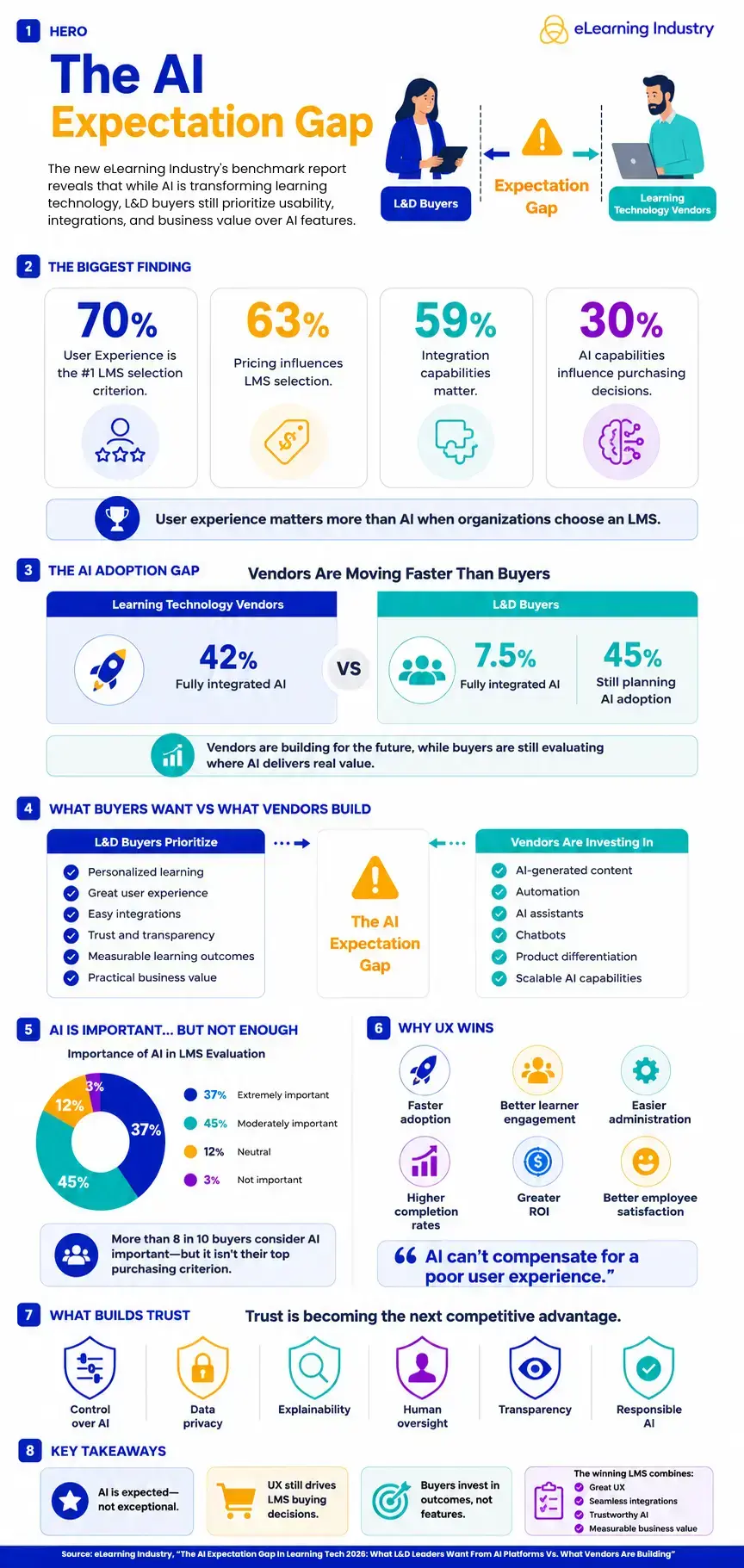
LMS selection criteria have changed a lot as Artificial Intelligence (AI) becomes more common in learning technology. Even though AI features are often highlighted in product launches and marketing, they are not the main reason people buy these systems. eLearning Industry’s 2026 benchmark report shows that User Experience (70%) is still the top priority for L&D buyers, with pricing (63%) and integration with current systems (59%) close behind. In contrast, AI capabilities are much less important at 30%, showing that organizations care more about usability and how well the system fits their needs than just having the latest technology.
This difference is what the report calls the AI Expectation Gap. Vendors are quickly adding more AI features to their platforms, but buyers are being more careful. They are looking for solutions that improve learning results, add business value, and fit smoothly into their current workflows. Instead of just asking which platform has the most AI features, decision-makers want to know if those features actually make the learning experience better.
As the LMS market matures, LMS evaluation criteria are getting more advanced. AI is now seen as a standard feature, not something special. When choosing an LMS today, buyers look beyond just comparing features. They focus on User Experience, clear ROI, and long-term value. Knowing what matters most now can help organizations choose better learning platforms and find the AI features that really help learners succeed.
Ebook
The AI Expectation Gap In Learning Tech 2026: What L&D Leaders Want From AI Platforms Vs. What Vendors Are Building
Unlock exclusive findings, industry benchmarks, and insights from L&D buyers, learning technology vendors, and your competitors in eLearning Industry’s new report.
The Top LMS Selection Criteria According To L&D Buyers
LMS selection criteria have changed a lot. Instead of just checking off features, they now focus on long-term business value. eLearning Industry’s 2026 benchmark report shows that L&D buyers want platforms that offer a smooth learning experience, work well with their current technology, and help them track results. Even though AI is a hot topic in learning technology, the data shows that buyers care more about how easy a platform is to use and how well it works when making their decisions.
1. User Experience (70%)
User Experience tops the list of LMS evaluation criteria, with 70% of people saying it matters most. A simple, easy-to-use interface helps learners find courses, finish training, and stay interested. It also makes things easier for administrators by saving time on managing content, enrollments, and reports. When a platform is user-friendly, more employees are likely to use it rather than avoid it out of frustration. In the end, a well-designed LMS leads to better participation and learning results, which flashy AI features alone cannot promise.
2. Pricing (63%)
Pricing is the second most important factor, mentioned by 63% of L&D buyers. This is because organizations need to make the most of their training budgets, so they look at the total cost over time rather than just the initial price. Buyers want proof that an LMS will bring real value by improving productivity, learning results, and efficiency. They prefer a smart, lasting investment over paying extra for features they might not use.
3. Integration With Existing Systems (59%)
Almost 60% of respondents say integration is a top priority. An LMS that works well with HRIS, CRM, ERP systems, collaboration tools, and reporting platforms makes things easier for both learners and administrators. On the other hand, poorly connected systems can lead to duplicate data, increased manual work, and fewer people using the platform, which reduces the value of the investment.
4. Analytics And Reporting (46%)
Today, organizations want to see clear business results from their learning programs. This is why 46% of buyers see analytics and reporting as essential. Strong reporting tools help L&D teams track learner progress, identify skill gaps, boost performance, and provide leaders with data that connects training to company goals.
5. Content Variety (31%)
Content is also a key factor when choosing an LMS. Buyers want platforms that offer a wide range of learning materials, support blended learning, and allow both in-house and external content. Having many content options helps organizations meet diverse learning needs without relying on a single source.
6. AI Capabilities (30%)
One of the most surprising findings is the ranking of AI-powered LMS features. Even though AI is seen as important for the future of learning, only 30% of respondents picked AI as a top factor, while 70% chose User Experience. This does not mean AI is not valuable. It just shows that buyers see AI as one part of the bigger picture, not the main reason to choose a platform. For most organizations, ease of use, value, and smooth operations matter more than the latest technology when picking a new learning platform.
What The Findings Tell Us About LMS Selection Criteria
Even as AI-powered LMS features gain attention, eLearning Industry’s latest report shows that User Experience (70%) remains the top factor in platform selection. Specifically, only 30% of L&D buyers mentioned AI capabilities as a priority. Pricing (63%) and integration with current systems (59%) are also more important than AI, indicating that organizations still want solutions that are easy to use, affordable, and compatible with their existing technology.
This finding highlights a key point for anyone making an LMS buying guide or evaluating LMS selection criteria: even the most advanced AI features can’t make up for a poor User Experience. If learners have trouble using the platform, finding content, or finishing training, fewer people will use it. Similarly, if administrators spend too much time managing courses, creating reports, or fixing problems, they lose productivity that AI can’t restore.
A good LMS User Experience directly affects learning results. Easy navigation, clear interfaces, and simple workflows help learners use the content more often and finish courses. HR and L&D teams also benefit from easier administration, quicker setup, and fewer support requests, which leads to happier employees and better Return On Investment.
The report sums up this idea well, saying “L&D buyers continue to evaluate learning technology through the lens of usability, value, and operational fit.” In short, when choosing a learning platform, organizations are not just looking for AI by itself. They want AI that makes a great platform even better.
The AI Expectation Gap Between Buyers And Vendors
LMS selection criteria are changing as AI advances, but learning technology vendors and L&D buyers are not moving at the same pace. eLearning Industry benchmark report shows a growing gap in AI expectations between these groups.
While 42% of vendors say they have fully integrated AI into their platforms, only 7.5% of L&D buyers report full AI integration in their learning environments. At the same time, 45% of buyers are still planning to adopt AI, which shows that many organizations are still evaluating rather than fully implementing these technologies.
This gap explains why LMS evaluation still focuses more on practical needs than on advanced AI features. Vendors are investing heavily in AI to stay ahead, but buyers must weigh new technology against real-world challenges. Budget limits, complex implementation, governance rules, and data privacy issues often slow down adoption. Change management within organizations can also make it hard to launch even the best AI-powered LMS.
When choosing an LMS, organizations should see AI as one part of the overall selection process, not the main factor. The report recommends that vendors help close the gap by offering practical examples, implementation support, and education that demonstrates clear business value. As AI develops, successful adoption will rely on technology, trust, readiness, and the ability to integrate AI into current learning strategies.
AI Is Important—Just Not Enough To Win Buyers
AI by itself does not drive LMS purchasing decisions. Even though L&D professionals are paying attention to AI in learning platforms, recent research shows that buyers look at a wider range of factors when choosing solutions. The report found that 82% of respondents see AI as important when choosing a platform, with 37% calling it extremely important and 45% moderately important. Only 3% think AI is not important at all, indicating how quickly it has become a standard feature rather than a specialty.
For organizations wondering how to choose an LMS, this finding is important. Buyers want AI-powered LMS solutions that help personalize learning, automate routine tasks, and improve results. However, they only value these features if the platform is easy to use, works well with their current technology, is cost-effective, and feels trustworthy. AI may get noticed, but buyers choose platforms that offer a complete and reliable experience.
Beyond AI: The Features That Actually Drive LMS Success
When evaluating LMS selection criteria, it’s easy to assume that AI capabilities top every buyer’s wish list. However, our report tells a different story. While AI is undeniably shaping the future of learning technology, L&D professionals are increasingly focusing on features that enhance the learning experience, build trust, and deliver real business value. In short, organizations want more than just an AI-powered LMS. They are looking for a platform that helps employees learn better and supports long-term business goals.
Personalization Makes Learning More Relevant
Of all AI features, personalized learning is the most popular. The report shows that 65% of L&D buyers prioritize personalization, making it the top AI capability in today’s learning platforms.
This preference is not just about having AI. Personalization makes learning more relevant to each employee by suggesting content, adjusting learning paths, and offering training that aligns with their roles, skills, and goals. This helps organizations boost engagement, improve knowledge retention, and get better learning results. More buyers now see that AI is valuable only when it makes learning easier and more effective, not more complicated.
Trust Is Now A Key Advantage
Trust is now a major factor when picking a learning platform. As AI tools become more advanced, buyers want to know how these systems work. They look for clear details on AI recommendations, strong system controls, reliable data privacy, and simple algorithms that support sound decision-making.
The report finds that trust is becoming the next arena in which companies compete. As AI becomes common in the market, vendors will stand out by using AI responsibly, being accountable, and giving users more control, not just by adding more AI features.
Business Outcomes Matter More Than Features
In the end, choosing an LMS comes down to one question: Does it deliver better results? Buyers look for proof that a platform improves learning, helps employees perform better, and creates real business value. The report shows that L&D leaders focus on usability, fit, and outcomes, not just new features.
This change highlights a key trend in learning technology. AI alone is no longer enough to stand out. The best platforms now offer a great User Experience, personalization, trustworthy AI, and useful analytics to help organizations reach their goals. This balanced approach should guide every LMS buying decision.
How To Choose An LMS In 2026: A Practical Evaluation Framework
Choosing an LMS is no longer just about comparing features. It’s now more important to look at how a platform will support your business over time, not just whether it has the latest technology. Even though AI is becoming a standard feature, our report shows that L&D buyers consider AI capabilities last. This shows why it’s important to use a clear checklist when evaluating LMS options.
User Experience
Begin by looking at User Experience, since it affects how engaged learners are and how productive administrators can be. Consider questions like: Is the interface easy to use for both learners and managers? Can people complete tasks without a lot of training? Does the platform work well on mobile devices and support accessibility? A good LMS makes it easier for people to use, while a bad experience can make even the best AI features less useful.
Integrations
Next, think about integrations, which are also a top priority for buyers. A good LMS should connect easily with your HR systems, collaboration tools, content libraries, and reporting platforms. Ask yourself: Will this LMS work with our current technology? How much customization will we need? Can data move automatically between systems? Good integrations save time and help create a smoother learning experience.
Analytics
Analytics are just as important. Learning leaders need data to show the impact of their programs. Ask: Can the platform track learner progress, completion rates, skill development, and ROI? Are the dashboards easy to customize and understand? Good reporting helps you make better decisions and keep improving.
Scalability
When you look at scalability, consider what your organization might need in the future. Ask if the LMS can handle growth, support global teams, offer content in multiple languages, and adapt to new learning strategies without losing performance.
AI Features
When it comes to AI features, focus on how they solve real learning problems, not just how many there are. Ask questions like: Does AI personalize learning paths? Does it improve content recommendations or automate repetitive tasks? These questions matter more than just asking if the platform has AI. The report also shows that buyers care more about personalization than AI itself.
Trust
Governance and trust are also important. As more organizations use AI, they are paying more attention to data privacy, transparency, clear explanations, and responsible AI use. Ask vendors how they keep learner data safe, reduce bias, and oversee AI-generated content.
Pricing
Finally, look at pricing with a long-term view. Instead of just picking the cheapest option, see if the LMS offers real value through ease of use, good integrations, strong analytics, and reliable support. Using this LMS buying guide can help you choose a platform that works for you now and can adapt to future learning needs.
Conclusion
When choosing an LMS in 2026, the goal is not to pick the platform with the most AI features. Instead, focus on finding one that helps your organization achieve better learning outcomes. The best vendors are not always the ones with the most advanced AI. They are the ones that offer easy-to-use design, reliable AI, strong integrations, and a learner-first experience that brings real results for both employees and the business.
