

I have left the mountainous confines of Telluride and am currently winding down mountainous roads to Grand Junction. But I am also unspooling much of what I saw at a festival that included far more laughs than I anticipated. Some of those zingers are in two of these films, though one is decidedly not (you’ll know when you get there).
Verdant brushland, inviting ponds, and rolling fields of horses color my view, populating a road away from the one fest where, before every screening, the ringmaster warns attendees to be careful of roaming bears. I’d like to think this dispatch carries the same caveat of splendor and worry, though with less actual doom.
It’ll come as a shock to no one that David and Nathan Zellner’s raucous, medieval, sci-fi biker lark, “Alpha Gang,” isn’t exactly subtle. A group of aliens posing as humans, dressed in 1950s black leather studded jackets, arrives at a castle in a war-torn, vaguely European country to conquer humanity with shiny silver machine guns.
Léa Seydoux, Dave Bautista, Kelvin Harrison Jr., Lily-Rose Depp, Doona Bae, and Riley Keough make up the gang whose codenames are numerical versions of Alpha (e.g., Alpha 1, 2, etc.). They spend their days listening to music by The Crystals, Ricky Nelson, and more on their jukebox, and hiding their emotions (the latter they consider a contagious disease) from one another. They’re curious about ants, plants, and hard candy, and possess chrome armor and eat orange grull.
The Zellners don’t do conventional world-building here. We never quite discover what country the film is set in (the inhabitants range from rural to fascist to sometimes Soviet) or what planet the Alpha Gang hails from. We don’t even know their species. So when they unleash bloody violence on humanity, we only know that they’re out to kill those they consider to be evolutionarily lesser. Instability is added to their broad mission when a stoic Chris Pine, whose dress recalls Elvis from “Jailhouse Rock,” arrives, alerting them to a rival Beta Gang led by Cate Blanchett sporting a studded eye patch and a slurred Cockney accent.
In a sense, “Alpha Gang” is a trippy, hyperviolent explosion of cool style and cooky jokes. It’s also a reminder that Bautista is one of our great deadpan comedians and Harrison Jr. can do just about anything, even seemingly falling in love with a hawk named Periwinkle as he does here. But most of all, this potpourri of aesthetic and influence, similar to “Sasquatch Sunset,” uses absurdity to critique the ways humans other, destroy, and shut down empathy. And while you’ll probably find that you have to wade through the wackiness to get to those grander themes, they’re hidden grace notes worth finding in a film that’s incredibly funny.
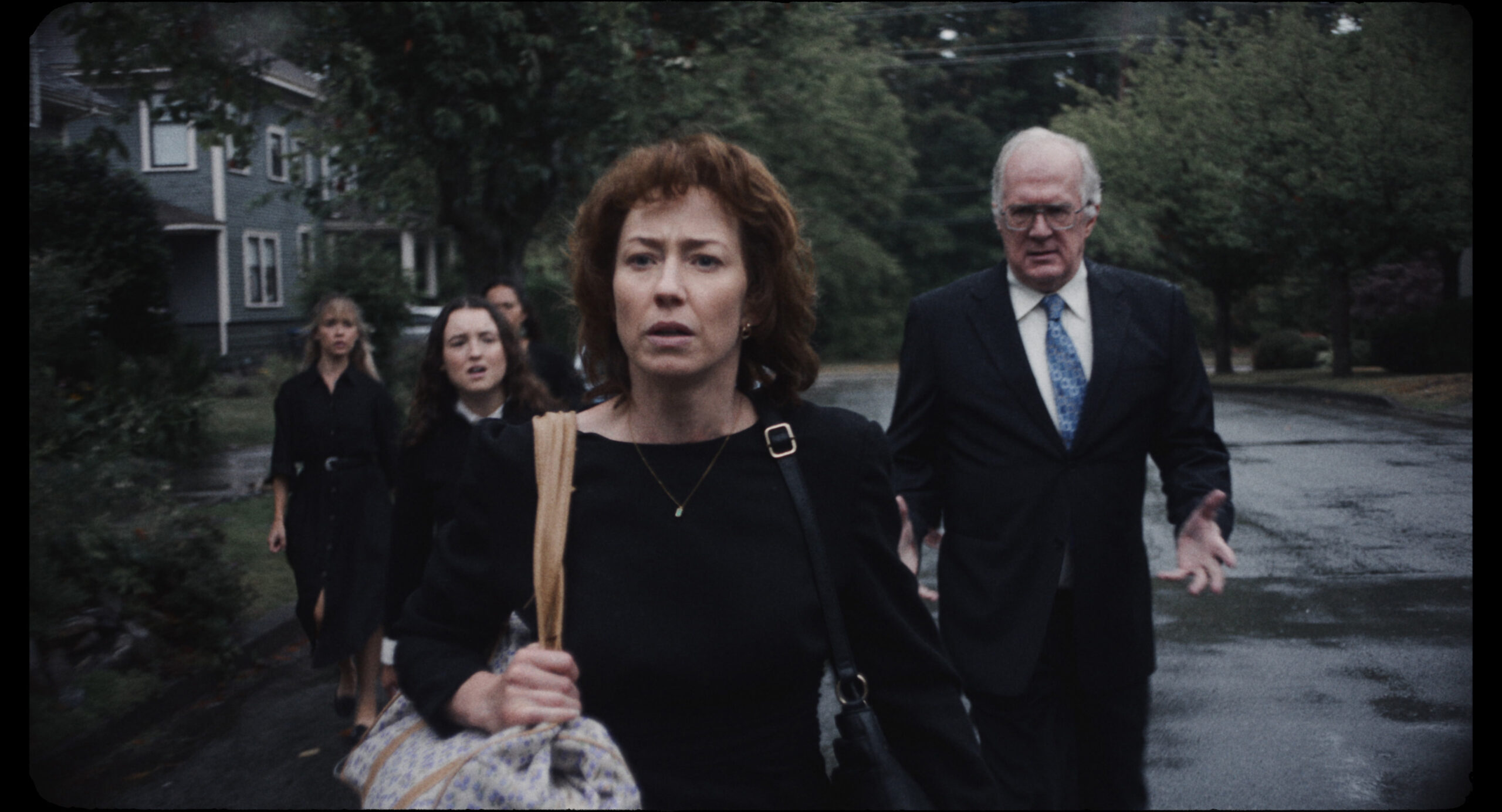
Guy Nattiv’s “The Liberation” is a slow-simmer mystery looking for a center. That search isn’t totally shocking. Its frail protagonist Rita Cooper (Carrie Coon), similarly scans the horizon of her milquetoast life—which involves being an assistant bank manager, raising her two daughters Ella (Bella Ramsey) and Jo (Odessa Young), and being a devoted wife to her husband Reuben (Tracy Letts) and caretaker to her father—for a kind of fulfillment and healing she can’t quite locate in her suburban New Jersey community. Her unconscious quest ends when the persuasive self-help feminist guru Ricki (Lily James) walks into her bank to deposit a huge chunk of change. Rita doesn’t stop to ask where that money came from or what it’s for. She’s already invested in a woman she believes sees her for who she is.
Maybe it’s because “The Liberation” is partly based on Nattiv’s grandmother’s involvement in a cult; the film at least understands that a cult can be interesting not because of its charismatic leader but because of the psychology of its followers. Why would someone join an organization that’s so obviously controlling and manipulative?
Nattiv, a deeply Jewish filmmaker whose past works include the Oscar-winning short “Skin,” partly places the reason for his protagonist’s actions in her status as a Holocaust survivor. And for a while, one wonders if he’ll connect how the loss of family and one’s country could lead someone to buy into the cult of contemporary Zionism (to be clear, he never gestures close enough to the subject for one to wholly make that leap).
The overlong film is also somewhat betrayed by its ping-pong structure. It switches between showing how Rita became twisted in Ricki’s sticky web in 1982 and her daughters visiting Ricki’s secluded woodland compound in 1984 to find their mother. The latter has an undercover element that pays homage to contemporary true-crime stories but never commits enough to the intrigue to fully sustain the genre’s tension and ambiguity. The structure also undermines Coon’s unquestionably captivating performance, making it far more melodramatic than Coon probably intended.
The narrative’s ping-pong movement could spring from several wells: It might be mirroring Rita’s spiritual split or psychological destabilization via Ricki, who demands that Rita stop using her psychiatric drugs, and it could arise from Nattiv physically trying to piece together his grandmother’s perspective. While at Telluride, Nattiv alluded to his mother and aunt also being associated with the cult, even bringing him to meetings when he was younger, which all sounds like an equally fascinating story the director could’ve told about himself. Instead, he’s wading through memories that aren’t necessarily his, causing the film to feel as though we’re looking at Rita through a mirror of a mirror.
That doesn’t mean there aren’t commendable components to “The Liberation.” Nattiv smartly portrays every level of Ricki’s grooming with straightforwardness (the scenes with the cult are always brightly lit, while those with Rita’s family look grim). His lens also trusts Coon’s physical countenance, charting the character’s spiral by showing her stilted exterior melt into powerful frivolity before reverting back into painful frigidity. But “The Liberation” is too caught within the fog to maximize what is working. Instead, it feels trapped in its fractured telling of a personal history that never quite feels personal.

Some movies just never come together despite the talent attached and the genius of the premise. Małgorzata Szumowska and Michał Englert’s absurdist biopic “The Idiot(s)” is such a case. It’s based on Andrew D. Kaufman’s The Gambler Wife: A True Story of Love, Risk and the Woman Who Saved Dostoyevsky, and it concerns Fyodor (Johnny Flynn) and Anna Dostoyevsky (Aimee Lou Wood), who have just arrived in Baden from Russia in debt and in search of inspiration. Their story is told with a kind of flippancy, blending the comedic sensibilities of “Amadeus” and Lina Wertmüller to dismantle the great-man mythology surrounding the author and elevate his far more responsible wife.
Fyodor, as Flynn plays him, is a man of many vices. Though he loves his wife, particularly being flogged by her during sex, he possesses an unfocused eye. Upon arriving in Braden, he first pursues the mysterious Natasha F (Vicky Krieps), a reference to the heroine of The Idiot, Nastasya Filippovna, who almost never speaks but whose enchanting gaze spellbinds the author nonetheless. When those efforts threaten to crack open his marriage, he turns to gambling away the pittance of money he and Anna have.
Worse yet, the only prospect of him being paid is if Fyodor sends pages of the novel he’s attempting to write, The Idiot, to his editor. That wouldn’t normally be a problem, except writer’s block has hit him, leaving Anna to make a deal with his rival, the Russian expat Ivan Turgenev (Christian Friedel), to pawn off their possessions and even write some pages by hand under his name.
While all of this sounds pretty bleak, Szumowska and Englert are knowingly crass in their approach—in one scene Fyodor defecates in front of his landlady’s door—and abrasive in their resolve. They push the boundaries of the period costumes, make jokes about Fyodor’s seizures, and do anachronistic covers of a-ha’s “Take On Me.”
Flynn and Wood are equally committed to this extreme rendering, earnestly espousing desperation, love, jealousy, regret, and humiliation with an openness that, for a time, papers over the picture’s repetitiveness. Unfortunately, even they can’t forestall the inevitable. “The Idiot(s)” runs out of steam quickly once it repeats the same punchline a dozen times.
The film wears you down rather than excites you, partly because Anna is never quite as strong of a character as a modern viewer would hope. While it’s true in real life that Anna separated Fyodor’s vices from the actual man she loved, the “stand by your man” theme running underneath their relationship feels less like love and more like a personal torture—causing anyone who decides to stick around to finish the film to also feel as though they’ve been hollowed out as well. Which may be the point, even if it’s inarticulately told.
