

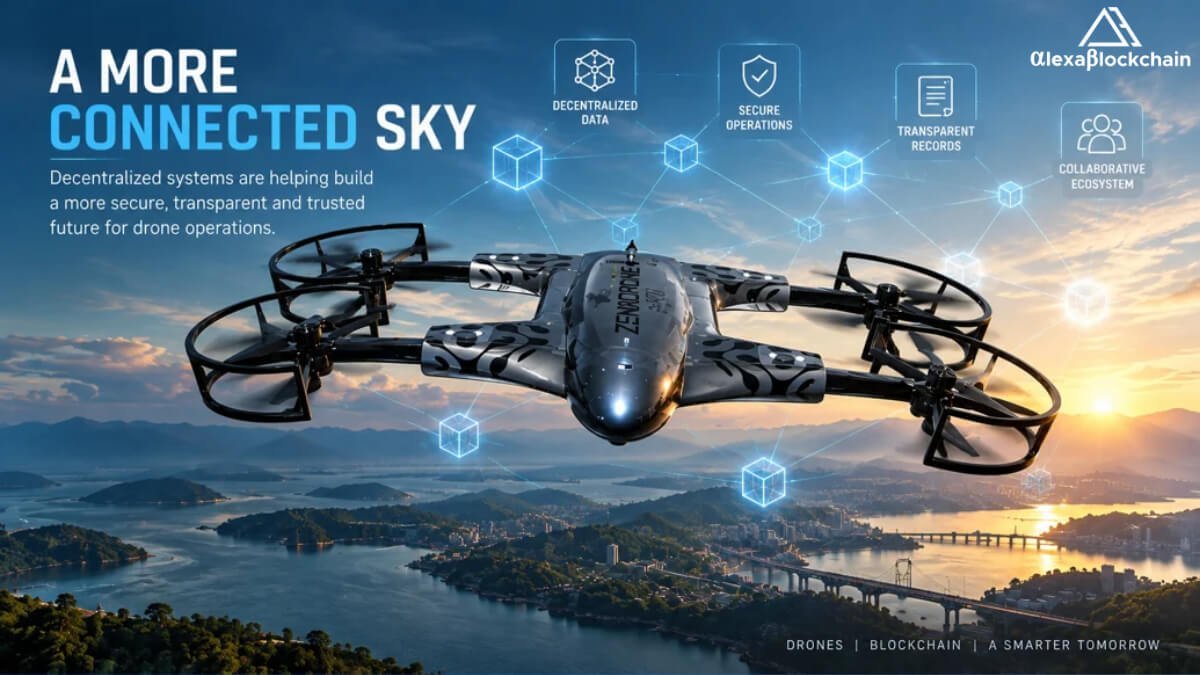
Drones are becoming increasingly autonomous, connected, and data-intensive. What began largely as remotely controlled aerial imaging has expanded into a much broader technology ecosystem involving automated inspections, mapping, infrastructure monitoring, agriculture, security, logistics, and environmental observation.
This evolution creates a new challenge. The more drones operate as connected machines rather than standalone aircraft, the more organizations need reliable ways to manage identity, data, permissions, and interactions between multiple systems.
Most drone platforms today still rely heavily on centralized infrastructure. Flight records, sensor data, user permissions, maintenance information, and mission outputs may ultimately pass through systems controlled by individual organizations or service providers. That model can work well, but as drone ecosystems become larger and involve more stakeholders, decentralized technologies are becoming worth examining.
Blockchain and other distributed systems will not replace conventional drone infrastructure. Instead, their more practical role may be providing additional layers of verification, coordination, and trust around selected parts of drone operations.
The Growing Data Challenge Behind Drone Operations
Modern commercial drones can generate substantial amounts of operational information. Depending on their sensors and mission, this can include high-resolution imagery, video, thermal readings, multispectral data, location information, timestamps, inspection results, telemetry, and flight logs.
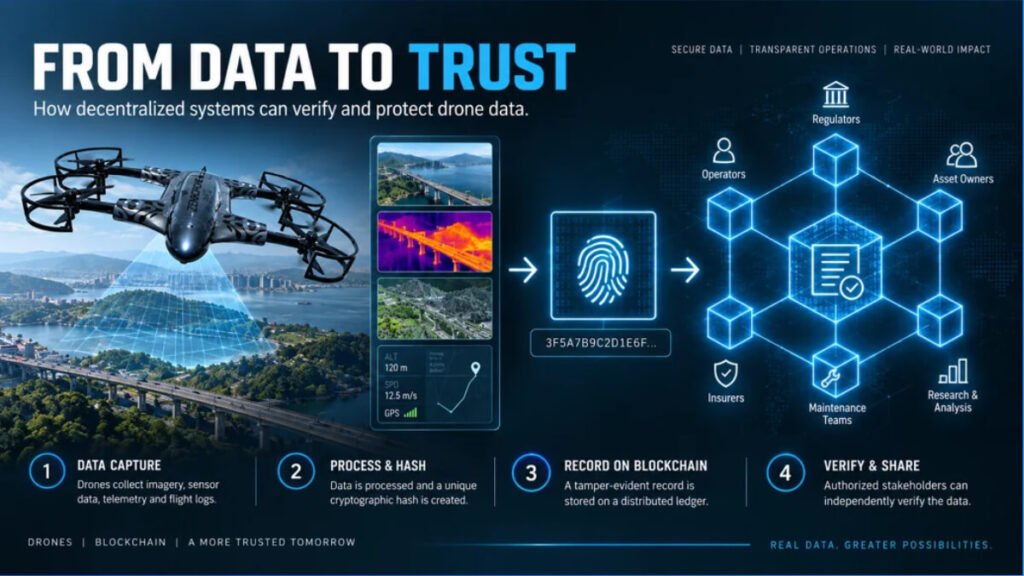
The value of this information often extends beyond the organization operating the aircraft. Consider an infrastructure inspection. A drone may inspect a bridge, power line, construction project, solar installation, or pipeline. The resulting information could potentially be reviewed by operators, engineers, contractors, asset owners, insurers, regulators, or maintenance teams.
This creates an important question: how can different parties establish confidence that a particular record came from an authorized source and has not been improperly modified?
Traditional databases address much of this problem through access controls and organizational governance. Distributed ledgers introduce another option: creating tamper-evident records that can be independently verified without requiring every participant to rely on one organization’s database. That distinction becomes increasingly relevant as machines participate more directly in digital workflows.
Creating Verifiable Records of Drone Data
One of the strongest potential intersections between blockchain and drones is data verification. Storing complete drone videos, photographs, or sensor datasets directly on a blockchain would usually be impractical. These files can be large, while distributed ledgers are generally not designed to function as high-volume media storage systems.
A more realistic architecture is to store the actual drone data off-chain while recording a cryptographic fingerprint, or hash, of the information on a distributed ledger. If the underlying file is later altered, its cryptographic fingerprint changes. Organizations can therefore compare a file against its previously recorded hash to determine whether it is identical to the original version.
For industries that depend on inspection records or historical evidence, that capability can be valuable.
Infrastructure inspections provide a useful example. Organizations increasingly use drone data collection for aerial inspection, mapping, monitoring, and data collection across construction, energy, agriculture, security, and other industrial environments. A verification layer could allow selected inspection records to be timestamped and independently checked later. The objective is not to put every piece of drone data on a blockchain. It is to establish provenance for information where proving origin and integrity matters.
Drone Identity Could Become More Important
Data integrity is only one side of the problem. Device identity is another. As autonomous systems become more common, digital networks need reliable ways of determining which machine is requesting access, producing information, or initiating an action.
A drone could potentially be assigned a cryptographically verifiable identity containing references to relevant credentials. Depending on the implementation, that identity might help systems confirm whether an aircraft is authorized to participate in a particular workflow.
This concept is closely related to developments already occurring across connected-device ecosystems. Machine identity and authentication are becoming increasingly important as IoT devices begin interacting more autonomously. For drone networks, verifiable identity could eventually support interactions between aircraft, charging infrastructure, fleet-management systems, data platforms, and other connected equipment.
However, decentralized identity does not mean that operational or personally identifiable information needs to become publicly visible. Privacy-preserving architectures can separate verification from disclosure, allowing a system to prove that a credential or authorization exists without exposing every underlying record.
Building Better Audit Trails
Autonomous operations introduce an accountability problem. When a human manually performs every action, organizations can often trace responsibility through conventional logs and procedures. When software makes more operational decisions, maintaining trustworthy records of what happened becomes increasingly important.
Distributed systems can provide an additional audit layer. A drone ecosystem could, for example, create verifiable records showing when a mission was initiated, which authorized system issued an instruction, when certain data was captured, and when records were subsequently accessed or transferred.
For drone operations, this principle could become increasingly relevant as autonomy grows: important machine activity may need records that can be verified independently rather than relying solely on the infrastructure that executed the workload.
Smart Contracts and Automated Workflows
Another potential application involves smart contracts. Smart contracts are programs deployed on blockchain networks that execute predefined actions when specified conditions are satisfied. In a drone ecosystem, they could potentially automate administrative processes surrounding a mission.
Imagine an infrastructure inspection performed by a drone service provider. The drone completes a predefined inspection route. Mission completion is verified by the relevant system. Required data is uploaded to approved storage. A digital record confirms completion. A smart contract could then trigger the next authorized step in the workflow. That action might involve notifying another participant, updating an asset record, granting controlled access to inspection data, or initiating a payment process. The important distinction is that blockchain would not be flying the drone. Flight control and safety-critical functions should remain within systems designed for real-time aviation operations. The distributed layer would instead coordinate certain digital processes around the mission.
Multi-Organization Drone Networks
Decentralized systems become particularly interesting when several independent organizations need to interact. A drone operation may eventually involve aircraft manufacturers, operators, infrastructure owners, maintenance companies, software providers, regulators, insurers, and data-analysis services.
A purely centralized model requires participants to agree on who operates the authoritative database. Distributed architecture offers another model in which authorized participants can share selected records while retaining their own systems.
This does not necessarily require a public, permissionless blockchain. Enterprise drone applications may be better suited to permissioned or hybrid networks where participation and data visibility can be controlled. The broader goal is interoperability: allowing organizations to verify shared information without surrendering control of all their internal data to a single intermediary.
Decentralized Infrastructure and Machine-to-Machine Interaction
The longer-term implications become more interesting when drones are considered alongside IoT, edge computing, artificial intelligence, and machine-to-machine communication. Connected devices are gradually gaining the ability to authenticate, exchange information, request services, and perform automated transactions.
A future autonomous drone might interact with digital infrastructure throughout a mission. It could authenticate itself to a service, submit verified sensor information, receive permission to access a resource, or coordinate with another machine. Distributed infrastructure could provide a common trust layer for some of these interactions.
Drones are particularly relevant to this trend because they combine physical mobility with sensors, connectivity, AI, and increasingly autonomous decision-making.
Decentralization Does Not Solve Every Problem
Despite the potential applications, blockchain should not be treated as a universal solution for drone technology. Distributed networks introduce their own trade-offs.
Scalability is one. Drone fleets can generate far more information than most blockchain networks should reasonably process directly. Latency is another. Aviation systems frequently require immediate responses, while blockchain confirmation times can vary.
Privacy also requires careful architecture. Drone imagery and operational data can contain commercially sensitive, security-related, or personally identifiable information. Making such information permanently visible on a public ledger could create serious problems.
Cybersecurity remains important as well. Blockchain can help demonstrate whether a recorded piece of information has changed, but it cannot guarantee that a sensor captured accurate information in the first place. Secure hardware, communications, access controls, software development, and operational procedures remain essential. Finally, drone operators must work within aviation, privacy, cybersecurity, and data-governance requirements that vary by jurisdiction. For these reasons, practical implementations are more likely to be hybrid systems rather than fully decentralized drone platforms.
The Most Realistic Path Is Hybrid
The future of decentralized drone infrastructure will probably not involve replacing cloud platforms, conventional databases, or existing fleet-management software. Instead, different technologies can perform the functions they handle best.
Drones and edge devices can manage real-time sensing and operational decisions. Cloud infrastructure can process and store large datasets. AI systems can analyze imagery and sensor information. Traditional databases can support high-speed application requirements.
A distributed ledger can then provide verification, shared auditability, digital identity, or automated coordination where those capabilities provide a genuine advantage. This architecture avoids using blockchain simply because it is available.
The relevant question is not whether drone operations should become decentralized. It is which parts of a multi-party drone ecosystem benefit from decentralized verification and which parts should remain conventional.
A New Trust Layer for Autonomous Systems
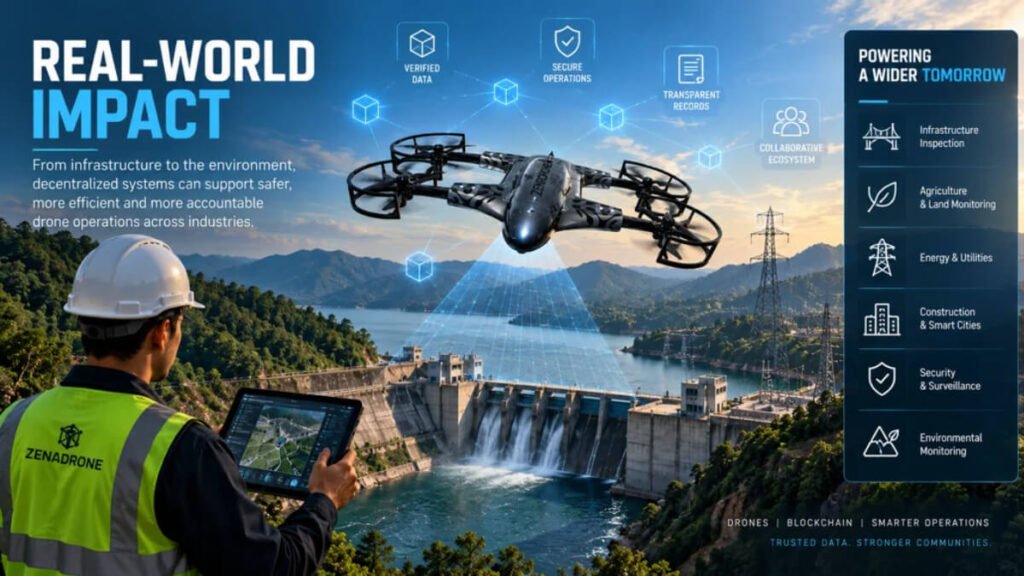
Drones are becoming part of a much larger network of intelligent machines. As that transition continues, the technical challenge will extend beyond making aircraft fly farther or collect better imagery. Organizations will also need mechanisms for establishing trust between machines, data platforms, service providers, and institutions.
Decentralized systems offer one possible layer for creating that trust. Cryptographic data verification could strengthen the provenance of important drone records. Digital identities could help authenticate machines. Distributed audit trails could make autonomous activity easier to verify. Smart contracts could automate selected multi-party workflows.
None of these applications requires putting an entire drone operation on a blockchain. The more practical future is likely to involve selective decentralization: using distributed infrastructure where independent verification, shared trust, and automated coordination provide measurable value while leaving safety-critical flight operations and large-scale data processing to technologies designed specifically for those tasks.
As autonomous drones, AI, IoT, and Web3 infrastructure continue to develop, their intersection may ultimately be less about cryptocurrency and more about something fundamental to autonomous systems: establishing who or what can be trusted when machines increasingly communicate and act on their own.
Read Also: This is the First U.S.-Chartered Depository Bank to Offer Stablecoin Invoicing
Disclaimer: The information provided on AlexaBlockchain is for informational purposes only and does not constitute financial advice. Read complete disclaimer here.
