

As some of you may recall, since the summer of 2023, I have had the privilege of directing a university-wide effort – the Harvard Initiative on Reducing on Global Methane Emissions – with support from the Salata Institute for Climate and Sustainability. Next week, at COP31 in Antalya, Türkiye, I will be making two presentations with my Harvard colleague, Professor Daniel Jacob, in regard to about two of the twenty-six individual research and outreach projects that are part of the Harvard methane initiative.
One is the main focus of today’s essay, because it is very much at the heart of the UNFCCC process, including the Paris Agreement, and COP31 – using satellite-based estimates of national methane emissions to facilitate the process. The other, which I will describe in a blog post subsequent to COP31, is work with my Harvard Kennedy School colleague, Joe Aldy, Harvard Business School Professor Forest Reinhardt, and Tracy Zhang, Harvard Public Policy PhD student, focused on estimating the marginal abatement costs of reducing methane emissions in the oil & gas (O&G) sector.
Before I turn to my major topic today, here is some information about the COP31 event focused on the second project above: “Reducing Methane Emissions: Abatement Costs in the Oil and Gas Sector,” Wednesday, November 18, 1:00 – 2:30 PM TRT, Pavilion of the International Emissions Trading Association (IETA), Blue Zone, COP-31. Panelists will include Daniel Jacob, myself, and others to be announced. For background on this session, see this linked paper, released earlier in the abatement-cost project.
Now I will turn to my major focus today.
Advancing Reporting of Satellite-Based Methane Emissions Estimates to Support International Climate Policy Processes
In brief, the goal of this project with Daniel Jacob, Willow Fortunoff, and a host of talented pre-docs and post-docs from Daniel’s team, is to produce consistent national methane emissions estimates using a common methodology worldwide – the Integrated Methane Inversion (IMI) tool developed by Daniel’s team – as technical input to the Second Global Stocktake (GST2), and to encourage countries to use the IMI to strengthen their methane inventories and climate reporting under the Paris Agreement, including the Biennial Transparency Reports (BTRs) due December 2026.
If you want to learn more about the IMI tool and our outreach strategy, here’s video of a press conference we held earlier this week, and a good article about the underlying research is here. If either of those are more than you want to watch or read, here’s a very brief description of the IMI tool, followed by an overview of our outreach strategy.
The IMI Tool
The Integrated Methane Inversion (IMI) is a free, open-source software tool that uses satellite observations to estimate how much methane a country emits at national, subnational, and sectoral levels. It helps countries check and improve the emissions figures they report to the United Nations.
Here’s how it works. The IMI starts with a country’s own national methane inventory, that is, its estimates to the UNfrom sources such as oil and gas operations, agriculture, and waste. It then combines that starting estimate with daily, global observations of atmospheric methane from the TROPOMI satellite instrument (operating since 2018), plus data from other satellites that detect individual sources. Weather data help the tool account for how winds carry methane from its source to the places where satellites observe it. Using this evidence, the IMI adjusts the country’s initial estimate. The results show estimated emissions across the country in areas roughly 12-25 kilometers across, along with a range that expresses the uncertainty in each estimate. The IMI also shows national totals for emissions from human activity and estimates by sector.
What makes the IMI estimates different from other estimates? Other satellite tools measure releases from individual sites, such as a leaking oil or gas facility. Those measurements help identify large emitters, but they do not provide a country’s total annual emissions. And, importantly, the IMI uses a common methodology for every country, allowing users to compare the results.
And here is what makes these estimates particularly reliable. The IMI uses established scientific methods described in over 50 peer-reviewed publications. Its code is publicly available, its methods are documented, and it is designed for non-expert use. A 2025 study by James East (formerly a postdoc with Daniel Jacob and now a faculty member at MIT) and colleagues reports its estimates of methane emissions from human activity worldwide, country by country. Users can explore the results through an interactive web interface.
Using These National Estimates in Support of UNFCCC Processes
The Harvard team is helping governments, NGOs, and international institutions interpret and use the IMI national methane emission results. Here is a brief overview of our communications and engagement strategy.
Let’s start with the Paris Climate Agreement, under which countries submit Nationally Determined Contributions (NDCs) every 5 years, and countries submit Biennial Transparency Reports (BTRs) every 2 years under the Enhanced Transparency Framework (ETF) of Article 13. Whereas the NDCs are forward-looking, the BTRs are backward-looking, with the BTRs providing descriptions of progress towards NDCs, as well as self-assessment. These are due December 31, 2026.
Another part of the Paris Agreement is the Global Stocktake, the second of which (GST2, 2024-2028) is being launched at COP31. This assesses collective global progress toward meeting goals of the Paris Agreement, and the inputs include Party-reported ETF data, IPCC and other scientific assessments, and non-Party submissions. The Information Collection and Preparation phase begins in late 2026, and our submission will be due in February 2027.
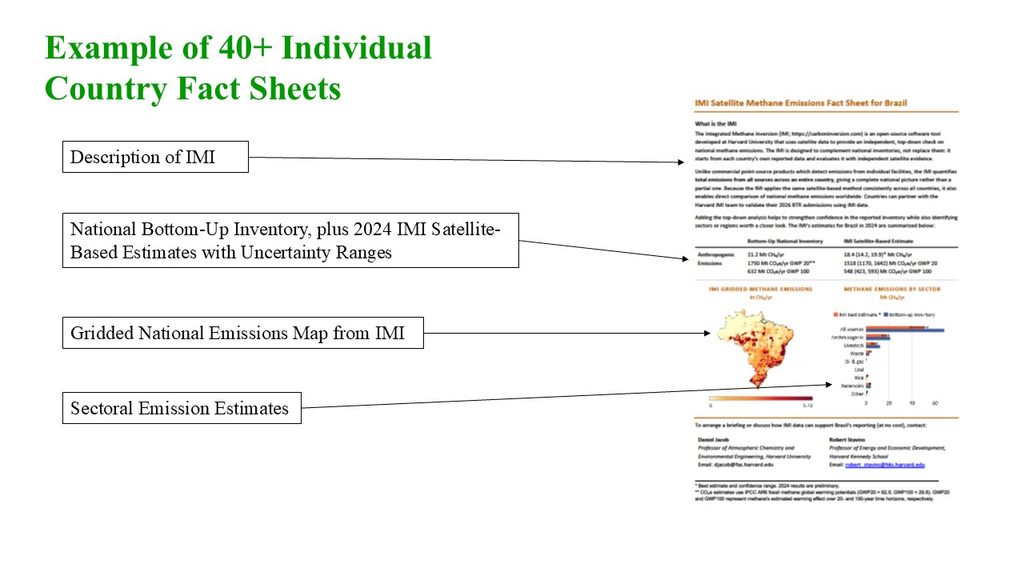
We build upon the IMI’s methodologically-consistent, high-resolution, satellite-informed estimates of national methane emissions, including sectoral detail, and then our strategic approach is to provide input to and support of both policy channels – the BTRs and GST2. Our objectivefor December 2026 is that 10–20 countries use our IMI estimates as supporting evidence in their 2026 BTRs. We are sharing country-level policy briefs with more than 40 countries, discussing each country’s specific concerns during a series of bilateral meetings. The 40+ Fact Sheets can be downloaded here. Here’s an example of one of the country fact sheets.
Finally, another element of our work in Antalya on this project is our Harvard Side Event at COP31 (“Quantifying and Communicating Methane Emissions for NDCs and the Global Methane Pledge,” Thursday, November 19, 2026 | 4:45 – 6:15 PM TRT, Side Event Room Yellow, Blue Zone, COP-31, with: Dan Cusworth, Vice President for Science, Carbon Mapper; Daniel Jacob, Harvard University; Amanda McKee, Director for Knowledge and Learning, NDC Partnership; and myself).
I hope very much to see some of you at COP31!

