

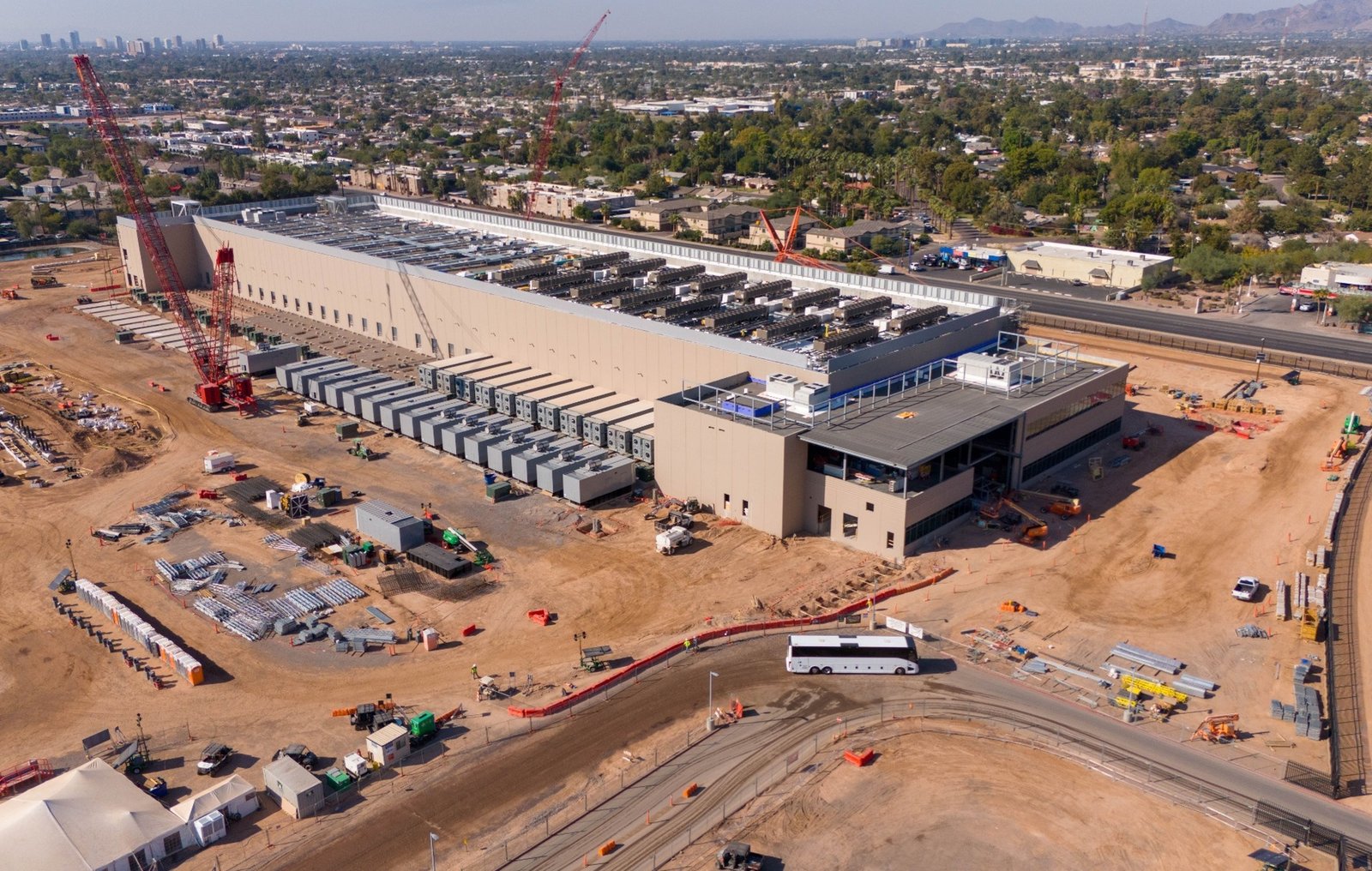
Data centers are physical facilities housing computers, servers, storage systems, and networking equipment used to store, process, and deliver digital information. Though the data center boom stretches back to the late 1990s, data centers have recently become highly contentious, challenging public policy decisionmakers as their size and numbers continue to grow across the US. The balance has shifted over a short period, especially with the rapid growth of hyperscale data centers with their large footprints. The public’s posture of indifference toward data centers shifted to hostility and rage against them. Several states and local jurisdictions have either placed moratoria on data centers or are asking voters whether to impose such moratoria.
Opponents (who include local people and outside environmental and anti-AI groups) contend that data centers are bad for communities and the country, but many communities just don’t want them irrespective of the evidence. They have complained about, among other things, higher electricity prices, water use, the noise, congestion, climate change, and pollution. On the positive side, data centers supply the computing power behind the AI tools poised to revolutionize scientific research, automation, and cloud services. Economically, they have the potential to raise productivity, wages, and the quality of life. Data centers have the potential to spur local economic development and expand the local tax base.
Three concepts in economics are pertinent for policymakers, especially local government officials, responsible for the permitting of data centers. They affect the timing for building data centers, the handling of local opposition, and the government’s role in promoting them. The last two topics present a conflict between the local population and government officials. Overall, the three concepts tell us that public policy on data centers is unlikely to lead to the best outcome from society’s perspective, if only because political forces will dominate rational economic thinking.
The Precautionary Principle
Those who favor a moratorium on data centers subscribe to the precautionary principle. The principle supports the “min-max” strategy, which aims to minimize the maximum harm that can result from an adverse event. The precautionary principle applies to environmental and safety policies across different industries and contexts. This principle says that even in the face of uncertainty, society should act today to avoid major problems in the future. Uncertainty refers to the lack of complete proof that the harm done by data centers to local communities and society in general is significant. The uncertainty can arise, for example, from unreliable evidence that electricity prices will appreciably rise, the availability of water will seriously decline, or AI will cause massive job losses.
The precautionary principle reflects a “better safe than sorry” stance that assigns a benefit to prevention even with inconclusive risk. It acts as insurance against major future problems or catastrophic events. Measured precautionary actions might include a detailed investigation of water availability and the likely rise in electricity prices because of data centers. Advocates of moratoriums implicitly assert that the costs of delay are small compared to the risk of moving ahead to build data centers today. When the risk extends to the faster and more immediate growth of potentially precarious AI as more data centers get built, the precautionary principle becomes more persuasive.
The precautionary principle is not devoid of controversy, however. Critics point to its shortcoming compared to a cost-benefit analysis that takes into account uncertainty and the risk aversion of the decisionmaker. “Safe” may have a high cost and the “sorry” may have a remote chance of happening. In this instance, delaying action would likely fail a cost-benefit test. It could, however, be justified only if society assigns an extremely high risk to data centers. What is the opportunity cost to society to avoid a possible problem tomorrow? The precautionary approach provides little guidance. When people purchase insurance, they at least implicitly compare the premiums with the expected cost from a bad event. Shouldn’t society have an idea of the costs of stopping or suspending the building of data centers today? What are the benefits from halting the building of data centers? In sum, the precautionary principle might not reflect an economically rational way to set socially desirable policy.
Looking at risk from a rational perspective, a relevant question is whether a cautious approach to data centers is worth paying for. Is the risk of delaying or halting the building of data centers worth the benefits? That’s what policymakers should be asking.
One paradigm for a wait-and-see strategy toward data centers is real options theory. It suggests that action should proceed incrementally until we know more. Waiting may be a rational response to a slow-moving uncertain peril in an environment of fast-changing technology. On the downside, there exists the risk of a potentially high cost from irreversibility in waiting too long to avoid a “tipping point,” or the threshold at which the US loses competitiveness in the global market for AI and suffers economically. That means that preventive action by slowing down the building of data centers could cause great harm to the US economy. It also may be unrealistic that we will have available more precise information on the dangers of AI. One must ask whether a wait-and-see strategy is simply a tactic to stall the building of data centers or has merit as a rational reaction to an uncertain future with the possibility of dire consequences.
NIMBYism
One paradox is NIMBYism and corporate welfare at play simultaneously. The first action attempts to obstruct the building of new data centers, while the second action compels citizens to subsidize them. NIMBYism can either delay data center construction and operation or, worse, terminate their construction. Corporate welfare, besides wasteful rent-seeking, redistributes wealth from taxpayers to owners of highly profitable data centers owned by billionaires. These seemingly conflicting actions reflect local and state governments’ support for data centers while local populations rage against them. NIMBYism, when carried to an extreme, can be socially damaging, while corporate welfare is typically damaging.
Regarding NIMBYism, the core cause is the local population suffering more harm — or believing it suffers — from a new facility than the benefits it receives. The local population may see negative effects like environmental, quality-of-life, or safety threat from a facility or production process. Frequently, the fears are irrational; but the political reality remains that if the public is wary of a new facility or production process in their locality, the owner will need to address those fears or face strong opposition.
The risk perceptions of local citizens may be distorted because of faulty or misleading information. Better education of citizens can lessen this problem. For example, while data centers may increase the price of electricity, which is a major concern of policymakers and activists opposed to data centers, this is not a sure outcome, as it depends on local conditions, the availability of electricity, and the incremental costs to increase its supply.
Another problem is that the siting/political process may not mirror a locality’s consensus. An active minority of opponents to a data center can dominate the preference of a more passive majority at town meetings or in referenda. This intervention can lead to a decision not representative of the majority preference in the community. The vocal group may be most affected by a facility or have ideological or self-interest reasons for opposing it. The group may perceive no benefits, for example, but only environmental, economic or safety threats from the facility. Added to this opposition are outside groups that have protested data centers because of their disdain for AI or Silicon Valley billionaires.
Corporate Welfare
Corporate welfare refers to government handouts and special protections granted to certain businesses to locate in a specific jurisdiction. Tax breaks, or as some observers call them, tax incentives, have in particular become a popular device for state and local governments. In recent years, several jurisdictions have bestowed tax favors on data centers. Proponents argue that tax breaks are necessary to attract businesses and that their costs are offset by the additional tax revenue from the increased economic activity. They claim that to be competitive with other jurisdictions they need to offer tax breaks or otherwise businesses will go elsewhere.
Politicians see themselves entangled in a vicious cycle where they are competing with other jurisdictions to attract new businesses. They don’t want to appear indifferent to attracting businesses that can bring new jobs. What we have seen, some years back with Amazon as a prime example (no pun intended), is jurisdictions driving up the tax breaks they are willing to pay to exorbitant levels. Analysts refer to this as the “race to the bottom.”
Corporate welfare has severe consequences. Governments frequently offer tax incentives to attract large facilities, especially when they employ a large number of people. Studies have shown that giveaways to businesses in terms of tax breaks and other favorable treatment most times have little effect on their decision on where to locate. Consequently, the giveaways are simply a windfall for the facility, funded by taxpayers who receive no benefits.
Recipients who receive tax breaks often use their political and economic clout to gain favors at the expense of their competitors and taxpayers. It is a classic example of special interests benefiting at the expense of the general public. Tax breaks are just as likely to result in perverse behavior and unintended consequences. They can shrink the tax base, shift tax burdens to other taxpayers or reduce public goods valued by the local citizenry. Tax breaks also open the door to rent-seeking and corruption: Large companies threaten to locate elsewhere unless they receive special treatment and even “bribe” officials with campaign funds in exchange for favoritism.
Of course, one can imagine situations where a tax break could contribute to the economic well-being of the local or state citizenry net of the subsidy cost. But government officials should make that determination before offering tax breaks to any company. Instead of tax breaks, governments should create a good business climate with reasonable tax rates and regulations, and pro-growth public expenditures, such as infrastructure development. States and locales can better satisfy this goal by broad-based tax cuts than by discriminatory and wasteful tax breaks where they play the role of picking winners and losers. Some states have recently pulled back from offering tax breaks to data centers, in view of the growing rage toward data centers. Offering tax breaks to highly profitable companies has become not only politically unpopular but also economically unwarranted.
