

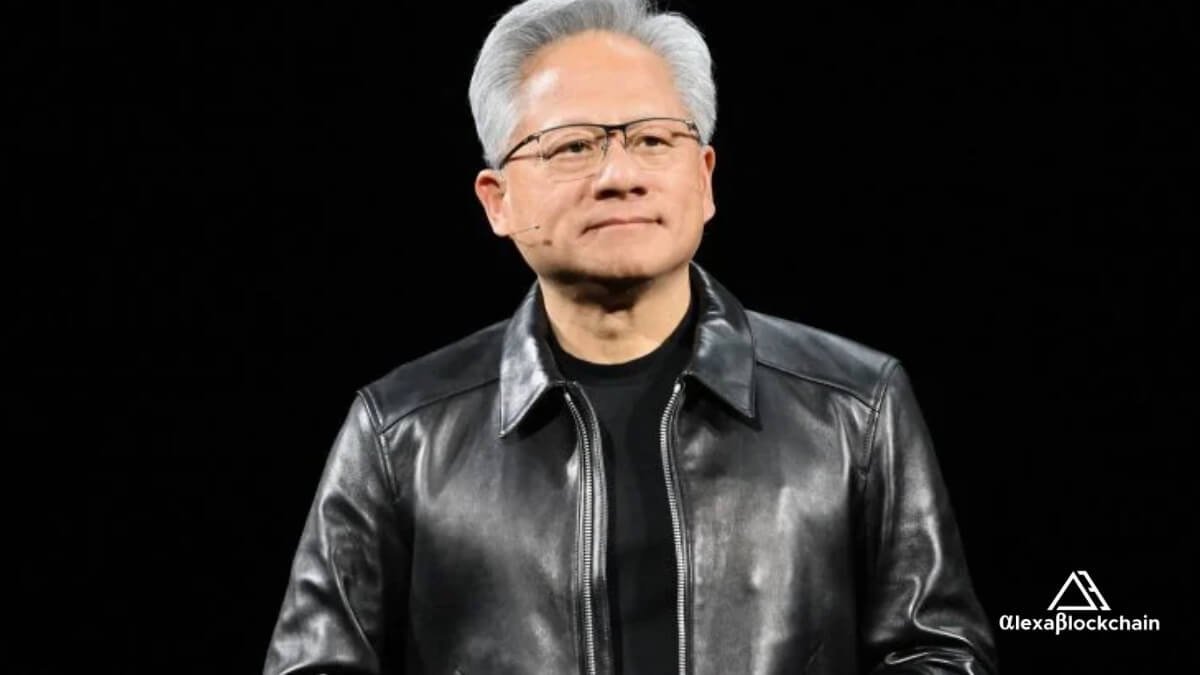
Nvidia’s leadership upheaval has raised questions over the future of the world’s dominant AI chipmaker. But the more consequential threat to its business may be emerging from competitors narrowing its technological advantage.
Ian Weisberger, CEO of institutional trading platform CoinRoutes, argues that Advanced Micro Devices (AMD) is challenging the economics that made Nvidia the biggest beneficiary of the artificial intelligence boom.
“Jensen Huang’s exit is the trigger for Nvidia’s fall, but it is not the cause. The real problem is that Nvidia’s chips are becoming a commodity,” Weisberger told AlexaBlockchain.
His assessment comes ahead of Nvidia’s November 17 earnings report, its first since Huang resigned after 33 years leading the company. CFO Colette Kress is serving as interim CEO while the board searches for a permanent replacement.
Wall Street Begins Separating Nvidia From the AI Boom
For years, Nvidia was Wall Street’s preferred investment in artificial intelligence, supported by its dominant position in high-performance GPUs and its CUDA software ecosystem.
That relationship is now being tested.
Nvidia shares closed at $162.85 on November 13, down 2.01% for the session and 12.75% for the week. The stock recorded its sixth consecutive weekly decline, its longest losing streak since October 2012.
AMD followed a different weekly trajectory.
Its shares rose 5.86% on November 12 as investors considered whether Nvidia’s leadership disruption could benefit competitors. AMD subsequently fell 8.75% on Friday to $534.06, although it still finished the week 18.93% higher.
For Weisberger, that divergence shows a broader reassessment.
“For years, Nvidia and the AI boom were treated as the same trade, because almost every serious AI system ran on its chips,” he said.
“The AI boom is not ending, but the era of one stock carrying the index might be.”
AMD Is Becoming a More Credible Alternative
AMD’s challenge extends beyond investor sentiment.
The company reported record third-quarter 2026 data-center revenue of $8.546 billion, an increase of 97% YoY. Growth reflected demand for its EPYC server processors and Instinct AI accelerators.
Its Helios rack-scale architecture is also attracting major AI developers.
In July, AMD announced an agreement with Anthropic covering up to 2 gigawatts of MI450-series GPU deployments. The first gigawatt is scheduled to begin deployment in the first half of 2027. The companies are also collaborating to improve AMD’s ROCm software ecosystem.
These developments strengthen AMD’s position as an alternative supplier, particularly for cloud providers seeking greater flexibility and lower computing costs.
However, growing competition does not necessarily mean AI accelerators have become interchangeable.
Research Shows Nvidia Still Holds a Substantial Lead
Independent research suggests the competitive gap remains significant.
Research organization Epoch AI estimated that Nvidia supplied 63% of AI computing capacity sold or shipped during the second quarter of 2026, measured in H100-equivalent computing power.
AMD accounted for 4%, while Google represented 25%, highlighting the growing importance of proprietary accelerators alongside traditional GPUs.
Nvidia also retains a considerable software advantage.
An OECD assessment identified CUDA, Nvidia’s computing platform, as a major competitive advantage. Developers have spent years optimizing software around Nvidia hardware, making migration to alternative architectures potentially expensive and complex.
Jon Peddie Research, in its October industry assessment, found that competition increasingly depends on memory bandwidth, sustained inference throughput, energy consumption and rack-level system performance rather than raw processing power alone.
That’s important. Customers may gain greater bargaining power even before rival hardware becomes a direct substitute for every Nvidia product.
Tuesday’s Earnings Will Test Pricing Power
Nvidia’s upcoming results will provide another measure of its competitive position.
The company reported $96.221 billion in revenue in its previous quarter, including $89 billion from data centers. Its gross margin reached 75%, underscoring the profitability of its integrated hardware and software business.
Management previously forecast third-quarter revenue of $108 billion, plus or minus 2%.
Yet strong results may not resolve the longer-term competitive question.
J.P. Morgan Asset Management has highlighted how custom AI chips are helping cloud providers improve efficiency. Its research also cautioned that semiconductor earnings cannot indefinitely outpace those of the hyperscalers purchasing the hardware.
Weisberger similarly believes the industry’s profits could increasingly shift toward businesses building applications on top of AI infrastructure.
“As the chips become interchangeable, buyers will shop on price, and the profits will move to the companies building products on top of them,” he said.
The challenge for Nvidia is therefore larger than replacing Huang.
Investors will be watching whether the company can defend its pricing, margins and software advantage as AMD and custom-chip developers capture a larger share of AI infrastructure spending.
Tuesday’s results may establish the strength of Nvidia’s current business. They cannot determine how much of its technological dominance will survive the next generation of competition.
Read Also: This is the First U.S.-Chartered Depository Bank to Offer Stablecoin Invoicing
Disclaimer: The information provided on AlexaBlockchain is for informational purposes only and does not constitute financial advice. Read complete disclaimer here.
