


Knowledge Should Not Stay Trapped With Individuals
Knowledge sharing determines whether valuable expertise becomes an organizational asset or remains with individual employees. Every organization has people who know how to solve tough problems, handle complex tasks, avoid repeated mistakes, and achieve better results. The real challenge is making this knowledge available to others when they need it.
This is important for Learning and Development (L&D) leaders because workplace learning is no longer limited to courses or formal training. Employees also learn from coworkers, conversations, communities, digital tools, project experiences, and the organization’s shared knowledge.
With AI, hybrid work, and distributed teams changing how people find information, organizations need better ways to capture, share, check, and use expertise. Good knowledge sharing makes this possible. But it takes more than just adding another collaboration tool. Success depends on culture, learning habits, technology, governance, and how easily knowledge fits into daily work.

Describe what you need and eLain suggests vendors that fit.
What Is Knowledge Sharing?
Knowledge sharing means intentionally exchanging information, skills, experience, insights, and practical know-how between people or groups so others can understand and use that knowledge. At work, this can happen through conversations, mentoring, documentation, peer learning, communities, training, collaboration tools, and knowledge management systems.
It’s important to remember that knowledge sharing is more than just sending information to someone. For example, a document might sit in a repository without anyone finding, understanding, or using it. Knowledge only becomes valuable when it reaches the right people and helps them make decisions, build skills, solve problems, or do their jobs better.
This difference matters a lot for L&D teams. While formal learning can introduce employees to new ideas and skills, much of the knowledge that helps people perform at work comes from experience. Organizations need ways to share that expertise with others, not just the people who first learned it.
Knowledge Sharing Vs. Knowledge Management
Knowledge sharing is just one part of the larger process of knowledge management in an organization.
Knowledge management is about how an organization finds, captures, organizes, governs, maintains, shares, and uses its knowledge. Knowledge sharing, on the other hand, is about how that knowledge moves between people, teams, and systems.
One way to look at it is that knowledge management establishes the environment and structure, while knowledge sharing ensures knowledge flows between people. Therefore, a good knowledge management and sharing strategy isn’t just about building bigger repositories. It helps employees find reliable information, connect with experts, share what they know, and apply their expertise in new situations.
Why Is Knowledge Sharing Important In The Workplace?
Knowledge sharing at work is important because organizations miss out when expertise stays isolated. When employees and teams share what they know, everyone learns faster, avoids repeating mistakes, and can build on previous work.
Problem Solving
A key benefit of sharing knowledge is that it helps solve problems faster. Rather than starting from scratch, teams can use solutions and lessons learned by others in the organization.
Reduces Duplicate Work
Employees often waste time making presentations, looking for answers, or creating processes that already exist. When knowledge is shared, organizations can reuse what others have already done.
Faster Onboarding
Sharing knowledge also helps new employees learn the ropes faster. They need more than just policies and training. They need to understand how things actually work, what problems might come up, what others have learned, and where to turn for help when standard advice isn’t enough.
Learning Transfer
For L&D leaders, another key benefit is learning transfer. Employees are more likely to use and remember their training when they keep talking about ideas, learn from peers, watch experts, and share examples after formal training is over.
Prevents Knowledge Loss
If only a few people hold important expertise, resignations, retirements, restructures, or internal moves can leave big gaps in what the organization can do.
What Types Of Knowledge Need To Be Shared?
Knowledge sharing works best when organizations recognize that different kinds of knowledge need different ways to share them. The two main types are explicit and tacit knowledge.
Explicit Knowledge
Explicit knowledge is easy to put into writing. Examples include procedures, policies, templates, checklists, technical documentation, FAQs, recorded instructions, and process guides.
This type of knowledge is well suited for knowledge bases, intranets, LMS resources, wikis, playbooks, and other places where people can search for information.
Tacit Knowledge
Tacit knowledge is harder to put into words because it comes from experience. It covers things like judgment, intuition, troubleshooting skills, understanding context, and the small choices experts make as they work.
For instance, an experienced Instructional Designer might recognize that a stakeholder’s request would not yield a good learning solution. The ability to find the real problem comes from experience, not just from following a checklist.
Sharing this kind of expertise usually requires more personal interaction, such as mentoring, job shadowing, storytelling, demonstrations, coaching, joining communities of practice, or working together to solve problems.
That’s why the way you share knowledge should match the type of knowledge you’re sharing.
Type Of Knowledge |
Workplace Example |
Effective Sharing Method |
| Explicit knowledge | Standard operating procedure | Knowledge base or playbook |
| Tacit knowledge | Expert judgment | Mentoring or job shadowing |
| Project knowledge | Lessons learned | Retrospective |
| Emerging expertise | New working practice | Community of practice |
| Formal learning knowledge | Training concepts | LMS plus peer discussion |
Knowledge sharing should help people exchange expertise without adding extra work. The best method depends on the kind of knowledge, who needs it, and how employees already do their jobs.
8 Knowledge Sharing Methods And Activities That Work
1. Knowledge Sharing Sessions
A knowledge-sharing session lets employees explain how they do something, show a process, share a lesson learned, or teach colleagues something helpful. These sessions do not have to be long presentations. Sometimes, a 20-minute demo from an internal expert is more useful than a formal hour-long course.
For example, an Instructional Designer might show how they built a reusable workflow that helped cut production time on several projects.
2. Communities Of Practice
Communities of practice bring together employees who have the same role, work in the same field, face similar problems, use the same technology, or share a professional interest.
Unlike one-time sessions, these communities give people a regular place to ask questions, discuss, solve problems, and build expertise. They are especially helpful for L&D teams spread out across different business units who might otherwise work alone.
3. Peer Learning
Peer learning lets employees be both learners and knowledge-sharers. Instead of always learning from a trainer or manager, employees learn from colleagues who have useful experience, perspectives, or skills. This can happen through peer coaching, working together on projects, discussions, demonstrations, and giving feedback.
For L&D teams, peer learning is helpful because it goes beyond formal training and leverages the expertise already within the organization.
4. Mentoring And Job Shadowing
Mentoring and job shadowing work well when employees need to acquire knowledge that is hard to put into writing or teach in a manual. An experienced employee can explain why they make certain decisions, show how they handle tough situations, and give context that is hard to put in a written guide.
This makes mentoring useful for career growth, keeping important knowledge in the company, and planning for future roles.
5. After-Action Reviews And Retrospectives
Teams should always capture what they learned before finishing important projects. A simple retrospective can look at what went well, what did not, what the team would do differently, what knowledge or skills were missing, and what other teams should know before doing similar work.
The goal is not just to write down what happened. It is to turn experience into knowledge that can help in the future.
6. Expert Demonstrations
Sometimes the quickest way to share knowledge is to show how the work is done. For example, a salesperson might show how they handle a tough objection. A learning designer could walk colleagues through their workflow. A systems administrator might show how they solve a recurring LMS problem. These activities let employees see both what experts do and how they think.
7. Knowledge Bases, Wikis, And Playbooks
A knowledge-sharing system helps people find the information they need more easily. But adding more content does not always make a knowledge base better. A good knowledge base needs someone to manage it, clear organization, good search tools, regular updates, and a way to remove old information.
If not, employees may stop trusting it and go back to asking coworkers for help.
8. Digital Collaboration Channels
Slack and Microsoft Teams can help teams share knowledge when conversations are intentionally organized. For instance, teams can set up channels for common questions, professional groups, project lessons, useful resources, or subject experts. This makes conversations easier to find than if knowledge is shared only in private messages.
The challenge is making sure useful information does not get lost in a long chat history. Important insights should be saved in the organization’s main knowledge-sharing systems.
Knowledge Sharing Examples In The Workplace
Knowledge sharing examples become more useful when they show how the practice affects actual work rather than treating sharing as an abstract cultural goal.
Team |
Knowledge Sharing Example |
Potential Value |
L&D |
Designers share successful learning design patterns. | Faster development and greater consistency |
Customer Support |
Common solutions become searchable articles. | Faster issue resolution |
Sales |
Experienced reps discuss objection-handling techniques. | Faster employee ramp-up |
HR |
Recruiters document interview lessons and practices. | More consistent hiring |
IT |
Teams capture solutions after incidents. | Less repeated troubleshooting |
Leadership |
Managers conduct project retrospectives. | Better future decisions |
Imagine an L&D team running a leadership development program. After each cohort, facilitators collect common learner questions, examples of how lessons were used at work, manager feedback, coaching notes, and areas where participants had trouble.
Rather than keeping this information with individual facilitators, the team adds the most helpful insights to its facilitator resources and talks about them in monthly knowledge sharing meetings. This way, the next group benefits from everything the previous cohort taught the L&D team.
That’s the difference between just delivering training and actually building your organization’s learning capability.
How To Build A Knowledge Sharing Strategy
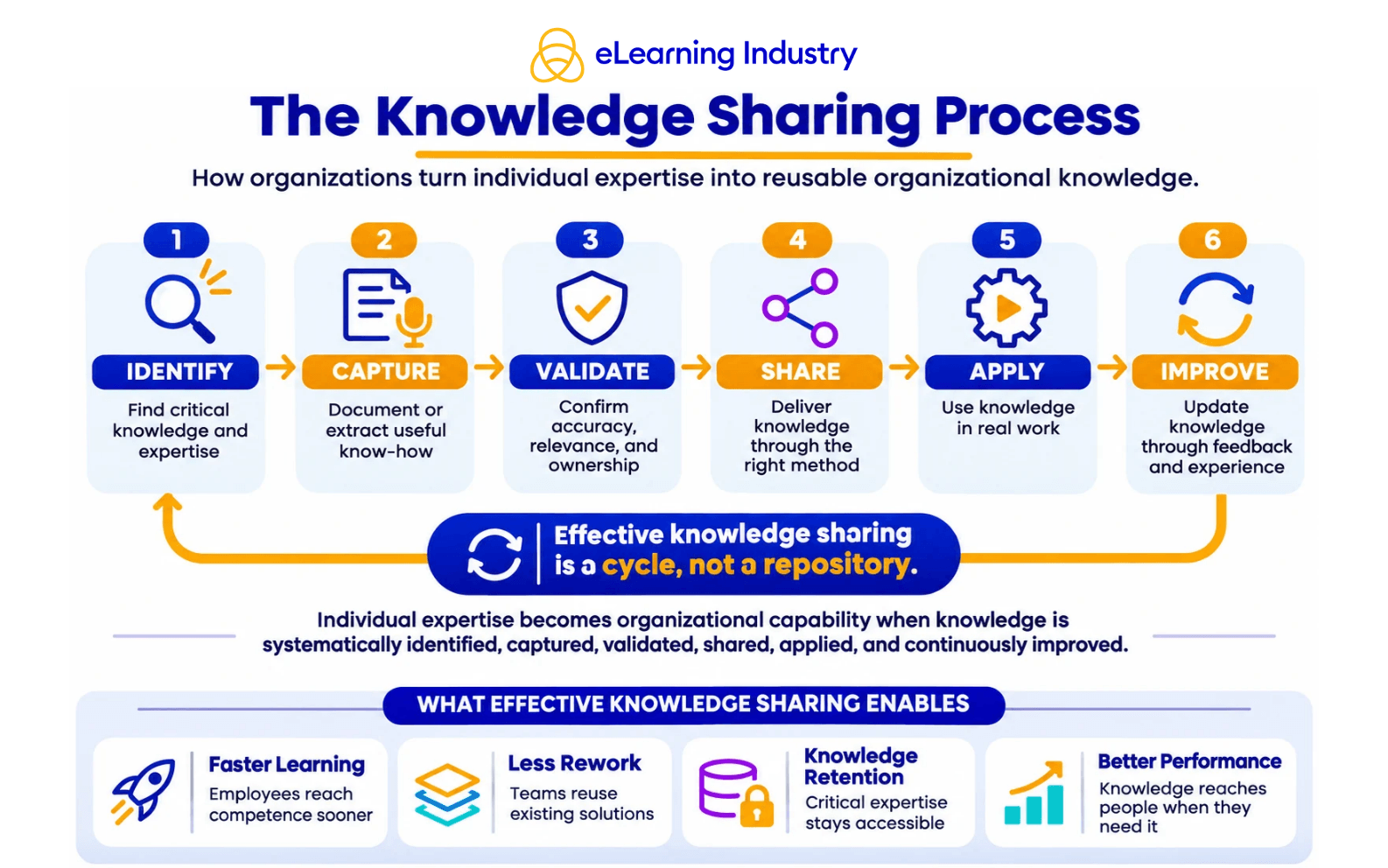
A knowledge sharing strategy explains how to find, capture, share, use, and improve valuable expertise. Without this structure, organizations may collect lots of content, but employees can still have trouble finding helpful answers. A useful knowledge sharing process usually has 6 stages.
1. Identify Critical Knowledge
Begin by figuring out which knowledge is most important. Look for areas where employees often struggle, questions that come up a lot, expertise that only a few people have, and knowledge that would cause problems if it were lost.
Prioritizing is important because organizations cannot and should not try to capture everything.
2. Capture It
After you identify critical knowledge, decide how to capture it in the easiest way possible. You might use documentation, interviews, videos, project reviews, recorded demonstrations, templates, or talks with subject matter experts.
3. Validate It
Shared knowledge has to be reliable. Organizations should set up clear ownership and review steps so employees know if information is accurate, up to date, and approved.
4. Share It
Choose the knowledge-sharing method that best matches the type of information. If a skill is complex, coaching or a demonstration might help. For repeatable processes, a searchable guide works well. New practices can benefit from sharing knowledge together in a professional community. Making another document should not always be the first solution.
5. Apply It
Knowledge is only valuable when employees can actually use it. So, L&D teams should link sharing to practice, reflection, coaching, performance support, peer learning, and real workplace challenges.
6. Improve It
Finally, treat knowledge as something that evolves. Employee questions, feedback, new tools, business changes, and experience should keep improving what the organization knows.
How To Overcome Knowledge Sharing Barriers
Barriers to knowledge sharing usually come from an organization’s systems and culture, not just because employees don’t want to share. APQC’s 2026 survey found that 40% of respondents felt their organization’s culture did not do enough to encourage knowledge sharing and reuse. This made culture the top threat to KM success in the study. Let’s take a closer look at what affects knowledge sharing.
Barrier |
What It Looks Like |
How To Respond |
Lack of time |
Sharing feels like extra work. | Integrate sharing into existing workflows. |
Knowledge hoarding |
Employees see expertise as personal leverage. | Recognize contribution and reuse. |
Low trust |
Employees question information or colleagues. | Establish ownership and review. |
Tool fragmentation |
Knowledge is scattered across platforms. | Clarify systems of record. |
Weak leadership support |
Leaders request sharing but do not participate. | Have leaders model the behavior. |
Fear of being wrong |
Employees hesitate to contribute. | Strengthen psychological safety. |
Outdated content |
Employees stop trusting repositories. | Establish content governance. |
Organizations should first look at the environment before assuming that low participation is just a motivation problem. If employees are supposed to share knowledge but do not have time, cannot find the right system, get no recognition, or think their input will be ignored, just telling them that sharing is important will not help much.
Conclusion
Knowledge sharing is valuable when expertise spreads beyond the person who developed it, helping others make decisions, solve problems, learn, and do their jobs better. For L&D and business leaders, this means looking past just courses, repositories, or collaboration tools. Lasting knowledge sharing in organizations depends on people, learning, workflow, culture, governance, and technology working together. The goal isn’t to get employees to share everything they know. Instead, it’s about building an environment where important knowledge reaches the right people at the right time and becomes useful in their daily work.
