

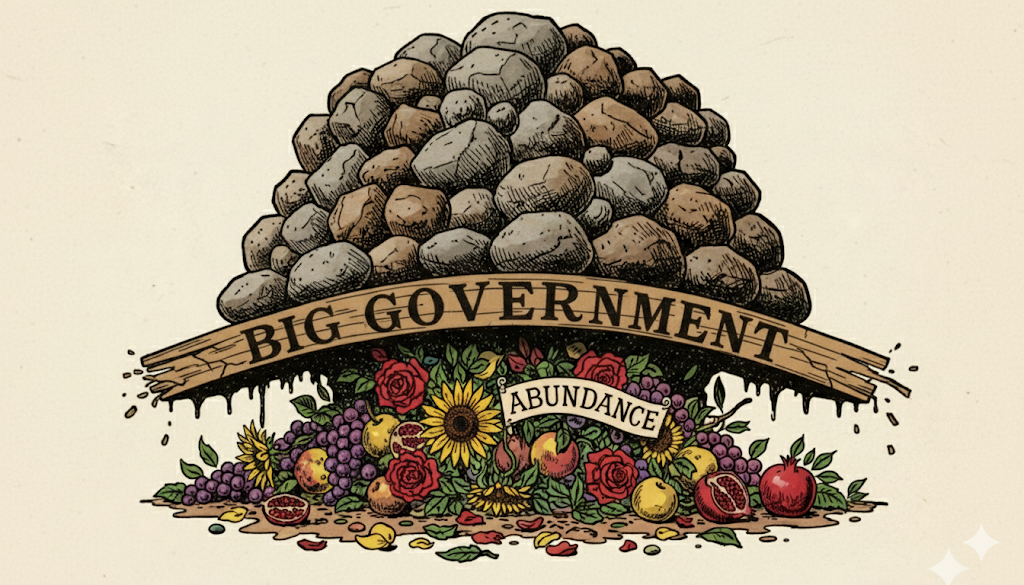
Abundance by Ezra Klein and Derek Thompson is not a book for libertarians or conservatives, and I had to remind myself of that frequently. Its implied reader is a member of the left in good standing who parks a Subaru Outback or Toyota Prius with a fading “Biden/Harris” bumper sticker on it in front of a house with one of those “In This House We Believe” signs in the front yard. Abundance is a book for those for whom the important word in “public transportation” and “public education” is not “transportation” or “education,” but “public.” It is a message from people who love government to people who love government.
And while it’s a pretty good message, on the whole, I read it with mixed feelings. I would have welcomed a much more full-throated defense of classical liberal institutions, but Klein and Thompson are progressive liberals, not classical liberals, and so I’m left to take what I can get. I therefore welcome their effort to put “market progressivism” on the political map. Could the left have picked a better book of the moment? Yes. Could they have done much worse? Also, yes.
Klein and Thompson write with the verve and vigor one would expect from writers for The New York Times and The Atlantic, and their memorable phrasing and clear labeling of phenomena like “lawn-sign liberalism” and “everything bagel liberalism” bring rhetorical punch to their call for self-examination from the left. It is refreshing to see progressives in good standing acknowledge that government is the problem. They rightly criticize anti-growth progressivism for its rejection of the Enlightenment and embrace of pre-Enlightenment, pre-Christian animism. They don’t seem to think that “fill the Earth and subdue it” is ipso facto sinful. In a passage that will warm the heart of any Public Choice Society attendee, they explain that “government is a plural rather than a singular,” a hodge-podge of competing interests with fundamentally different and often irreconcilable ideas about The Good, along with a mishmash of groups simply trying to enrich themselves at others’ expense.
Their chapter on housing is especially illuminating, because they take their fellow lawn-sign liberals to task for working so hard to govern a lot of potential housing out of existence. One of the ironies of lawn-sign liberalism is that it has made housing unaffordable in the places where large agglomerations of population are most needed: the San Francisco Bay Area, Boston, and New York. On a recent trip to Berkeley, California, I was enjoying the immaculate July weather and wondering, “why don’t I live here?” Then I remembered one of the major answers: housing prices. Our very nice house in Birmingham’s Avondale neighborhood would likely be out of our reach in the Bay Area.
Then, of course, there are interminable regulatory delays standing between everyone and innovative new technologies. Siting anything is a regulatory nightmare, and the authors point to the monster Ronald Reagan created when he signed the California Environmental Quality Act, now one of the reasons it takes about a year and a half to clear all the reviews for a new housing development and another two years to secure all the necessary permits.
With delays like those, it’s no wonder that any new housing in the Bay Area caters to wealthy people with luxury tastes. If you have to wait four years for a project to even start, then it has to have an enormous payoff in order to make sense. They show, over and over again, how government creates problems by blocking new housing development, wasting tens of billions of dollars building “no-speed rail” that I’m not sure will be completed in my lifetime, and letting coalitions of special interests block resource-saving technologies and innovations at every step.
It is maddening, then, to read over and over again that they believe more government is the solution. After chronicling example after example of how coercion creates pathological incentives that restrict even the most well-meaning civil servant’s best intentions, they conclude that they just need to fiddle with things a bit to unleash the full power of good intentions. After all, they argue, if it works in Denmark, why can’t it work here? That question, I take it, is rhetorical, but it’s akin to looking at a map of the Birmingham, Alabama, metropolitan area and asking, “If it works so well in the posh and very exclusive suburbs, why can’t it work in Birmingham proper?”
The book’s discussion of Operation Warp Speed, which delivered COVID-19 vaccines in December 2020, also rings hollow. First, giving the government credit for Operation Warp Speed is a lot like giving the government credit for ending Jim Crow. Scientists had sequenced the COVID-19 genome on January 11, 2020. Moderna had cooked up its first batch of vaccines two days later. That the FDA got out of the way just enough for Moderna to roll out a vaccine almost a whole year later is anything but a victory.
I agree with Casey Mulligan, whom Klein and Thompson misinterpret: the fact that it took so long is a damning indictment of the regulatory state. The COVID vaccine saved millions of lives and trillions of dollars, but how many more lives and how many more trillions could it have saved had it rolled out much earlier and in a way targeted at reducing transmission above all else? It made me wonder — and should make readers wonder — about the medical miracles we are missing out on during the FDA’s years-long mandated delays.
What’s more, if the COVID pandemic showed us anything, it is that states most definitely do not lack “capacity.” Governments basically shut down the world economy and put everyone under veritable house arrest for the better part of a year. States have enormous “capacity.” What they lack are decent goals and incentives. Klein and Thompson point out — as many economists like Ludwig von Mises, Milton Friedman, and Thomas Sowell have — that a lot of today’s problems were yesterday’s solutions. It would have been refreshing to see them take a step back and say, “Maybe we’re wrong to think that this time will be different.”
To that end, I also don’t think they’re right about the political right. Repeatedly, they explain how the right hates government, but that’s not true. The right loves government when it’s fighting wars, rounding up illegal immigrants, banning things they don’t like, and so on. Republicans might talk a good game about small government and personal liberty, but the “accomplishments” touted by incumbent legislators from either party will almost always involve new spending or new mandates.
Just look at Trumpism: it’s authoritarian interventionism dressed in red rather than blue. No doubt, they have to repeat a few tropes to show that they are leftists in good standing, but it’s not as clear as the right hates government. I think Bryan Caplan’s overly simplistic model of left and right applies here: the left hates markets, and the right hates the left. To wit, seven states have banned lab-grown meat. All seven — Texas, Alabama, Florida, Indiana, Mississippi, Montana, and Nebraska — are dark red.
The government’s record reminds me of an abusive alcoholic asking to be trusted after a lifetime of broken promises. I’m glad if Abundance’s authors are on board with housing deregulation, but based on past performance, I’m a lot less optimistic than they are that this time will be different. Klein, Thompson, and their fellow leftists get misty-eyed when they think about big, complicated projects like the New Deal and the Apollo program. Yes, the federal government gave us the moon landing. It also gave us the Transportation Security Administration, which is a much better representation of what governments actually do.
Klein, Thompson, and others on the left should focus more on the fact that it is because of governments that you are not allowed to pump your own gas in New Jersey. Opening a daycare in Tennessee requires adhering to regulations that define what constitutes a “snack.” I read that Europeans spend 575 million hours per year clicking on “accept cookies” notifications. Early in the COVID pandemic, the FDA stopped the rapid production and shut down distribution of at-home testing kits. Government-backed union work rules were the reason I couldn’t get my own luggage cart from the lobby of a New York hotel on a 2011 trip. Government is certainly one reason fully self-driving, autonomous cars aren’t ubiquitous and cheap. To borrow from Steven Landsburg, that is the “majesty of the law.” Just like we might want the reformed abusive alcoholic to go a year or two without going on a bender and beating his wife, it would be wise to see if governments can do the small stuff — fix potholes, get rid of senseless regulations, and so on — before we trust them with big things. For now, it’s impossible to claim that government policies are regularly (or even occasionally) well-designed interventions aimed at widely agreed-upon market failures.
But again, I’m not the anticipated reader of this book, and I might be expecting too much. Klein and Thompson nudge lawn-sign liberals in a pro-abundance direction, at least. Maybe, because one of Gavin Newsom’s aides read Abundance, there will be one less piece of red tape new housing projects have to deal with, and maybe the state of California will waste one billion fewer dollars. If so, then Abundance is a win.
