

The AI Skills Gap Is Widening, And CEOs Should Be Aware And Ready To Act
Back in the day, workforce transformation moved at a pace leaders could manage. Today, AI has completely changed that equation. Technology is accelerating faster than organizations can adapt, and the gap between capability and need is widening in real time. In fact, over 90% of global enterprises are expected to face critical skills shortages by 2026, with billions in value at risk if they fail to respond. So, what does this mean for CEOs? It means the AI skills gap is no longer a future concern, but an immediate business constraint.
Companies are not just competing on product innovation anymore, but on how quickly they can align talent with emerging demands. And that responsibility is shifting upward. Workforce readiness now sits at the core of executive decision-making.
The truth is, AI and workforce skills are becoming inseparable from growth strategy. If your teams can’t evolve as fast as your technology stack, your execution slows down, no matter how strong your vision is. So, where should leaders focus? This is where a clear AI strategy becomes critical. Not as a technical roadmap, but as a business imperative tied directly to performance, speed, and resilience.
This article breaks down the most important AI and skills gap trends shaping 2026 and, more importantly, what they mean for learning tech companies looking to lead in this shift.
Do you need to position your company at the center of workforce transformation?
eLearning Industry helps learning and HR tech vendors showcase their solutions, insights, and thought leadership.
TL;DR
- AI is reshaping required skills across every industry.
- The skills gap is becoming a strategic business risk.
- Learning tech companies are uniquely positioned to solve this challenge.
- CEOs must align product, strategy, and market positioning with workforce transformation.
In This Guide, You Will Find…
Why The AI Skills Gap Is A CEO-Level Problem
Back in the day, skills development was something leaders could delegate. HR handled it, L&D supported it, and the business kept moving. Today, that model no longer holds. AI is reshaping how people work at every level, and AI skills are now directly tied to whether a company can execute on its strategy or not. So, why is this a CEO-level problem? Because the impact goes far beyond hiring or internal capability building. When teams lack the right skills, productivity slows down. Projects take longer, decision-making becomes reactive, and innovation starts to stall. Over time, this affects growth.
Think about it from a market perspective. Investors are no longer looking only at product pipelines or revenue projections. They’re asking whether organizations can actually deliver in a rapidly changing environment. And that’s where workforce transformation becomes a defining factor. If your workforce can’t keep up with technological change, your competitive edge erodes.
The truth is, skills are no longer a support function. They’ve become a core business asset. In many ways, they determine how fast a company can move, adapt, and scale. This is exactly what will define winners in the future of skills 2026 landscape. So, what does this mean for CEOs? It means workforce readiness is no longer something you oversee from a distance. It’s something you own. Because in this environment, your ability to compete is only as strong as your ability to evolve.
The Scale Of The AI Skills Gap In 2026
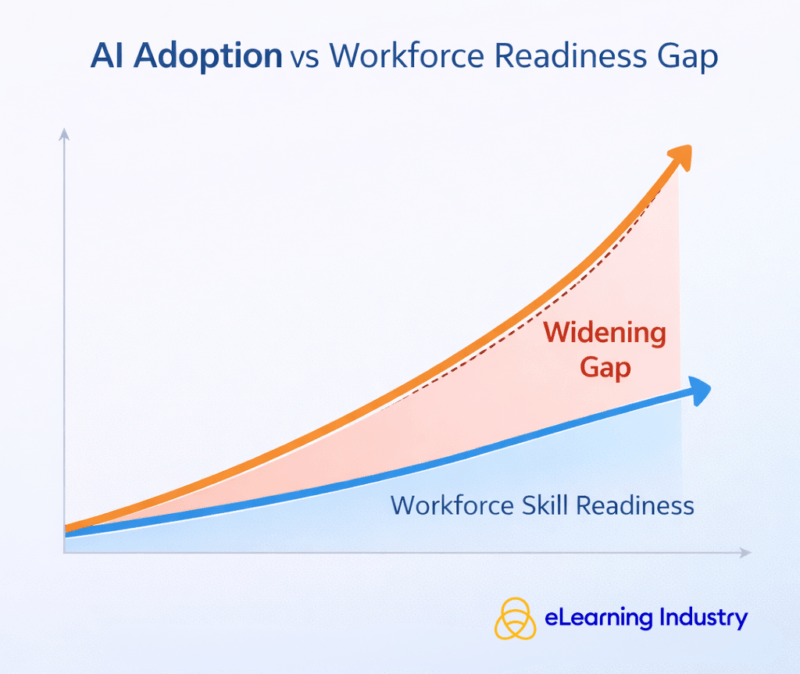
Back in the day, skills gaps were something companies could measure and gradually fix. Today, the scale is completely different. AI adoption is moving at a speed most organizations simply can’t match. That mismatch is what is expanding the AI skills gap across industries. According to the World Economic Forum, 44% of workers’ core skills are expected to change by 2027 due to technology and AI integration. This isn’t just about technical roles, as it signals a broad reshaping of how work itself is defined.
So, what’s actually happening inside organizations?
- New roles are emerging faster than companies can define them.
- Existing roles are being reshaped by AI, not replaced.
- Job descriptions are expanding while expectations are rising.
- Entry-level pathways are shrinking as automation increases.
But here’s where many leaders get it wrong. This gap isn’t only technical. Yes, companies need engineers and data specialists. But they also need people who can:
- Interpret AI-driven insights.
- Make decisions in AI-supported environments.
- Combine domain expertise with analytical thinking.
This is why the problem is showing up across the business, not just in technical teams. It’s also why many learning tech trends are shifting toward capability mapping and real-time skill visibility.
Key AI And Skills Gap Trends CEOs Must Watch
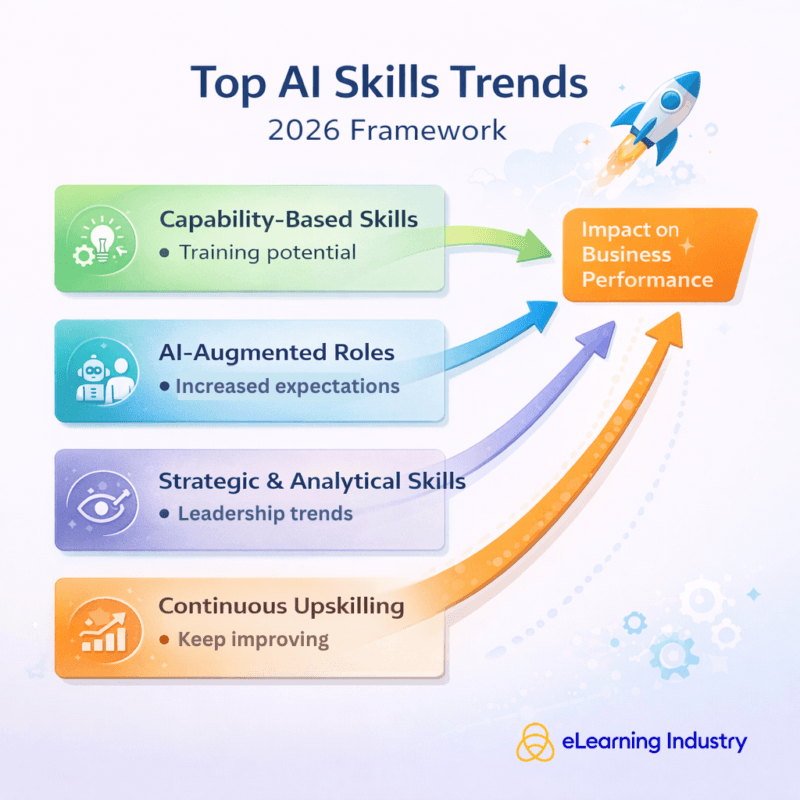
1. Shift From Role-Based Skills To Capability-Based Skills
Jobs are no longer evolving in neat, predictable cycles. Instead, they are being reshaped continuously by AI adoption across workflows, tools, and decision systems. This is expanding the AI skills gap as traditional job descriptions fail to keep pace with how work is actually being executed inside organizations.
What’s emerging is a shift toward capability-based thinking. Instead of defining talent by fixed roles, companies are starting to define it through modular capabilities like problem-solving, adaptability, and AI fluency. This shift is reshaping talent development trends, forcing leaders to rethink how workforce value is structured and measured.
2. Rise Of AI-Augmented Roles
Most roles are no longer purely human-driven. They are becoming AI-augmented environments where employees and systems work side by side. This is fundamentally changing productivity expectations across industries.
But it also introduces a second layer of the AI skills gap. It’s no longer about access to AI tools. It’s about the ability to effectively collaborate with them. This shift is accelerating upskilling trends, where human-AI interaction is becoming a core performance requirement rather than a specialized skill.
3. Demand For Strategic And Analytical Skills
As automation absorbs more execution-level work, human value is moving toward judgment, interpretation, and strategic decision-making. Organizations are increasingly prioritizing analytical thinking, AI oversight, and cross-functional reasoning.
This is reshaping reskilling trends, especially as companies realize that technical exposure alone is not enough. The ability to interpret outputs and make high-quality decisions is becoming central to how competitive advantage is built in modern environments.
4. Continuous Upskilling Becomes Mandatory
Skill relevance is now shrinking faster than traditional development cycles can support. What was sufficient two years ago may already be partially outdated, creating constant pressure on workforce capability.
This is pushing organizations toward continuous capability evolution rather than periodic learning cycles. In practice, this is also influencing AI marketing ideas, as vendors reposition learning systems as always-on infrastructure tied directly to performance outcomes.
5. Enterprise Demand For Scalable Learning Solutions
Enterprises are struggling to scale workforce capability at the speed required by AI-driven transformation. Fragmented systems and isolated initiatives are no longer sufficient for complex, distributed organizations.
As a result, demand is rising for scalable systems that connect capability gaps to measurable business outcomes. This is becoming a critical layer of modern AI business strategy, where workforce readiness is treated as a direct input into execution capacity and competitive positioning.
6. From Productivity Optimization To Intelligence Amplification
Organizations are no longer just trying to improve efficiency, like they used to back in the day. They are now trying to amplify decision intelligence. AI is shifting the goal from doing more with less to making better decisions at scale. This is redefining how leaders think about performance across teams.
This shift is accelerating expectations around judgment quality, not just output speed. In this environment, value is increasingly tied to how effectively humans and systems combine reasoning. It’s becoming a defining layer of modern talent development trends.
7. Organizational Redesign Around Skills Fluidity
Traditional org structures are beginning to strain under the pressure of rapid capability change. Fixed departments and rigid reporting lines are less effective in environments where skills need to be redeployed dynamically.
Companies are increasingly experimenting with fluid talent models where capability clusters form around problems rather than functions. This is reshaping how organizations respond to change and is becoming a core part of emerging upskilling trends in large enterprises.
What These Trends Mean For Learning Tech Companies
What these trends ultimately signal is a structural shift in how organizations think about capability building. The conversation is no longer about content delivery or isolated programs, but about how quickly companies can close the AI skills gap and align workforce capability with rapidly evolving business demands.
For learning tech companies, this changes both the expectation and the opportunity. Buyers are no longer evaluating platforms as tools. Instead, they are evaluating them as infrastructure for performance, adaptability, and workforce intelligence. This is where AI in learning and development becomes a defining layer of differentiation, not just a feature set.
At the same time, the rise of AI adoption in L&D is forcing a shift from static systems to dynamic, responsive ecosystems that can evolve with the organization.
Key implications for learning tech companies:
- Demand is shifting toward AI-powered platforms that adapt to changing skill requirements in real time.
- Outcomes matter more than engagement, as companies want measurable impact on performance and execution.
- Personalization is no longer optional. Systems must adjust to roles, context, and capability levels dynamically.
- Buyers expect platforms to act as strategic intelligence layers, not just content repositories.
- Vendors are increasingly positioned as long-term partners in workforce transformation rather than transactional providers.
Ultimately, the winners in this space will be those who can connect learning directly to business execution, not just knowledge delivery.
The Business Opportunity: Monetizing The Skills Gap
The widening AI skills gap is no longer just a workforce challenge. It has now become a structural market shift that is reshaping how learning technology companies position, package, and monetize their offerings. As enterprises accelerate AI investments, they are no longer buying learning tools in isolation. They are buying capability systems that directly influence execution speed, productivity, and strategic agility.
What’s emerging is a clear commercial expansion zone where learning tech vendors move from supporting development to enabling performance outcomes. The organizations that win in this space will be those that align directly with enterprise priorities shaped by CEO strategies, not departmental learning budgets.
Key monetization opportunities for learning tech vendors:
- AI-powered learning products that dynamically adjust to evolving roles and business needs.
- Workforce analytics platforms that map capability gaps and forecast operational risk.
- Enterprise-scale systems that integrate learning into daily workflows rather than standalone environments.
- Advisory and consulting services that help organizations interpret capability data and redesign operating models.
- AI-driven insights that connect skills intelligence directly to business performance metrics.
This shift is important because companies are no longer asking, “What content do we need?” They are asking, “What capability do we need to execute strategy faster?” That change is redefining the entire category.
At the same time, AI and workforce skills are converging into a single enterprise priority. Learning is no longer treated as a separate function. Instead, it is becoming part of core business infrastructure. Vendors that understand this shift are moving closer to executive decision-making, while others risk being commoditized.
This is also where future of skills 2026 becomes a commercial reference point. The next phase of competition will not be about course libraries or static systems, but about real-time capability intelligence and adaptive workforce systems. In this environment, the opportunity is not incremental. It is category-defining. The second AI skills gap, between organizational awareness and execution capability, is where the next generation of learning tech revenue will be created.
Why Many Companies Will Fail To Address The Skills Gap
-
Reactive Approach Instead Of Proactive Planning
Many organizations still treat capability issues as something to fix after performance drops. This lagging response model cannot keep up with the speed of change driven by workforce transformation. By the time you identify gaps, business impact has already occurred.
-
Lack Of Strategic Alignment With Business Priorities
Skills initiatives are often disconnected from core business goals. Instead of linking capability needs to revenue, product delivery, or market expansion, they remain isolated within HR functions.
-
Underinvestment In Capability Infrastructure
While companies that use AI today are aggressively reallocating budgets toward automation and data systems, many organizations still underfund workforce capability systems. This creates a structural imbalance between technology and human readiness.
-
Poor Measurement Of Skill Effectiveness
Most organizations still rely on outdated proxies like course completion or participation rates. These metrics fail to reflect actual performance impact or business readiness.
-
Fragmented Ownership Of Workforce Capability
Responsibility is split across HR, L&D, and business units, leading to inconsistent execution and unclear accountability. This fragmentation slows decision-making and reduces impact.
-
Overfocus On Tools Instead Of Outcomes
Many companies invest in platforms without defining what success looks like in operational terms. This leads to adoption without transformation.
-
Failure To Anticipate The Scale Of Change
The skills gap in 2026 will not resemble today’s workforce challenges. It will be broader, faster, and more systemic, driven by continuous technological evolution.
-
Limited Integration Of AI Into Workforce Planning
Even as AI becomes central to business operations, many organizations are not using it to model future capability needs or predict workforce risk.
-
Short-Term Budgeting Cycles
Annual planning structures make it difficult to invest in long-term capability building, even when the need is clearly structural rather than cyclical.
How CEOs Can Respond Strategically
-
Align Workforce Strategy Directly With Business Goals
CEOs need to treat capability as a core input into growth, not a downstream function. This means ensuring that workforce planning is explicitly tied to revenue targets, product velocity, and market expansion. The rise of AI and workforce skills makes this alignment even more critical, as capability now directly determines execution speed and competitive positioning.
-
Invest In Scalable Learning Infrastructure, Not Fragmented Tools
Point solutions are no longer sufficient in an environment shaped by rapid change. Organizations need systems that can scale across functions, geographies, and evolving role requirements. This is where learning tech trends are shifting toward integrated, adaptive ecosystems rather than isolated learning platforms.
-
Embed Workforce Capability Into Enterprise Decision-Making
Workforce readiness should be treated as a strategic input in planning cycles, not a reporting metric. CEOs who integrate capability data into forecasting, resourcing, and transformation initiatives are better positioned to respond to disruption.
-
Partner With Learning Technology Providers As Strategic Enablers
Vendors are no longer just service providers. They are becoming infrastructure partners. The most effective relationships are those where external platforms support continuous visibility into skill readiness and capability gaps.
-
Measure Impact Through Performance Outcomes, Not Activity Metrics
Traditional indicators like participation or completion rates are no longer sufficient. CEOs should focus on how capability investment translates into execution speed, productivity, and business outcomes.
-
Reframe Workforce Capability As A Competitive Asset
Talent is no longer a cost center, but a differentiator. Organizations that manage skills as a strategic asset outperform those that treat it as an operational function.
-
Integrate Capability Planning Into Enterprise AI Strategy
Workforce design must evolve alongside technology deployment. Without embedding skills planning into enterprise AI strategy, organizations risk building advanced systems that their people cannot fully leverage.
Key Takeaway
The AI skills gap 2026 is no longer a distant concern but a defining constraint on enterprise growth. Executives now realize that AI and workforce skills are becoming inseparable from competitive performance and long-term resilience. Successful organizations are treating workforce transformation as a core strategic priority, not an operational afterthought. Even the biggest AI companies are signaling that capability, not just technology, will define future leadership.
This shift underscores why leaders can no longer separate strategy from capability planning, as both now evolve together under accelerating technological change. The challenge is not awareness, but execution at scale across complex organizations. This is where credibility and trusted positioning become decisive in enterprise decision-making. Ultimately, competitive advantage will depend on how quickly organizations translate capability into execution, not just how fast they adopt new systems.
As the AI-driven skills gap reshapes industries, organizations are actively searching for trusted partners to support workforce transformation. Companies that clearly communicate their expertise in AI-driven learning and skills development gain stronger visibility and enterprise trust.
eLearning Industry helps learning and HR tech vendors showcase their solutions, insights, and thought leadership, connecting them with decision-makers navigating the future of work. Clarity wins at scale.
The AI skills gap is the mismatch between the skills employees currently have and the skills needed to effectively use and manage AI-powered tools and systems in the workplace.
It’s widening because AI technology is evolving faster than workforce training programs can adapt, leaving many employees without up-to-date AI literacy or applied technical skills.
Nearly all industries are affected, but it is especially visible in knowledge-heavy sectors like finance, healthcare, marketing, manufacturing, and software development.
Key in-demand skills include data literacy, prompt engineering, critical thinking, AI tool fluency, automation design, and strategic decision-making.
CEOs can invest in continuous learning programs, integrate AI training into workflows, partner with learning platforms, and shift toward capability-based workforce planning.
Companies risk lower productivity, poor AI adoption, reduced competitiveness, and increased talent shortages as roles evolve faster than employee capabilities.
