


The White House announced last week that it is “taking steps” to ban large institutional investors from buying single-family homes. It’s unclear whether the President has legal authority to do this without action from Congress. But setting aside that issue, let’s investigate the merits of the policy.
Many commentators have pointed out that institutional investors have such a small presence in the single-family market that it is implausible to attribute much of the recent appreciation in house prices to their activities. Institutional investors, defined as those owning 100 or more homes in their portfolios, own less than one percent of the single-family housing stock nationally and only about three percent of single-family homes for rent. Their purchasing activities have declined since 2022, but even at the peak the largest (1000+ homes) investors accounted for under three percent of single-family house purchases nationally. Institutional investors matter more in some markets than in others, but in no metro area do companies with 100+ home portfolios own more than five percent of the single-family stock. Figure 1 shows the large investor ownership share by state. All the states in blue – the large majority of them – have a large investor share less than one percent of single-family stock.
If we zoom out to the largest 50 metro areas, the same correlation holds, though a bit more weakly. Places with more large institutional investor ownership of single-family homes saw larger price declines over the most recently available 12-month period (Figure 3).
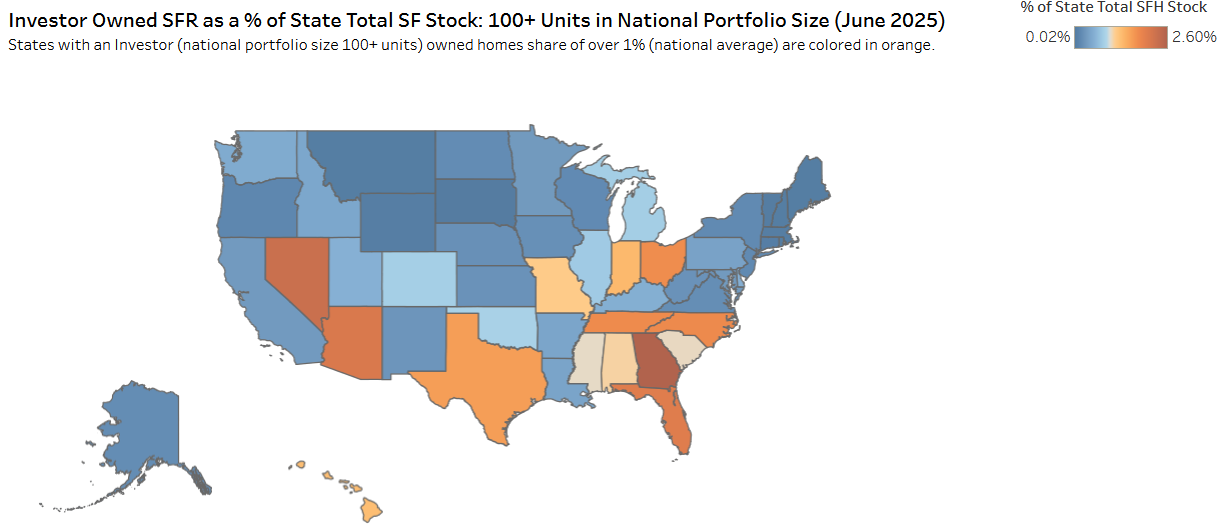
Figure 1: Large Investor SF Ownership Share by State. AEI Housing Center Data.
What commentators have so far left unsaid is just how beneficial the small amount of institutional investment is for the American housing market. It’s not just not a big problem; it’s not a problem at all, but rather something to be welcomed.
Institutional investors help make the housing market more liquid and less cyclical. They upgrade the quality of the housing stock, typically at lower cost than smaller renovation outfits. They make desirable neighborhoods accessible for households that could not afford to buy in those neighborhoods. Increasingly, they are directly increasing housing supply.
Institutional investors first started to take interest in single-family houses in 2012, at the bottom of the last housing cycle. They are less capital-constrained than smaller investors, let alone most owner-occupiers. As a result, they are better able to use cash reserves to identify good deals and the market and buy them at prices that make sense over the long run. The ability of institutional investors to support the housing market after a financial crisis will help prevent future liquidity problems in the mortgage finance sector from spiraling into a housing crash.
Why have institutional investors only emerged as players in single-family housing so recently? Economists point to technological advances such as cloud computing and mobile connectivity that have helped with acquisition and management of single-family houses. Machine learning (artificial intelligence) may have helped develop forecast models for acquisition as well. To be sure, some buyers became overconfident in their forecast models and ended up losing a lot of money — most famously Zillow. But Zillow’s model was to buy low and sell dear, rather than manage rental properties. Most institutional investors tend to focus on particular neighborhoods or cities to reduce the per-unit costs of property management.
Mortgage underwriting standards tightened dramatically after the Great Recession, making it difficult for younger Americans and those with a lot of income from “side gigs” and self-employment to qualify. As a result, homeownership rates declined. By making more single-family homes available to renters, buy-to-rent institutional investors have helped families that could not afford to buy or qualify for a mortgage to move into desirable neighborhoods.
The most recent and careful paper on the subject finds that large institutional investors slightly raise house purchase prices and reduce rents. The effect on prices is truly tiny: for every percentage point of the total single-family housing stock owned by large institutional investors, house prices go up 1.7 percent. Since these investors own less than one percent of the single-family housing stock nationally, counterfactually eliminating all large investor ownership of single-family housing would decrease national house prices by less than 1.7 percent. And even Trump is not proposing to force investors to sell what they already own.
The effect on rents is slightly bigger: for every percentage point of the single-family rental stock that institutional investors own, rents fall 0.7 percent. Since institutional investors own about three percent of the national single-family rental stock, the total effect on rents is around negative two percent. While small investors substitute to some extent for large investors, the Coven paper still finds that large investors increase the total supply of single-family rental homes by 0.5 for every home that they purchase.
Foreclosures are a disproportionate channel by which institutional investors acquire homes. For example, INVH reported that 37 percent of the houses they acquired between September 2015 and September 2016 were from distressed sales. Typically, large investors renovate homes before renting them out. Invitation Homes reported spending about $39,000 per purchased home on renovations in 2021. Large investors may have a comparative advantage in buying and renovating homes because they have full-time teams working in specific regions according to established procedures and buying materials in bulk. Thus, large institutional investors increase the average quality of the US housing stock.
Increasingly, large institutional investors expand total housing supply directly, through build-to-rent developments. In the Q2 2024 last year, build-to-rent (BTR) developments were 7.2 percent of all single-family house starts. BTR isn’t useful for getting renter households access to desirable neighborhoods, but it is especially useful for increasing overall housing supply, decreasing both sale prices and rents because the rental and for-sale markets are connected. When BTR drives down rents through new supply on the market, that encourages some households to rent rather than buy and reduces for-sale prices for buyers of the remaining homes on the market. BTR has been especially desirable in unfreezing a housing market challenged by mortgage lock-in. Unfortunately, HUD Secretary Bill Pulte reportedly wants to crack down on BTR as well as institutional purchases of existing homes.
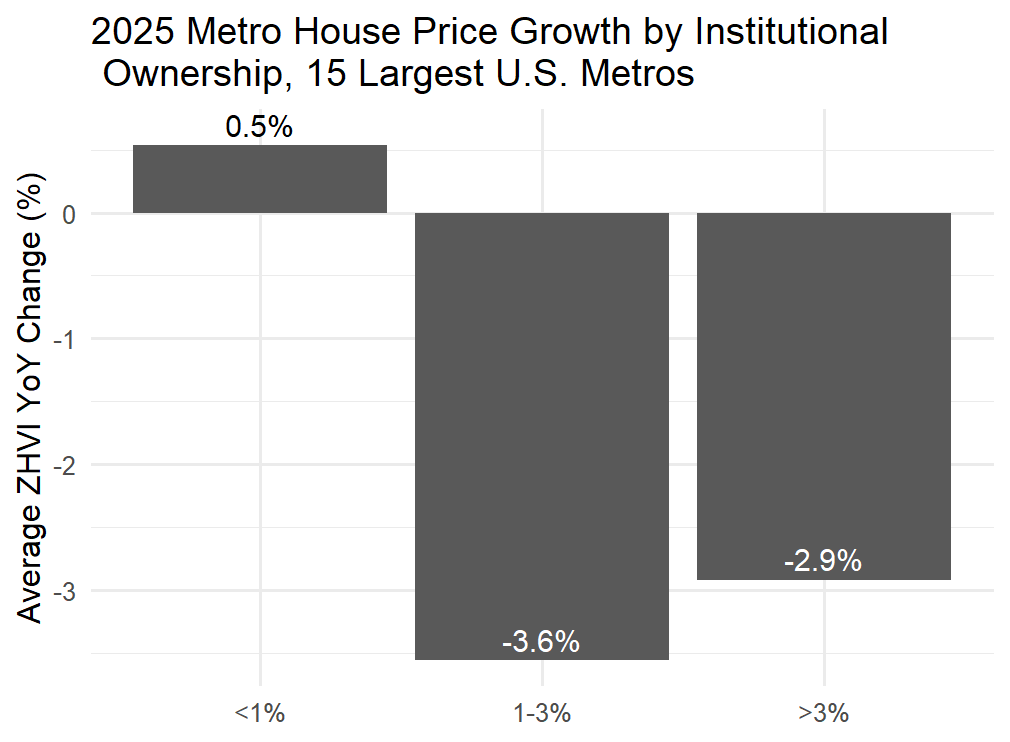
In the past year, housing prices have declined the most in markets where large institutional investors are concentrated. If we look at the largest 15 metro areas in the country, house prices have grown 0.5 percent in the markets with under one percent institutional ownership and fallen 3.6 percent in the markets with between one and three percent institutional ownership. In the only market with over three percent ownership (Atlanta), prices have fallen 2.9 percent.*
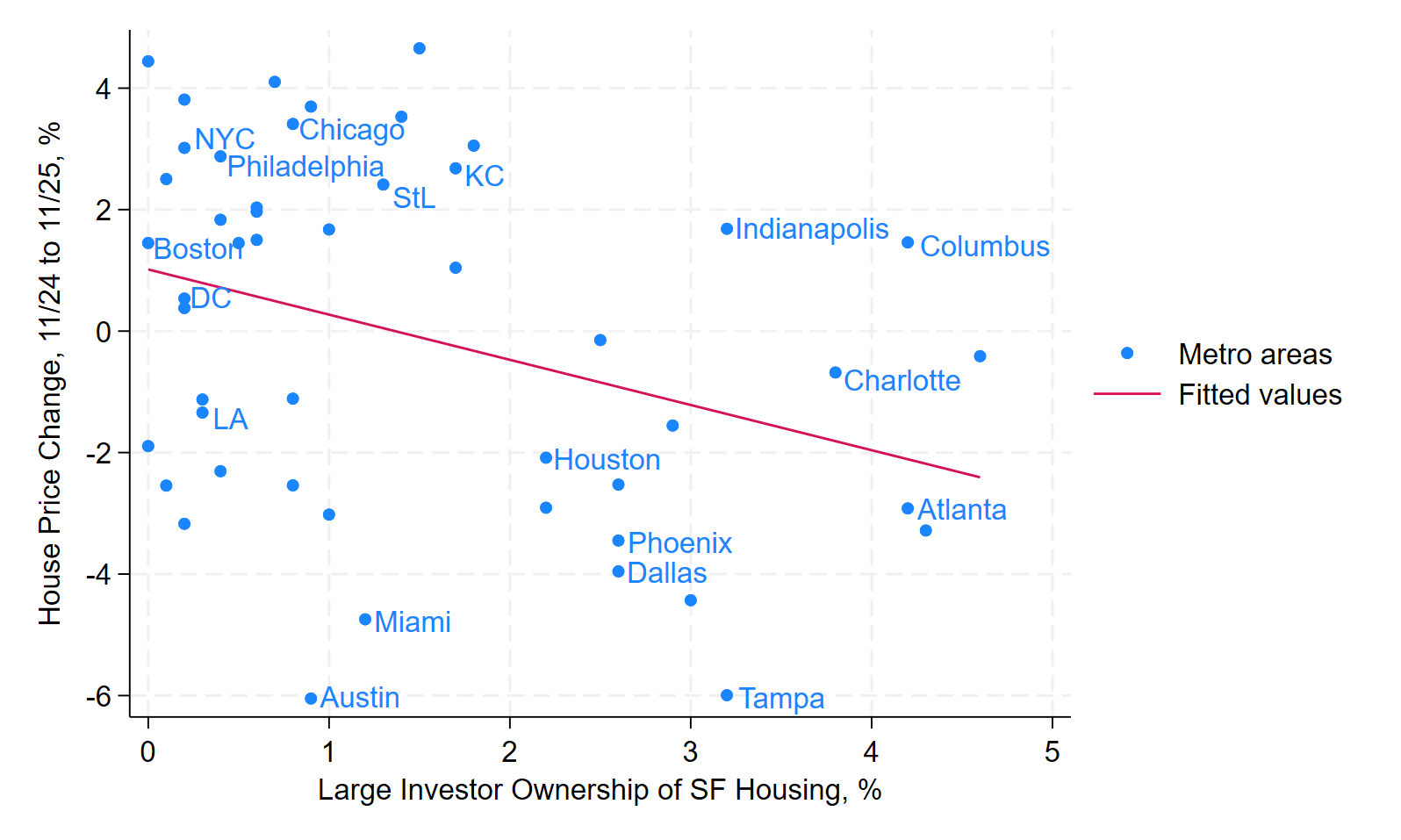
While correlation does not equal causation, these data certainly cast doubt on any claims that banning institutional investment will reduce house prices.
Left- and right-wing populists that want to ban institutional ownership of single-family homes will hurt the average American if they get their way. Institutional investors are increasing housing supply and making housing markets more liquid and less volatile. They help younger families and those of modest income gain access to desirable neighborhoods. Their upward impact on prices is tiny, and could even have reversed once we consider the new impact of build-to-rent development.
* These data are my own calculations based on data from the AEI Housing Center and the Zillow Housing Value Index. The ZHVI covers the 12 months from November 2024 to November 2025.
