

What Is Bloom’s Revised Taxonomy?
Bloom’s revised taxonomy is a guide for classifying learning goals based on how complex they are. It helps teachers and Instructional Designers organize learning from simple recall of facts to higher-order thinking skills. Unlike the original model, Bloom’s revised taxonomy emphasizes active learning instead of just listing static knowledge.
The framework was first introduced by Benjamin Bloom in 1956, where it primarily organized learning into knowledge-based categories. However, in 2001, the taxonomy was revised by Anderson and Krathwohl to better reflect modern learning needs. This updated version changed the structure and emphasis, making it more relevant for today’s Instructional Design and corporate learning environments.
The key difference between the original and revised Bloom’s taxonomy lies in the shift from nouns to verbs. Instead of describing what learners “know,” it now focuses on what learners “do” with that knowledge. This makes it more practical for writing learning objectives and designing measurable outcomes.
This change is why Bloom’s taxonomy levels are widely used in training, eLearning, and performance development today. It clarifies the cognitive domain keywords of Bloom’s taxonomy and helps connect learning to real-world applications.
In This Guide
What Are The Levels Of Bloom’s Revised Taxonomy?
Bloom’s Revised Taxonomy includes six levels, often visualized as a triangle or pyramid, moving from simple to complex cognitive processes. These Bloom’s taxonomy levels, explained below, show how learners build knowledge step by step and apply it in real-world situations.
Level |
Description (Cognitive Level Meaning) |
Sample Verbs (Bloom’s Taxonomy Words) |
Workplace Example |
Remember |
Recall basic facts and information. | define, list, recall, identify | Employee remembers compliance rules during onboarding. |
Understand |
Explain ideas or concepts in their own words. | describe, summarize, explain, interpret | Learner summarizes company policy in a training quiz. |
Apply |
Use knowledge in real situations. | apply, use, implement, execute | Employee applies a new CRM process in daily work. |
Analyze |
Break information into parts and examine relationships. | compare, differentiate, analyze, organize | The manager analyzes performance data to identify trends. |
Evaluate |
Make judgments based on criteria. | evaluate, justify, critique, assess | The team lead evaluates training effectiveness after the rollout. |
Create |
Produce new or original work. | design, develop, create, formulate | An Instructional Designer creates a new onboarding program. |
Using Bloom’s taxonomy cognitive domain keywords (verbs) is important because they turn abstract learning goals into clear actions. When applied correctly, these verbs help ensure that learning objectives match real-world work performance. This approach allows organizations to shift from merely “knowing” to actively “doing,” “thinking,” and “innovating,” thus making learning more effective and performance-focused.
Bloom’s Taxonomy Verbs Explained
The revised Bloom’s taxonomy levels are practical tools for designing learning objectives, assessments, and training experiences that align with real workplace needs. Each level uses specific verbs, which are not just writing tools but the foundation of effective learning design. The reason Instructional Designers rely heavily on Bloom’s revised taxonomy verbs is simple: verbs define what learners actually do. Specifically, using the right verbs helps ensure alignment between learning objectives, activities, and assessments. For example, “understand compliance rules” is unclear and hard to evaluate, while “explain compliance rules in workplace scenarios” is measurable and actionable. Below is a simple breakdown of the 6 levels of Bloom’s taxonomy and their verbs, with real examples relevant to corporate L&D.
1. Remember
At the base of the Bloom’s taxonomy pyramid is the “Remember” level. This focuses on basic recall of information. It is the starting point of all learning. At this stage, learners are not expected to interpret or analyze, but only to recognize or reproduce information.
Common Bloom’s taxonomy keywords here include: define, recall, list, identify, and name.
L&D Example
A compliance training module may ask employees to list the company’s data protection rules or define key policy terms. This ensures foundational knowledge is in place before deeper learning happens.
2. Understand
The “Understand” level focuses on making meaning from information. Learners move beyond memorization and begin to explain ideas in their own words. This level is essential for learning transfer because it shows whether learners truly grasp the concept rather than just remembering it.
Key verbs include: explain, summarize, interpret, and describe.
L&D Example
After reading a policy, employees may be asked to summarize its purpose or explain why data privacy is important in daily operations.
3. Apply
At this level, learners use knowledge in real situations. This is where theory becomes action. This is one of the most important stages in corporate training because it reflects job performance.
Common verbs: use, implement, execute, demonstrate.
L&D Example
A sales training program might ask employees to apply a negotiation technique during a simulated client conversation or a real customer interaction.
4. Analyze
The “Analyze” level is where learners begin to think critically. They break information into parts and examine relationships. This level supports stronger decision-making and problem-solving.
Keywords include: differentiate, compare, organize, and examine.
L&D Example
Managers may be asked to compare two performance reports and identify patterns that explain differences in team productivity.
5. Evaluate
At this stage, learners make judgments based on criteria. It is a key step in leadership development and strategic thinking.
Common verbs: judge, critique, justify, assess.
L&D Example
A team leader might evaluate two project proposals and justify which one better aligns with business goals and resource constraints.
6. Create
At the top of the revised Bloom’s taxonomy levels is “Create,” which focuses on innovation and original thinking. This level represents the highest form of cognitive engagement.
Key verbs include: design, build, formulate, and develop.
L&D Example
An Instructional Designer may be asked to design a new onboarding program that improves employee engagement and reduces time-to-productivity.
How To Use Bloom’s Taxonomy For Writing Learning Objectives
Bloom’s revised taxonomy is a helpful tool for Instructional Designers and L&D professionals. It allows them to translate learning needs into clear, measurable outcomes. Instead of writing vague goals, this approach helps you organize learning objectives by cognitive level. This ensures that each objective reflects a specific type of thinking and performance.
At its core, the taxonomy connects directly to business outcomes. Each level of Bloom’s taxonomy, from Remember to Create, supports a different depth of skill. When you align learning objectives with these levels, you move from “what learners should know” to “what learners should be able to do in real workplace situations.” This is especially important in corporate training, where impact matters more than content coverage.
A common issue in many programs is the use of vague language such as “understand,” “know,” or “be aware of.” These do not reflect measurable outcomes. However, by using Bloom’s taxonomy verbs, you can make objectives more precise and actionable.
For example:
- Weak objective: “Understand compliance.”
- Strong objective: “Analyze compliance risks in real scenarios.”
The weak version sits at a low, unclear cognitive level and is difficult to assess. The strong version uses the Analyze level of Bloom’s revised taxonomy, making it measurable and directly linked to workplace performance.
Another example:
- Weak: “Know how to use the CRM system.”
- Strong: “Apply CRM features to manage customer interactions effectively.”
This shift is what makes revised Bloom’s taxonomy so powerful for Instructional Design. It provides clarity, removes confusion, and ensures each learning objective targets a specific level of thinking.
Overall, when writing objectives, L&D professionals should always ask: What level of Bloom’s taxonomy does this belong to, and how will I measure it? This simple question changes learning design. It moves from general content delivery to structured, outcome-focused learning, aligning with different levels of understanding and educational principles.
Bloom’s Taxonomy In Corporate Learning Strategy
In corporate learning strategy, Bloom’s revised taxonomy is a practical guide that helps organizations design learning that actually improves performance. For decision-makers in L&D, HR, and talent development, it provides a structured way to move employees from basic knowledge acquisition to higher-order thinking and real-world application.
Upskilling Programs
When implementing Bloom’s taxonomy levels to corporate learning, it becomes especially useful for upskilling programs. Many organizations successfully deliver training at the lower levels, such as Remember and Understand, where employees recall information or explain concepts. However, modern workplaces require more than that. By intentionally designing learning experiences aligned with Bloom’s taxonomy of cognitive levels, organizations can ensure employees are not just informed but also capable of applying, analyzing, and creating solutions in real-world scenarios.
Leadership Development
In leadership development, Bloom’s taxonomy helps learners move from theoretical awareness to strategic thinking. For example, early-stage leaders may start by understanding policies and frameworks, but advanced development should push them to evaluate complex decisions and create innovative strategies. Using Bloom’s taxonomy verbs in learning objectives ensures that leadership programs are measurable and guided by action, rather than abstract or passive.
Digital Learning
Within digital learning ecosystems, Bloom’s taxonomy helps structure content across platforms and formats. Microlearning modules, simulations, and assessments can each target different levels of Bloom’s taxonomy, ensuring a balanced learning journey. A well-designed ecosystem avoids overloading learners with content that only targets recall and instead builds capability progressively.
Bloom’s Taxonomy Chart, Grid, And Visual Models
Bloom’s Revised Taxonomy is often easier to understand when it is shown visually. That is why many Instructional Designers rely on tools such as Bloom’s taxonomy charts, grids, or the well-known taxonomy triangle (Bloom’s pyramid). These visual models help translate abstract learning theory into something practical for course design and assessment planning.
Bloom’s Pyramid
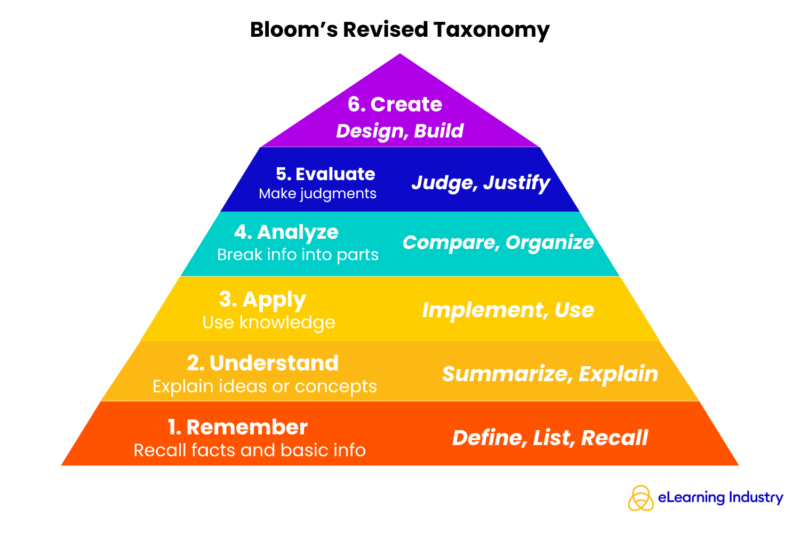
The Bloom’s pyramid, also commonly referred to as the Bloom’s levels of taxonomy visual, represents the six cognitive levels in a clear hierarchy. At the base are lower-order thinking skills, such as Remember and Understand, while the top of the pyramid focuses on higher-order thinking, such as Evaluate and Create. This helps L&D professionals quickly see how learning should progress from basic knowledge to advanced thinking skills. In many modern Bloom’s taxonomy images, the pyramid is updated with action verbs to reflect the revised Bloom’s taxonomy, making it more aligned with real learning outcomes.
Bloom’s Taxonomy Triangle
Another common model is the taxonomy triangle. This model shows the same structure but focuses on how people progress and move between levels rather than simply following a strict order. It’s often used in visual storytelling or to explain Bloom’s taxonomy to people who aren’t academics. It emphasizes that learners gain in complexity over time rather than staying at one level.
Bloom’s Taxonomy Grid
The Bloom’s taxonomy grid is practical and commonly used in instructional design. It helps connect different levels of thinking with learning activities or assessments. This alignment allows designers to match Bloom’s taxonomy objectives with measurable outcomes and ensures a balance of thinking skills in training content. Many organizations also create their own templates or charts based on this grid for developing courses.
Bloom’s Revised Taxonomy Vs. Original: Key Differences
Bloom’s Revised Taxonomy (often called revised Bloom’s taxonomy or updated Bloom’s taxonomy) builds on the original framework developed by Benjamin Bloom. While both models are widely used in education and corporate learning, they differ in terminology, structure, and application in modern Instructional Design.
Nouns Vs. Verbs
The original Bloom’s Taxonomy (1956) used noun-based categories such as Knowledge, Comprehension, Application, Analysis, Synthesis, and Evaluation. In contrast, Bloom’s revised taxonomy, introduced in 2001, shifts to verb-based categories: Remember, Understand, Apply, Analyze, Evaluate, and Create. This change reflects a stronger focus on action and measurable learning outcomes.
Structure
In terms of structure, the original model is often represented as a strict hierarchical pyramid in which learners must master lower levels before progressing to higher ones. This is still commonly used to visualize both models. However, the revised version is more flexible and dynamic. It recognizes that learning is not always linear and that learners may operate across multiple cognitive levels simultaneously.
Outcomes
The actionable outcomes are especially important for Instructional Designers and L&D professionals. The revised model makes it easier to write learning objectives using action-oriented verbs. These verbs help define measurable outcomes, such as “analyze customer data” or “create a training plan,” instead of vague statements like “understand data.”
Verdict: Which One Is Better?
The updated version improves assessment design, performance tracking, and skill alignment. It suits today’s workplaces, where workers need to apply, evaluate, and create knowledge rather than just remember it. Both models are based on the same ideas, but their differences are clear. The revised model shifts from organizing knowledge in a fixed way to focusing on learning through action. This makes it more useful for today’s needs in Instructional Design and talent development.
Conclusion
Bloom’s Revised Taxonomy still matters because it is a practical thinking tool for designing meaningful learning experiences. It helps Instructional Designers and educators move beyond content delivery and focus on how people actually learn and apply knowledge. In corporate learning, it supports better learning design by aligning objectives with real skills rather than just theory. It also helps organizations measure learning impact more clearly and consistently. Most importantly, it drives performance by ensuring training leads to action, problem-solving, and real workplace outcomes, rather than stopping at knowledge recall or passive understanding.
Frequently Asked Questions (FAQ) About Bloom’s Revised Taxonomy
Bloom’s revised taxonomy is a framework used in education and Instructional Design to classify learning objectives into cognitive levels. It helps educators structure learning from basic knowledge recall to higher-order thinking skills like analysis, evaluation, and creation.
It was revised to better reflect how learning actually happens. The original model focused on nouns (knowledge categories), while the revised version focuses on verbs (active thinking). This makes it more practical for writing learning objectives and designing assessments.
It was revised by a group of cognitive psychologists, led by Lorin Anderson, a former student of Bloom, and David R. Krathwohl, one of Bloom’s partners.
The revised Bloom’s taxonomy includes six cognitive levels: Remember, Understand, Apply, Analyze, Evaluate, and Create. These levels represent a progression from basic recall of information to advanced creative thinking and problem-solving.
- Remember – Recall facts (e.g., list key terms)
- Understand – Explain ideas (e.g., summarize a concept)
- Apply – Use knowledge (e.g., implement a process)
- Analyze – Break down information (e.g., compare data sets)
- Evaluate – Justify decisions (e.g., critique a method)
- Create – Produce new work (e.g., design a solution)
Bloom’s taxonomy is a framework for describing different levels of thinking in learning. It starts from remembering basic information and moves up to creating new ideas or solutions.
Bloom’s taxonomy is a learning framework that organizes thinking skills into levels. It was originally developed in 1956 by Benjamin Bloom and later revised in 2001 by Anderson and Krathwohl to make it more action-oriented and practical for modern education and training design.
