

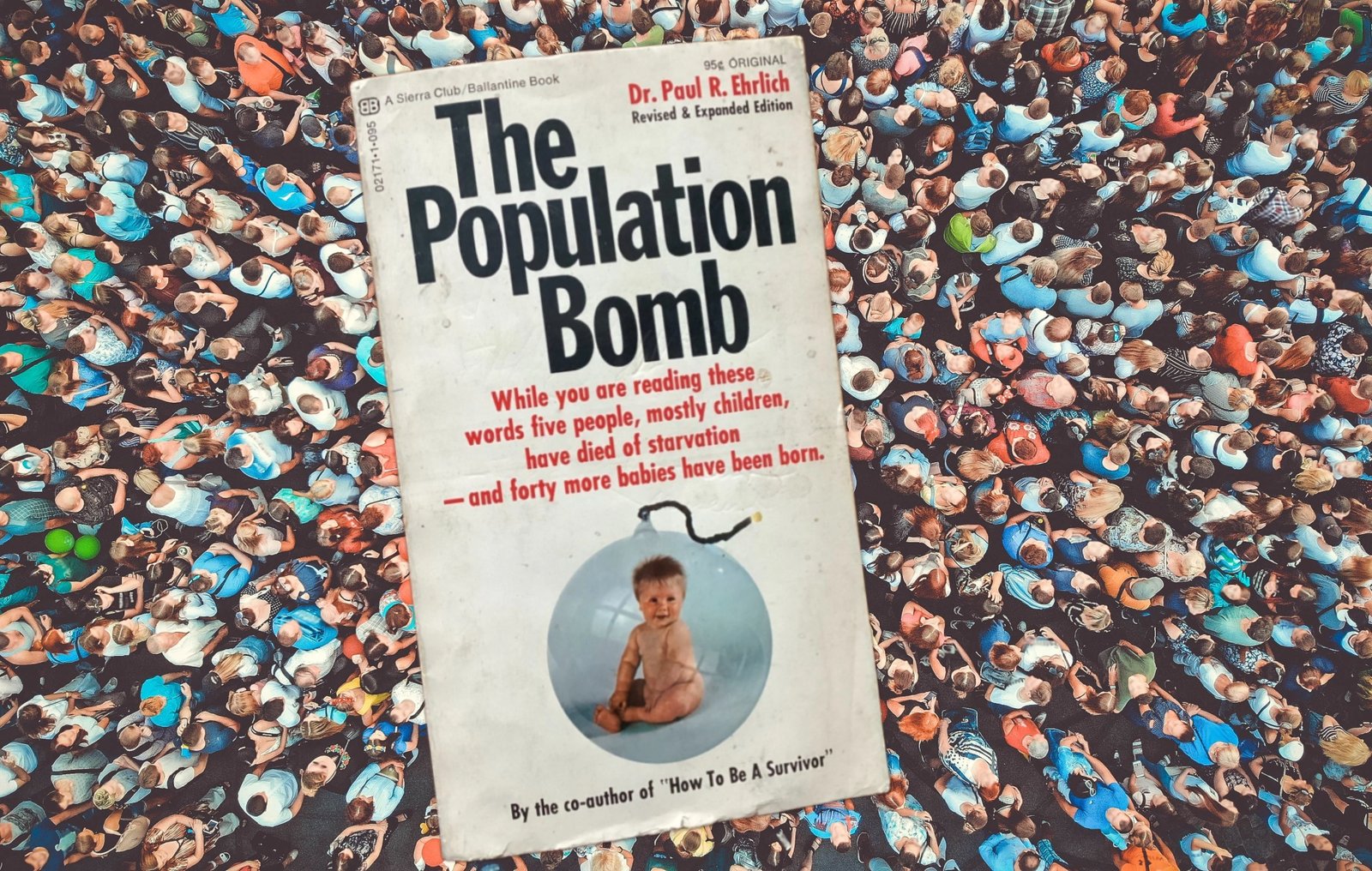
Paul Ehrlich, famed biologist, died last week at age 93. Ehrlich rose to fame in the 1960s as the author of a book that resonated powerfully with the public, The Population Bomb, and became a recurring guest on late-night talk shows and a frequent subject of discussion in all the major newspapers. The even more famous Johnny Carson, interviewing him in 1980 — more than a decade after the book’s publication, a sign of its lasting impact — said he generated “more mail than any guest we ever had on the show.”
All in all, he appeared 25 times on one of history’s most famous talk shows.
The Population Bomb arrived at the right time: economic growth was fast across the world, and so was population growth. Given finite resources, population growth (at 3.5 billion people in 1968) would outstrip food production and deplete the stock of key resources (think metals, fossil fuels, farmable land). Eventually, Ehrlich argued, starvation would occur, mass famines would follow, and social collapse would take place. Whatever technological progress could be achieved would only delay the inevitable — and only do so trivially.
To stave off the chain reaction, Ehrlich suggested, economic growth would need to slow down. Overpopulation should be curtailed by discouraging large families, possibly with coercive population control measures. However, Ehrlich did not stop there. He proposed that the Federal Communications Commission should discourage media that portrayed large families positively. He argued for immigration restrictions because allowing the poor of the world to come to America would accelerate their consumption and hasten the collapse. He argued that international aid should be tied to conditions requiring other nations to slow down population growth. All his policy proposals ended up being calls for greater coercion and greater control.
Ultimately, he was proven wrong. We now have more than twice as many humans on this planet as when Ehrlich wrote his doomsday prophecy. We live longer, healthier, wealthier, safer lives on a planet that has, on many dimensions (but not all), grown cleaner. None of the extreme predictions came to pass. Technological innovations were not trivial — they were exceptional. The Green Revolution, improvements in transportation, improvements in energy efficiency have all staved off the predicted catastrophe.
Ehrlich’s intellectual nemesis — population economist Julian Simon — had long argued that humans were capable of producing economic growth and reducing environmental impacts, and of creating and innovating our way out of these problems. Humans, in Simon’s view, were The Ultimate Resource. In all the obituaries for Ehrlich, Simon is mentioned for his contrarian optimism (often labeled Cornucopianism) and for having bet on these outcomes against Ehrlich.
But, in the midst of all the commemorations, claims of vindication, and assertions that Ehrlich was merely “premature,” something has been forgotten: Paul Ehrlich lost even within the environmental movement he had helped fuel. His views have been largely and subtly, not always explicitly, abandoned — in favor of those of Julian Simon.
To see why, think about the explicit premise that Ehrlich held: humans are mouths to feed, polluters, and ultimately trespassers in the ecosystem. In other words, for the biologist that he was, they were a form of parasite. If a population grows too large, correction must come through extinction since the parasite kills the host. Human ingenuity plays little role; at best, it is trivial. After all, a parasite is a parasite. If the parasite innovates, it is to be a better parasite. Humans are not creators or even equal creatures, but burdens upon the ecosystem.
From that premise, it follows naturally that some degree of population control (including coercion) could be justified. Indeed, this view warrants a normative stance that says that some humans are dispensable or can be subjected to things that most would (and did, when Ehrlich’s proposals were applied) find morally repellent.
In contrast, Simon’s view was that humans are not merely consumers. We are creators. Given the right institutions, we can solve environmental problems through innovation. The real question is not population, but the institutional framework within which people operate. In fact, Simon frequently pointed out that Ehrlich’s prediction could come true because of the policies he proposed. Innovation rarely happens under compulsion. Innovation requires open environments that encourage it. Being a libertarian, he argued that the most extreme environmental disasters occurred in coercive regimes such as the USSR, Communist China, and Castro-led Cuba. That coercion is similar in nature (though not in intent) to what Ehrlich desired. Simon also argued that in uncoerced, free-market economies, improvements and innovations emerge to solve problems as they arise.
In Simon’s view, institutions mattered above all else. The term is broad, to be sure. Classical liberals, conservatives, and libertarians — closer to Simon — tend to emphasize secure property rights, open markets, and free trade as drivers of innovation. Social democrats, centrists, and progressives, by contrast, often use the “institutions” to mean a capable state that regulates to solve problems. In their view, markets alone are not sufficient. Government intervention, such as pricing pollution, is justified as a way to change behavior and spur innovation by aligning private incentives with social costs. In this sense, “institutions” carries very different meanings across perspectives.
But this is also where it becomes clear that Paul Ehrlich lost the argument. Consider the case of a carbon tax. Its justification rests on the idea that pricing pollution changes behavior and encourages innovation — not that humans are parasites, but that they respond to incentives. The premise is cooperation, not coercion born of scarcity panic.
All of these perspectives share a crucial assumption: humans are capable of solving problems. Environmental outcomes depend on incentives and institutions, not on reducing the number of “mouths.” In that sense, even Ehrlich’s opponents across the ideological spectrum converge on a common conclusion: humans are not parasites, but the ultimate resource.
This was not always the case. Environmental movements from the 1940s through the 1970s were far more receptive to Paul Ehrlich’s view. Many on the left and the right accepted his core premise, and for a time it was dominant. Today, it is not merely contested; it has largely been abandoned, even by those who neither cite nor sympathize with Julian Simon.
This is the real defeat of Ehrlich — even where one could think he had the most support, he lost ground. His core premises have been largely abandoned by all except the most extreme. In a way, Ehrlich died well after his ideas did.
And those ideas were truly horrible for human welfare. I do not rejoice in Ehrlich’s death. I will, however, dance on the tomb of his ideas and you should too. And when dancing, I will wear my “Julian Simon Fan Club” pin.
