


For decades, US dollar dominance rested on a simple but profound foundation. Predictable institutions made the dollar stable, on the belief — sometimes overstated — that the United States would not deliberately undermine its own currency. That belief is now visibly eroding.
The dollar has fallen to its weakest level in nearly four years, not because of a recession or crisis at home, but because investors are increasingly uneasy about the direction of American policy. Against a basket of other currencies, the US dollar is approaching the lows seen during the COVID pandemic as markets are beginning to price in something more corrosive than cyclical weakness. Political and institutional risk is emanating from Washington itself.
Bloomberg Dollar Index, 2020 – present
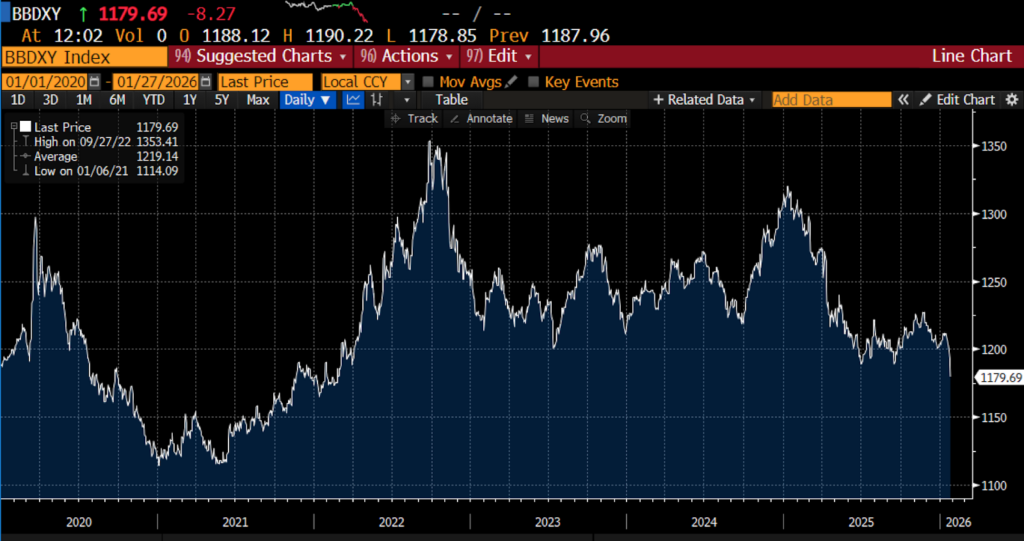
The immediate catalysts are not difficult to identify. A barrage of radical policy proposals — universal tariffs, explicit talk of engineering a weaker dollar to boost exports , revived speculation around a so-called Mar-a-Lago Accord, and even loose discussion of restructuring Treasury obligations — has injected deep uncertainty into currency markets. Add to that overt efforts to pressure the Federal Reserve toward lower interest rates, including attempts to shape the future composition of the FOMC, and the result is a growing conviction that the dollar is less insulated from political whim than at any point in recent history. Currency traders are responding accordingly. Options markets now show the most expensive hedges against dollar weakness since records began in 2011, while positioning across major currencies reflects a decisive shift away from the greenback.
What distinguishes this episode from earlier periods of dollar weakness is not simply the magnitude of the decline, but its character. Historically, the dollar tended to soften when global growth strengthened or when US monetary policy eased relative to its peers. Today, the US economy continues to perform reasonably well by conventional measures, yet the dollar is underperforming nearly every major peer currency. That disconnect is telling. Investors are no longer reacting solely to interest rate differentials or growth forecasts; they are embedding a political risk premium into the currency itself. Unpredictable Washington policymaking, threats against allies, widening fiscal deficits, and open speculation about currency coordination have transformed what was once a safe-haven asset into a policy-contingent one.
The renewed debate over coordinated foreign exchange intervention underscores that shift. Reports that US authorities have been checking dollar-yen levels, a step often associated with preparatory intervention, have revived memories of the 1985 Plaza Accord era, when the dollar was deliberately driven lower through multinational agreement. Whether or not any formal coordination ultimately emerges, the signal matters more than the mechanics. Markets interpret these gestures as tacit approval of dollar depreciation, particularly when paired with rhetoric favoring export competitiveness over currency stability. Once traders suspect policymakers are tolerant of a weaker currency, or actively seeking one, the long dollar trade becomes structurally fragile.
US Dollar Index versus gold price per ounce, Jan 2025 – present
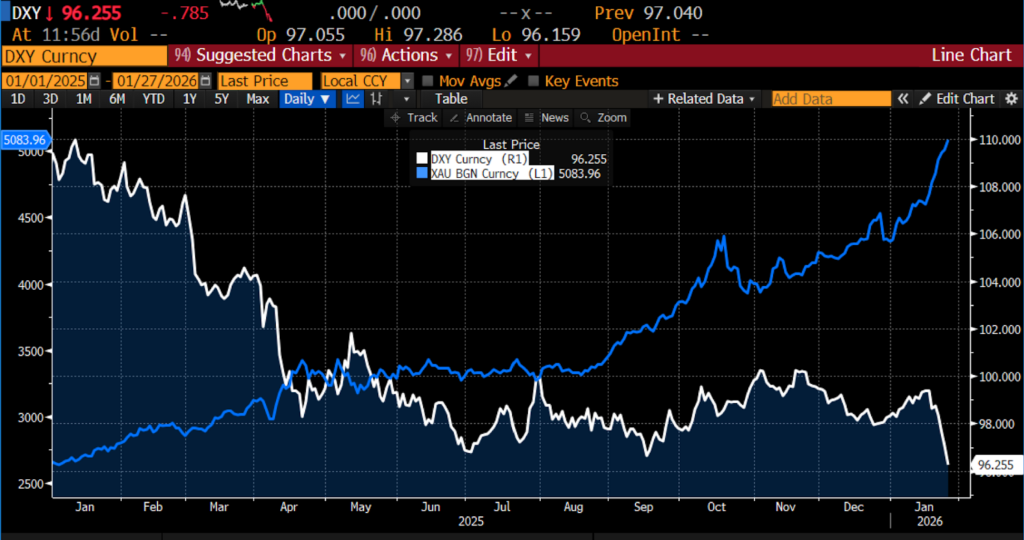
This erosion of confidence is unfolding alongside a powerful and sustained rise in gold. Prices have surged above $5,000 an ounce after climbing roughly 85 percent over the past year. Silver, while more volatile and less purely monetary, has followed in its wake. These are not speculative curiosities; they are signals. Gold has long served as a barometer of trust in paper claims, especially when fiscal discipline and monetary independence come into question. That institutional investors, central banks, and sovereign wealth funds are among the largest buyers reinforces the point. This is not retail exuberance, but strategic reallocation.
The motivations behind this shift are straightforward. Large deficits, rising debt burdens, and persistent questions about the future independence of the Federal Reserve all raise doubts about the long-term purchasing power of dollar-denominated assets. When political actors treat interest rates, exchange rates, and even sovereign debt structure as tools to be manipulated for short-term advantage, investors naturally seek refuge in assets that lie outside the policy sphere altogether. Gold does not rely on promises, committees, or continuity of leadership. Its appeal rises precisely when those things appear uncertain.
This environment also helps explain the renewed seriousness of discussions around dedollarization. Contrary to some caricatures, dedollarization does not require the sudden collapse of the dollar or the emergence of a single rival currency. It is a gradual process of diversification: more trade invoiced in non-dollar currencies, more reserves held in gold or alternative assets, and more systematic hedging against dollar exposure. Recent strength in the euro, renewed interest in Asian currencies, and record highs in emerging market currency indices all point in this direction. When even long-standing US partners begin to question the durability of American policy commitments, diversification becomes a rational response rather than an ideological statement.
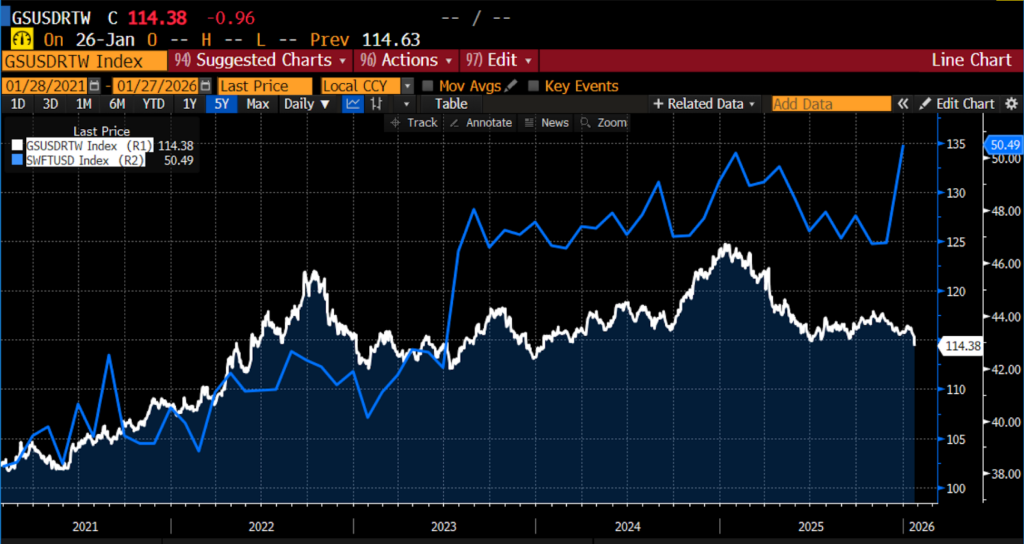
The rise in the dollar’s share of SWIFT transactions from roughly 38 percent five years ago to a little over 50 percent today does not, by itself, imply that the dollar is being adopted by more participants or that it has become structurally “stronger.” The SWIFT metric captures the share of transaction value denominated in a currency, not the number of users or the depth of confidence behind it, and that distinction is crucial. Over the past five years, higher US inflation has mechanically lifted nominal dollar transaction values even where real trade volumes have not increased, inflating the dollar’s apparent share without signaling greater monetary centrality.
At the same time, repeated episodes of geopolitical stress and financial volatility have driven derisking behavior, in which assets are liquidated, and capital is repatriated through dollar channels, temporarily boosting dollar settlement activity even as the longer-term appetite for dollar assets weakens. Legacy invoicing conventions in commodities, shipping, and trade finance also change slowly, meaning dollar usage can remain dominant or even rise in aggregate while marginal flows quietly diversify elsewhere. Taken together, the increase in SWIFT share over this period is better understood as a reflection of inflation, crisis-driven liquidity demand, and institutional inertia than as evidence of renewed confidence in the dollar’s long-run strength.
Real Trade-Weighted US Dollar and USD percent in SWIFT, Jan 2021 – present
Ironically, many of the policies intended to bolster US competitiveness may be accelerating this very shift. Tariffs invite retaliation and fragment trade relationships. Efforts to weaken the dollar to support exporters risk undermining confidence in US financial markets, which have long been among the country’s greatest competitive advantages. Pressure on the Federal Reserve blurs the line between monetary policy and politics, weakening the institutional credibility that supports low borrowing costs, and anchors inflation expectations.
Markets, however, are rarely sentimental. They respond to incentives, signals, and risks as they appear, not as policymakers wish them to be interpreted. The dollar’s slide, the surge in gold, and the growing urgency of dedollarization discussions are all manifestations of the same underlying judgment: that the rules governing US economic policy are becoming less stable, less predictable, and more politicized.
Until that perception changes, skepticism toward the dollar and demand for monetary hedges are unlikely to fade.
