

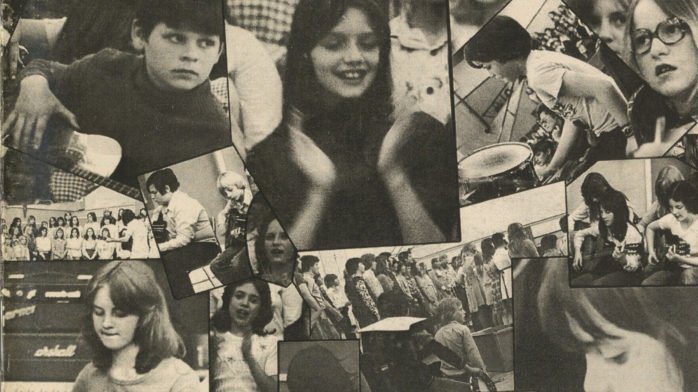
In 1976 and 1977 an inspired music teacher in the small school district of Langley Township, British Columbia, a suburb of Vancouver, recorded his elementary school students singing popular songs in a school gym. Two vinyl records were produced over the two years, and families were invited to pay $7 for a copy. The recordings were largely forgotten — just another personal memento stored away in a few homes in Western Canada — until a record collector stumbled across a copy in a thrift store in 2000.
Enthralled by what he heard, the collector sent a sample to a disc jockey at WFMU, an eclectic, listener-supported radio station in New Jersey. The station began playing some of the songs over the airwaves. Listeners were touched by the haunting, ethereal quality of the performances. In 2001, a small record company released a compilation called The Langley Township Music Project: Innocence & Despair.
The record became an underground hit. The Washington Post called it “an album that seems to capture nothing less than the sound of falling in love with music.” Spin said the album “seems to sum up all the reasons music is holy.” And Dwight Gamer of The New York Times wrote that the music was “magic: a kind of celestial pep rally.” Listeners were moved by the ingenuousness of the young voices, the strange authenticity of performances by children too young to understand all of the adult themes in the lyrics. As Hans Fenger, the music teacher who made the recordings, writes in the liner notes:
The kids had a grasp of what they liked: emotion, drama, and making music as a group. Whether the results were good, bad, in tune or out was no big deal — they had élan. This was not the way music was traditionally taught. But then I never liked conventional “children’s music,” which is condescending and ignores the reality of children’s lives, which can be dark and scary. These children hated “cute.” They cherished songs that evoked loneliness and sadness.
You can learn the story of Fenger’s extraordinary music project in the 2002 VH1 documentary above, which includes interviews and a reunion with some of the students. And listen below for a few samples of that touching quality of loneliness and sadness Fenger and others have been talking about.
David Bowie’s ‘Space Oddity’:
One of the most widely praised songs from Innocence & Despair is the 1976 recording of David Bowie’s “Space Oddity.” In a 2001 interview with Mike Appelstein for Scram magazine, Fenger explained the sound effects in the recording. “When I first taught ‘Space Oddity,’ ” he said, “the first part I taught after the song was the kids counting down. They loved that: they’d go ‘TEN!’ They couldn’t say it loud enough; the countdown in the song was the big winner. But as soon as they got to zero, nothing happened. So I brought this old steel guitar. Well, one of the little guys whose name I’ve forgot, I put him on this thing and said, ‘Now listen, when they get to zero, you’re the rocket. So make a lot of noise on this. He’s fooling around with this steel guitar, and I didn’t even think of this, but he intuitively took out a Coke bottle from his lunch and started doing this (imitates a bottle running up and down the fretboard). I just cranked up the volume and turned down the master volume so it was really distorted. And that was the ‘Space Oddity’ sound effect.”
The Beach Boys’ ‘In My Room’:
The children recorded “In My Room” by the Beach Boys in 1977. Fenger told Appelstein it was the ultimate children’s song. “It’s the perfect introspective song for a nine-year-old,” he said, “just as ‘Dust in the Wind’ is the perfect philosophy song for a nine-year-old. Adults may think it’s dumb, but for a child, it’s a very heavy, profound thought. To think that there is nothing, and it’s expressed in such a simple way.”
The Eagles’ ‘Desperado’:
Several of the recordings feature soloists. A young girl named Sheila Behman sang the Eagles’ “Desperado” in 1977. “With ‘Desperado,’ ” said Fenger, “you can see it as a cowboy romantic story, but that’s not the way Sheila heard it. She couldn’t articulate metaphorically what the song was about, but in that sense, I think it was purer because it was unaffected. It’s not as if the kids were trying to be somebody else. They were just trying to be who they were, and they’re doing this music and falling in love with it.”
Note: An earlier version of this post appeared on our site in 2013.
Related Content
David Bowie Urges Kids to READ in a 1987 Poster Sponsored by the American Library Association
When David Bowie Launched His Own Internet Service Provider: The Rise and Fall of BowieNet (1998)
How David Bowie Used William S. Burroughs’ Cut-Up Method to Write His Unforgettable Lyrics
