


Hasan Piker, the far-left political commentator and streamer, has enjoyed a remarkable rise into the mainstream left media ecosystem. He has now campaigned alongside Democratic Senate candidates, been a guest on some of the largest podcasts in America, and appeared on CNN and NBC News. Most recently, the New York Times published a conversation between Piker, the paper’s culture editor Nadja Spiegelman, and the New Yorker writer Jia Tolentino. The topic: is theft ever justified?
In their conversation, Tolentino argues that “stealing from a big box store … [is not] very significant as a moral wrong.” Piker’s response in agreement: “I’m pro stealing from big corporations, because they steal quite a bit more from their own workers.”
Piker and his interlocutors are at least self-aware enough not to want to justify theft against everyone, so they conveniently set limits to when stealing is acceptable. When asked if it would be acceptable to steal from Zohran Mamdani’s city-owned grocery stores, Piker responds, “No, I would not, because I feel like that’s taxpayer-funded, it’s union labor, and the prices are also adjusted regardless.”
In other words, theft’s only okay when it comes to the bourgeoisie — they have no right to property because the system is unjust. As Spiegelman puts it, “Jeff Bezos has too much money — he’s a billionaire — so why should I have to pay for organic avocados?”
Microlooting, as they call it, “has a slight political valence to theft, as opposed to just the thrill of getting away with something.” Microlooting, in other words, is theft as a form of political protest. But fundamentally, microlooting is still just theft. “[I]f it was as easy as pirating intellectual property, I would” steal a car, Piker clarified. Thus, there may be an appeal to “political protest” but the practical criteria just seems to be viability.
And whether the Times’ trio only justifies stealing from the wealthy or justifies stealing broadly, the same result emerges — that they are dismantling the building blocks of our civilization. Liberal democratic capitalism — the system that all three have benefited immensely from — relies on some basic precepts. John Locke articulated these as natural rights to life, liberty, and property. Adam Smith argued that commerce and manufacturing cannot flourish “in which the people do not feel themselves secure in the possession of their property.” And property rights aren’t even just economically useful, but they’re also a necessary condition for liberty broadly. As F.A. Hayek argued, “There can be no freedom of the press if the instruments of printing are under government control, no freedom of assembly if the needed rooms are so controlled, no freedom of movement if the means of transport are a government monopoly.”
And the natural rights at the center of liberal democratic capitalism are not given or taken away, based on who the right-bearer is. The Declaration of Independence’s radicalism was in part because it promised “inalienable rights” to “all men.” The promise of natural rights was never just to people of only a certain ethnicity, nationality, or religion. So too with wealth. Everyone can agree the poorest in our society deserve the same rights to life, liberty, and property as the most wealthy. But reverse that statement, and agreement becomes far less universal. But there’s no difference. If you believe that wealth shouldn’t be a determining factor in someone’s rights, then you should believe that in all cases.
And even putting the moral question aside, the preservation of property rights — with its attendant injunction against stealing — provides us with the predictability necessary for economic flourishing. Piker assumes that the stability of our society is naturally occurring. It is not. Each time he receives payment from Twitch, swipes his credit card, or purchases a service, he assumes that the set of rules necessary for a functioning capitalist society will persist. And the preservation of property is fundamental to that predictability. One study, for example, found that governments going from no cadastral system (records of land ownership) to a full cadastre system is associated with an immediate 2.86 percentage point increase in GDP per capita.
Piker’s dismissiveness of the very foundations of our society suggests that there is some better alternative to liberal democratic capitalism. As yet, there is not.
For 250,000 years, the average person — everywhere — lived off effectively no more than $3 a day. But that all changed roughly 300 years ago, with an unprecedented explosion in global prosperity that lifted the vast majority of people out of poverty.
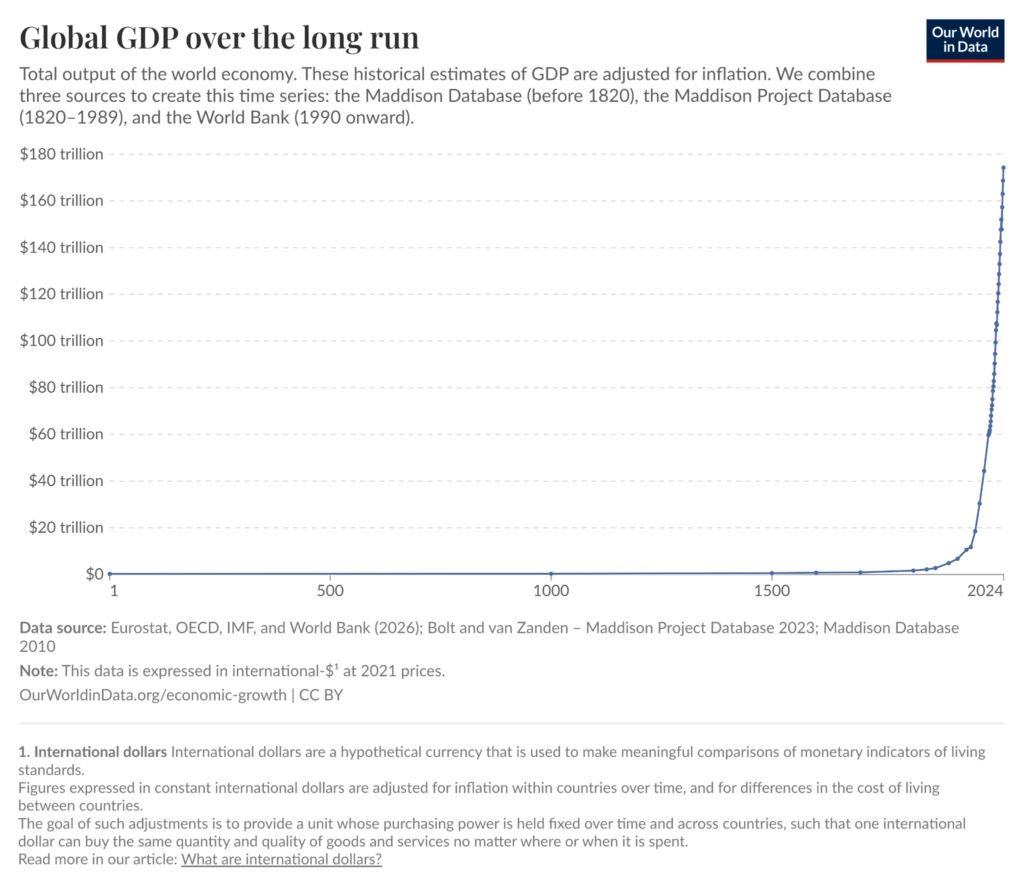
The alternative to our current prosperity is poverty, disease, authoritarianism, tribalism, violence, and an early death — staples of pre-capitalist human existence.
But Hasan Piker isn’t the first person to feel resentful for the conditions created by capitalism — not nearly. Joseph Schumpeter in Capitalism, Socialism, and Democracy was pessimistic about the future of capitalism because of the potential anti-capitalism of a modern intellectual class. For Schumpeter, capitalism unlocked so much productivity that it freed a portion of humanity from the direct world of commerce and work. In other words, capitalism creates a class of people who deal in ideas but are disconnected and alienated from the very system that made it possible for them to deal in ideas. And eventually that disconnect leads to criticism of capitalism.
Discontent breeds resentment…. and it often rationalizes itself into the social criticism which … is the intellectual spectator’s typical attitude toward men, classes and institutions…. The role of the intellectual group consists primarily in stimulating, energizing, verbalizing, and organizing this material [of anti-capitalist sentiments and resentments]…. The intellectual group cannot help nibbling … at the foundations of capitalist society.
Schumpeter’s analysis applies to Piker to be sure but Piker’s only the most recent example in a long train of privileged activists and revolutionaries. Among others, Fidel Castro, Salvador Allende, Pol Pot, and Mao Zedong were all born into wealthy families. And this trend is visible from the very beginning of Marxism. As the historian Sean McMeekin pointed out in his 2024 book on the history of communism: “Marx’s social radicalism did not arise from his own economic situation or any unpleasant experience of business or factory life.” In fact, Marx was “kind of a perennial student,” McMeekin wrote, both chronically in debt and financially dependent. Marx’s income came from collaborator and patron Friedrich Engels, who could only afford to fund Marx’s freeloading lifestyle with profit from his factory and cotton trading. Marx’s work was directly supported by the capitalist system both men resented.
This pattern also holds true demographically. A 2018 study on the breakdown of American political factions found that progressive activists “are nearly twice as likely as the average [American] to make more than $100,000 a year,” and “are nearly three times as likely to have a postgraduate degree.” An earlier study of student political organizations found that far-left student activists came predominantly from upper-middle-class backgrounds, while far-right activists were more often lower-middle-class or working-class.
And the problem’s only getting worse at some of our most elite educational institutions. Writing for The Harvard Crimson, Julien Berman found that in 2000 “the opinions of student writers at elite universities … weren’t all that more progressive than those at non-elite ones.” But “[o]pinion sections at elite universities have gotten significantly more progressive,” he writes, with The Crimson being “over three times more progressive in 2023 than it was in 2001.”
Some may object that the relative affluence and education of progressive activists proves the truth of their views — after all, shouldn’t we take more seriously the opinions of the most educated in our society? But to even ask the question requires assuming that left-wing activists arrive at their positions based on well-reasoned arguments rather than, as Schumpeter points out, a resentment for the very system that made their status, comfort, and influence possible in the first place.
Education doesn’t displace human nature. And to take a line from another great thinker, “[e]xperience suggests that if men cannot struggle on behalf of a just cause because that just cause was victorious in an earlier generation, then they will struggle against the just cause.” That is human nature — and no amount of education will change that. And ultimately, Hasan Piker is just the latest left-wing activist to take advantage of that fact in appealing to affluent, educated left-wingers who would rather struggle in resentment against our system than to be grateful for their deliverance from poverty.
