

By Katie Azevedo, M.Ed.
Dual coding is a study strategy that can shorten how long you study and increase how much you learn.
Dual coding works best when combined with other study methods, especially interleaved practice, the Feynman technique, and any study method using active recall.
This is because no single study method guarantees complete and perfect understanding. Study methods are meant to be used in combination with other study methods. We can change our study method combinations depending on what we’re studying and how long we have before a test.
In this blog post, I’m going to show you what dual coding is, explain how it works, and teach you exactly how to use it to study for your next test or exam.
What is Dual Coding?
Dual coding is the process of combining words and visuals to learn something more deeply and thoroughly.
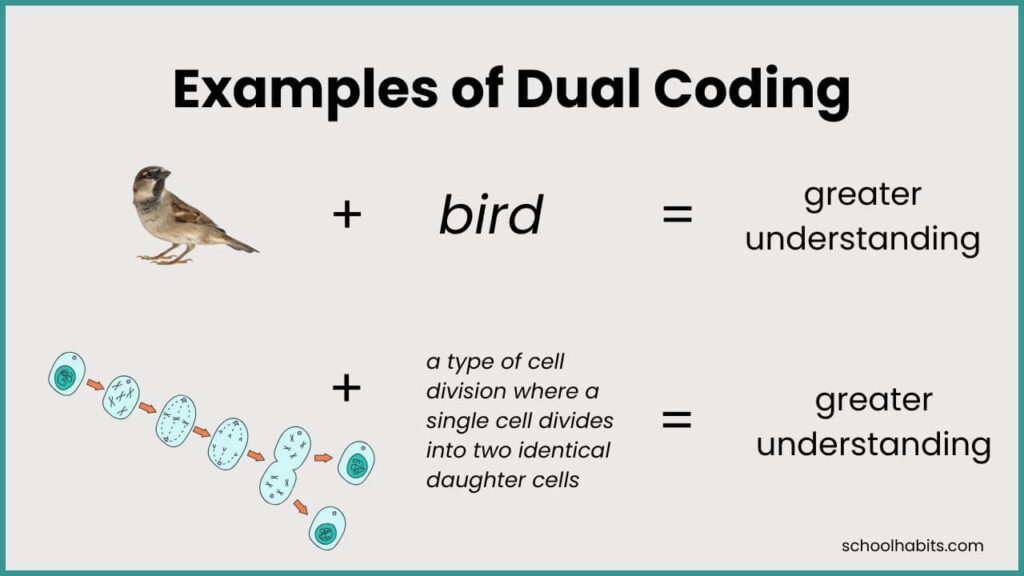
Example: When you’re young, you learn that “bird” is the word for a certain kind of flying mammal. You’re also shown a picture of a bird and told it’s a bird. Now you have two ways to store and recall the concept of a bird – B I R D spelled out, as well as an image.
Whenever we learn something new in the form of words AND pictures, we essentially store that concept in two different formats in our brain. This gives our brain more ways to retrieve that information later when we need it, like for a test, exam, or class discussion.
You’ve already been exposed to dual coding at school. Many teachers deliberately pair words and visuals together during classroom instruction because they understand this approach can help you (the student) learn better. For example, you’re probably used to hearing a teacher explain something to the class while also showing some kind of visual on the board or in a slide presentation. This is dual coding from a teaching perspective.
The point of this blog post is to show you how to use dual coding to study – which is the only thing you can control (because you can’t control how a teacher teaches you).
Is Dual Coding Good for Studying Everything?
Dual coding is effective for studying any type of information you could create a visual for. This includes:
- Sequences, steps, or processes
- Definitions, concepts, or systems
- Graphs and diagrams
- Cause and effect relationships
Keep in mind that “visual” doesn’t just mean “picture.” It can, but that’s not all “visual” means. Creating a visual of information could be a timeline, a graph, a flow chart, a stick figure, something with arrows, or literally any other way to represent the information that doesn’t involve words.
Dual coding can be an effective study method for math, history, foreign language courses, ELA, sciences, and nearly every kind of course you can take in high school or college. I’ve even had students use this strategy in pre-med courses and highly complex finance courses.
How to Use Dual Coding to Study
To use dual coding to study, you simply need to add some kind of visual to the information you’re learning. You don’t need to draw complicated pictures or color-code your entire notebook to tap into the power of dual coding.
Here are simple ways to use dual coding with your current materials:
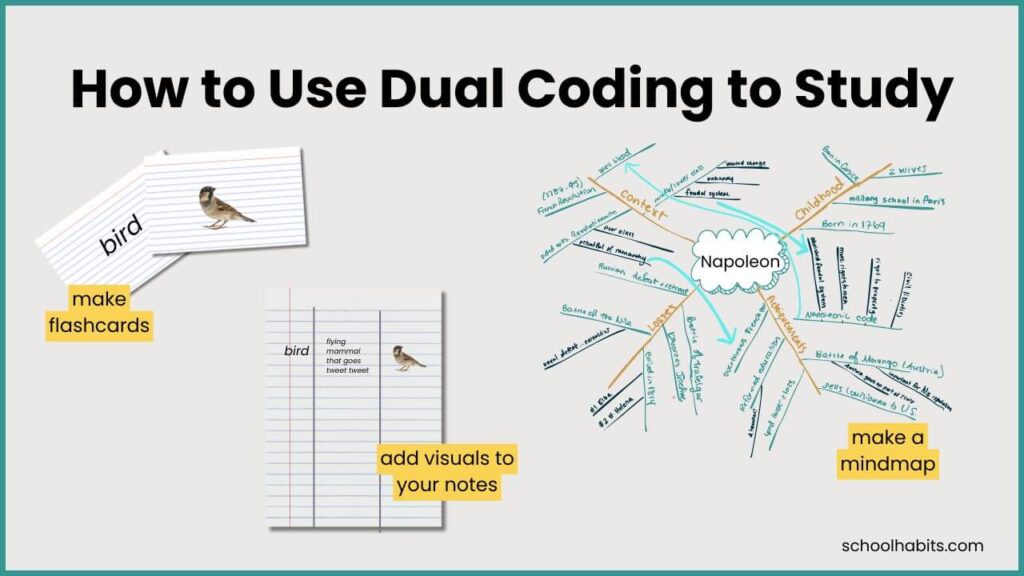
1. Add Visuals to Your Notes
In a perfect world, you’d take notes during lectures or take notes from textbooks using dual coding from the very beginning. You’d write down what your teacher or professor says AND you’d pair it with some kind of visual or graphic. Again, that’s in a perfect world.
For most students, this is really hard to do. Most students struggle to get the right words on the paper fast enough – and adding visuals in real-time is unrealistic.
No problem. There’s a way around this.
I teach note-taking as a two-part process. Most people focus only on part one, which is writing down the actual notes. I like to emphasize the importance of part two, which is revisiting your notes later that same day to revise them, clean them up, fill in the missing gaps, and add visuals.
It makes the most sense to use this revision process to add in the dual coding strategy.
Let me simplify the steps:
- Take notes during class.
- Later that day, go back to your notes and clean them up. Fill in the gaps, make them neater, clarify what you wrote down.
- Add visuals to any parts of your notes that it’s possible to add visuals for.
Here are some ideas for how to turn your notes into visuals:
- Create a mind map for each page of your notes to show how all the concepts work together
- Make a chart, diagram or graph from anything in your notes that can be quantified
- Make a Venn diagram to compare concepts
- Turn a sequence of events into a timeline
- Turn steps into a flowchart
- Draw arrows to show cause-and-effect relationships
How does rewriting your notes with visuals work as a study method? Great question.
When we spend a little time each day revisiting our notes, reviewing the information, filling in the gaps, and adding visuals, we are learning the material at a reasonable pace throughout the unit. This is the opposite of what we usually do, which is cramming in a study session the night before a test. Rewriting your notes with visuals helps you learn the material as you go, which means you can study it less before the test.
2. Illustrate Definitions
In elementary and middle school, teachers often require students to draw images of vocabulary words they’re learning. You may have dreaded this task, but it served a purpose. This is dual coding in action.
High school teachers and college professors don’t usually require you to draw your vocabulary words, because they leave your study preferences up to you. But it would be silly not to.
It’s not childish. It’s smart.
For every new term, draw a small image or icon that represents the meaning. You could also find an image in Google Images to use – as long as it makes sense to your brain.
I suggest a tri-column note system for this process:
- Column 1: The word
- Column 2: The definition
- Column 3: The image
3. Sketch the Big Picture
You know at this point that the only effective study methods involve active recall. If you’re “studying” in some kind of way that does not involve active recall, you’re not actually studying. I can’t emphasize this point enough.
Using dual coding during your study sessions is a great active recall study method. You can ask yourself a word or concept and test yourself on being able to draw it out.
You can also look at an image and test yourself on identifying the word or concept.
Finally, you can attempt to create an overarching “big picture” view of a whole unit or chapter, sketching out how all the related parts fit together.
It obviously depends on what you’re studying, but maybe you draw an actual picture, or maybe you use symbols or boxes to organize major ideas and how they relate in the form of a mind map.
You could even copy existing visuals from your textbook and explain them in your own words. (Yes, dual coding works in reverse too!)
4. Make Visual Flashcards
Most students use flashcards with just words on both sides — a term on the front and a definition on the back. That’s great for active recall, but you can make your flashcards even more effective by adding visuals.
Here’s how:
- On one side, put the term or question.
- On the other side, include a definition and a simple visual: a drawing, symbol, diagram, or chart that helps represent the idea.
- For some terms, you could try leaving off the definition and just including the visual.
Visual flashcards give your brain an extra way to store and retrieve (remember) information. You’re not just recalling a word — you’re recalling a concept anchored in two different formats.
Final Notes About Using Dual Coding to Study
Dual coding isn’t flashy, complicated, or trendy. And that’s exactly why it works. It helps you slow down just enough to process what you’re learning and think about it differently. Most students try to force themselves to memorize definitions word-for-word, but our brains simply don’t operate this way.
Try just one of the techniques from this post during your next study session. You’ll likely find that adding even a single, simple visual helps you understand the material more clearly — and recall it more fully when it counts.
The post How to Use Dual Coding to Study (And Why You Should) appeared first on SchoolHabits.
