

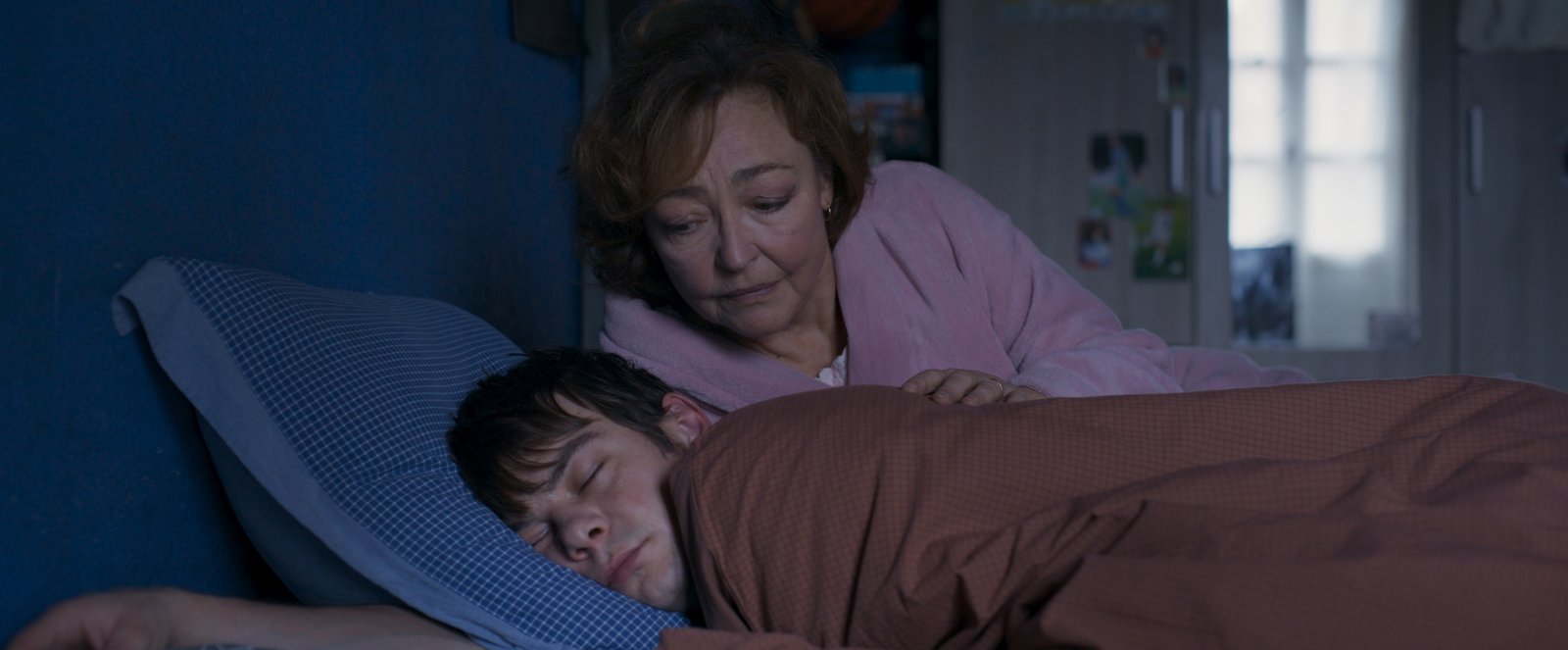
Death and desire make for strange bedfellows in the films of Alain Guiraudie.
Predominantly set in cloistered, rural communities whose characters—and, indeed, whose auras and enclaves—are cast aswirl by crosscurrents of violence and eroticism, the French filmmaker’s cinema derives both comedy and tragedy from closeted compulsions. His latest, “Misericordia” (now in U.S. theaters), takes its title from the Latin word for “mercy,” but this is perhaps meant teasingly.
Returning to the quiet village of Saint-Martial for the funeral of local baker Jean-Pierre (Serge Richard), a former employer, the enigmatic Jéremie (Félix Kysyl) is initially welcomed in by the baker’s widow, Martine (Catherine Frot). Though her son Vincent (Jean-Baptiste Durand) is wary of Jéremie’s designs toward his mother, the truth is far trickier. Still harboring intense feelings for Jean-Pierre, Jéremie’s other interest is in an older ex-farmer (David Ayala)—until Vincent disappears, and Jéremie finds himself under suspicion by the police, neighbors, and a peculiar priest (Jacques Develay) whom he starts encountering around every corner, whether hunting for mushrooms or wandering at night.
Without sacrificing the near-ritualistic structure and pacing of “Stranger by the Lake”—his international breakthrough, set at a secluded cruising spot, about a young man troubled and tantalized by the knowledge his lover might kill him—Guiraudie leaves behind that film’s sexually explicit psychodrama in favor of something more tonally deadpan and oneiric, though no less erotic. (Cinematographer Claire Mathon shot both, and she suffuses Saint-Martial—all slate roofs and cobbled streets ceding to chestnut groves and holm oak forests—with an overcast earthiness to contrast the earlier film’s sun-dappled shorelines.)
Foregrounding queer, working-class men whose sexualities are fluid, transgressive, and elusive, even to them, Guiraudie’s films delight in tracing the contours of their unspoken, unfathomable longings: not only carnal needs, but communal, filial, and spiritual ones, for absolution as much as abandon. For the filmmaker, this exploration is a source of cinematic pleasure most of all; in the lush bodies of landscapes as much as those possessed by lonely hearts passing through, Guiraudie cultivates a dreamlike space where life and death—specifically Eros and Thanatos, their Bataillan counterparts—are helplessly intertwined.
A shape-shifting tale of love, lust, and their violent eruptions, “Misericordia” suggests morality is a slippery subject, that even the pious among us can’t resist their innermost urges. If all of us are defenseless against what we desire, what use is there in imposing ethical judgments of guilt and innocence, right and wrong, or crime and punishment, on the peculiarities of our hearts?
RogerEbert.com spoke with Guiraudie during his visit to Chicago, as part of a U.S. tour mounted by Janus and Sideshow in support of his latest film. Originally scheduled to take place in the lobby of the Hotel Sofitel, the conversation shifted upstairs and into a surreptitiously secured side-room on account of a saxophonist whose volume, striking up to practice for an unrelated gala later that evening, was making it seem faintly absurd to keep conversing across language barriers about such delicate matters as scopophilia, dogma, and the phallic properties of mushrooms.
This interview, translated with the assistance of Juliette Acosta, has been edited and condensed.

Welcome to Chicago. It’s lovely to have you here, though I should say there’s usually far less saxophone.
Chicago is a city of jazz, is it not? I don’t have anything against saxophones, personally, and I’ve actually been learning saxophone since December. But now, yes, it’s not appropriate; and it’s bothersome if you are conducting interviews, particularly if you’re recording them.
I’m glad we could find this little hideaway, certainly. “Misericordia” is set in Saint-Martial, this remote village in the department of Aveyron, in southern France; it’s not the first film you’ve made in this region, and many of your films unfold in these secluded locales. Do you think of them as microcosms of society, or perhaps as sanctuaries?
I don’t think these settings ever represent society, really. That’s not my intention. I think it’s the opposite, actually. It’s a world that exists apart from society, out of time—although it’s also slightly more complicated than that. I always try to base my films on reality but, at the same time, I also like to work with these more tragic and theatrical aspects of life; there’s a certain purity to that. Especially in this film, but also in “Stranger by the Lake” for example, all of the characters could be real—and they are inspired by people I’ve known—but they also reflect personal fantasies and reflect my own identity as well. I put a little bit of myself in every character.
The worlds that I build are atemporal, caught somewhere between the 1970s and the present, and they exist between reality and fantasy. In “Misericordia,” [Saint-Martial] exists between my childhood village and a more phantasmic milieu. Working on this film in terms of dramatization, tragedy, and theatricality, I specifically wanted to approach it as a fable, as a fairy-tale, so it was important for me that it could exist apart from a more contemporary world.
In that vein, mushrooms carry potent meaning in “Misericordia,” as these erotic and morbid symbols that are also woven into the fabric of communal life in Saint-Martial.
[laughs] So, mushrooms have a very important part to play in traditional life in the French countryside; when it’s mushroom season, everybody in the countryside goes hunting for mushrooms. But it’s more than that, too. There’s something so phallic about mushrooms, of course, but I wanted to evoke this idea of the body rotting in the ground but also returning, somehow, as well.
It’s not only symbolic in this sense, but also concrete and quite down to earth. [laughs] The mushrooms threaten to betray the presence of the body in the ground, causing Jérémie to feel this constant pressure to retrieve the mushrooms and protect this secret, to protect himself.

Your films steep their locales in such eroticism, a palpable tension that reflects or even surfaces the characters’ sublimated desires; there’s such mystery but also materiality to the landscape, to the movement of clouds, the interplay between shadow and light over characters’ faces.
The atmosphere of the forest in autumn time, and the fog that materializes whenever it rains, have much to do with the sensuality of this film, as does the wind, as do the colors of the leaves, as does twilight. I thought a lot about the forest as a setting, because it’s deeply connected to the feeling of a fairy-tale; it’s such an atemporal place. The forest rarely evolves, and it instead stays the same. In my films, the fact that the characters are almost inscribed in the landscape, in nature, in this case to the setting of Saint-Martial and its foliage, adds to the eroticism.
In “Stranger by the Lake,” this idea of silence—particularly as it pertains to latent eroticism and yearning—becomes deadly, after one character leaves unspoken what he discovers about another. In “Misericordia,” the presence of the church and the priest adds other elements of repression, which then evolve alongside the film. The priest tells Jérémie, “I could love without noise for eternity,” though he’s actually far from reserved in expressing himself.
Silence, in many instances, has more to do with modesty on the part of the person, a certain reserve to be found in leaving things unsaid, which brings in elements of mystery as well. In the case of the priest, he isn’t really silent, because he actually talks about his love Jérémie a lot. [laughs] It’s hard for me to talk about silence in this film, because people do say what they have to say to each other, even if parts of what they mean are concealed.
There’s a certain simplicity and restraint to this type of understatement, and it causes the audience to rely more on their imagination. It reduces things to their essence. For example, at one point, I’d included a scene that explained exactly what had happened between Jérémie and the baker, Martine’s husband, that took place between Jérémie and Martine. In the end, we got rid of that scene, in the editing process, and removing it was ultimately the right decision. It made the film better.
What follows the baker’s funeral in “Misericordia,” is this entanglement of unexpected attractions, though everyone seems to want someone else. Across your films, one could call this a throughline, the strange desire that erupts around death.
We artists usually make movies to figure out those very issues that are not at all resolved in our own heads. I don’t personally feel that I make a direct connection between death and desire, but I’d maintain those are still the two great mysteries of life. In “Stranger by the Lake,” there was definitely more of a direct link; in “Misericordia,” the heart of the matter is not a relationship of desire between a murderer and a victim, I wouldn’t say. Even if there’s murder, and if there are murderers, the movie is more about a life sustained by desire. [laughs]
In the film, we care more about how the murderer is going to stay free than we do about punishing him; what the main issue is, really, is this constant circulation of desire. That particular idea was essential during filming; we used a lot of close-ups, and we wanted to convey that every character was possibly being observed by another character at all times. What I pushed all the way in this film, more than in previous films, was my own desire for the characters—and I’m saying that of the characters, to be clear, not the actors. [laughs]
More than in my previous films, the use of close-ups—and especially extreme close-ups—was intended for me to get as close to the characters as possible, to make it so that the camera was itself desirous. The true pleasure of looking at others—that idea of scopophilia—is not about wanting someone sexually, per se, but of holding them in your gaze; it’s about possessing them, and this film was the first time I’d pushed that concept so far.

I recall, in a previous interview, you disclosing your admiration for David Lynch, and that was on my mind as well during “Misericordia,” in its dream logic as much as its tale of self-destruction within lust. In light of his passing, would you be willing to discuss what his films meant, and continue to mean, to you?
David Lynch, for me, embodies something that’s incredibly important in cinema: he takes what is reality and he finds a cinematic territory—-not a dream and not reality—that exists somewhere in between the two. It’s a very specific territory. And one theme that he has worked to further through his work—in films like “Blue Velvet” and “Mulholland Dr.”—is how the American Dream, which is such a strange concept, could turn into a nightmare. He has always been a political filmmaker, but in a highly poetic way. Many of the filmmakers that I admire the most, from Nanni Moretti to Pedro Almodóvar, have that goal in mind, but David Lynch is the one who actually succeeded.
Last question. “Misericordia” features this breathtaking scene, in a church confessional, between Jérémie and the priest, that illuminates their struggles between freedom and imprisonment. What can you tell me about conceiving of and filming that sequence?
I always knew that was going to be a very important scene and so I used it during my auditions with Félix Kysyl and Jacques Develay, the actors, and they really convinced me of that moment during their auditions, so the success of that scene is theirs; they’re the ones who are so good in it. This scene is all about secrecy, and there are lots of close-ups within it that play with light and darkness. At first, we thought it was going to be impossible to fit the camera inside the confessional itself, but during the shooting we tried a few different things, and in the end it actually did fit, so we were able to go inside.
The way that specific scene worked, of course, was because of the editing process as well. It was the perfect combination of elements but, as with the film as a whole, it’s a process, and you find those elements not only in writing but also in filming and editing. As a young filmmaker, I was extremely opposed to shot-reverse-shot as a technique, but “Misericordia” is filmed with shot-reverse-shot, and I really enjoy that element of it. As a young filmmaker, of course, you have to possess very strong ideas about what the form of your film will be; but as you evolve and learn as a filmmaker, it’s a simple matter of liberating yourself from any such dogmas.
“Misericordia” is now playing in limited theaters, via Janus and Sideshow.
