


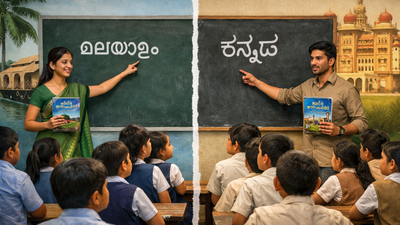
A language Bill in Kerala has become a schooling dispute between two states, not because Malayalam needs defending in Kerala, but because border classrooms do.On January 9, Karnataka Chief Minister Siddaramaiah wrote to Kerala Chief Minister Pinarayi Vijayan objecting to the Malayalam Language Bill, 2025, passed by the Kerala Assembly, and urged Kerala Governor Rajendra Vishwanath Arlekar to withhold assent to the legislation.At its core, the Bill does two things at once. It seeks to formalise Malayalam as Kerala’s official language for official purposes, and it pushes Malayalam beyond files and signage into the one place where policy becomes personal: The school timetable. It does so by making Malayalam the compulsory first language from Classes 1 to 10, while also claiming, through a safeguarding clause, that notified linguistic minorities such as Kannada and Tamil will be protected.The Governor is now expected to review the Bill after objections from Karnataka’s Border Areas Development Authority, which argues the law could disadvantage Kannada-speaking minorities in Kasaragod. Kasaragod is Kerala’s northern border district abutting Karnataka, where Malayalam is the state’s official language, but Kannada and other tongues are part of everyday life in several pockets. In such districts, a “first language” rule is never just pedagogy; it is policy deciding which identity becomes default in the classroom.That review matters because the legislative act is already done: the Assembly has passed it. The argument is no longer whether or not Kerala can promote Malayalam. Of course it can. The argument is whether promotion in a border district has a habit of turning into compulsion once it reaches principals, inspectors, and paperwork. In places like Kasaragod, language is not a cultural accessory you wear on festival days, it is the currency of school admissions, teacher appointments, and a child’s sense of belonging.Vijayan has dismissed Siddaramaiah’s concerns as “not based on facts”, insisting the Bill has inbuilt protections for linguistic minorities. Siddaramaiah has framed it as an attack on linguistic freedom, with Kasaragod as Exhibit A. Between these two positions sits the real question — not rhetorical, but administrative: Who carries the burden of “safeguards” when the default rule is compulsory? A clause can promise comfort; a classroom has to live it.And that is what makes this episode different. States asserting language is routine, part pride, part politics, part governance. What is unusual is one southern state asking another’s Governor to stop a language law because the law does not merely signal identity, it reorganises education. In India, the quickest way to change a child’s future is to change the language in which the future is taught.
Malayalam Language Bill 2025 : Why Kasaragod unsettles neat language boundaries
Kasaragod unsettles neat assumptions about language and federalism. While it falls squarely within Kerala’s administrative jurisdiction, its linguistic character does not align cleanly with state boundaries. Malayalam structures governance, but Kannada continues to circulate through homes, markets, and older schooling traditions. Border districts rarely inherit language exclusively from capitals; they absorb it from roads, migration, and long-settled communities.Karnataka’s intervention, viewed in this light, is not as anomalous as it might appear. Linguistic minorities at borders are rarely treated as entirely someone else’s. Political and cultural kinship in India has always travelled more fluidly than jurisdiction. By framing the Malayalam Language Bill as a minority-rights concern rather than a routine governance choice, Karnataka elevates the dispute from state pride to constitutional unease. The focus shifts away from Kerala’s right to language promotion — which few contest — to how minority communities experience state power where identity is layered rather than singular.Border districts complicate tidy federal assumptions. They reveal that language, when enforced uniformly, does not always land uniformly.
Malayalam Language Bill 2025: The distance between safeguards and counters
An official language provision looks orderly in statute. It promises coherence and efficiency. In practice, it establishes a default, and defaults shape behaviour.Kerala’s defence rests on the assurance that linguistic minorities in notified areas may continue official correspondence in their mother tongues and receive responses accordingly. The reassurance is legally sound. Karnataka’s anxiety lies not in the text, but in routine. Once a language becomes official across functions, administrative habit tends to privilege the default rather than the exception.This is where language law ceases to be theoretical. Not in debates or legislative intent, but at counters that issue certificates, process admissions, correct records, and resolve grievances. When Malayalam becomes the assumed language of notices, forms, and files, minority-language rights no longer operate automatically. They must be claimed. Claiming rights requires awareness, confidence, and time.India’s bureaucratic truth is unsentimental: Rights on paper do not eliminate friction, they relocate it. A Kannada-speaking family navigating Malayalam-first documentation does not experience inclusion as abstraction. It experiences delay, translation, repetition, and often quiet adjustment. None of this violates a clause. All of it reshapes trust in the state.
Why classrooms change the stakes
The dispute intensifies because the Bill enters schooling. Language in offices can be mediated. Language in classrooms is formative. By treating Malayalam as the compulsory first language from Classes 1 to 10, the policy moves language from administration into learning architecture. A first-language slot is not another subject among many. It determines textbook ecosystems, teacher pipelines, assessment comfort, and the emotional ease with which a child enters school.This is no longer about Kerala functioning in Malayalam. It is about what a Kannada-speaking child in a border district must study, internalise, and be evaluated in during the years when identity takes shape. Even where exemptions exist, compulsion often expresses itself through availability: Which languages schools are equipped to teach, which teachers are posted, which options timetables prioritise. These design decisions quietly narrow down the choice.Assurances of opt-outs address part of the concern. They do not erase it. A policy that declares compulsion places the work of adjustment on minorities, even when safeguards exist. Choice survives, but by exception, not by design. This is why classrooms become the red line. Language in education signals whose knowledge feels native, whose accent feels normal, and whose identity must adapt.
Malayalam Language Bill 2025: Where the Constitution quietly enters
Karnataka’s objection is not framed only as political discomfort or cultural anxiety. It leans deliberately on constitutional language protections. Articles 29 and 30 safeguard the right of linguistic minorities to preserve their language and establish educational institutions. Articles 350A and 350B impose obligations on states to facilitate mother-tongue instruction at the primary level and to maintain institutional oversight of minority safeguards. These provisions exist because minority protections often fail not through open violation, but through administrative drift.Together, these provisions form Karnataka’s constitutional footing. The claim is not that Kerala cannot promote Malayalam, but that when a state law reorganises schooling language in districts with recognised linguistic minorities, it enters terrain the Constitution treats with caution. Promoting a language through government communication, public signage, or symbolic policy rarely unsettles constitutional balance. Mandating a language within early schooling does, because the medium of instruction shapes how easily a child enters the system, not just what the child learns within it.This does not settle the legal question. The provisions have not been judicially tested against this Bill. What they do provide, however, is a legally intelligible place to stand, one that relies not on imputing intent, but on anticipating consequence.
India has seen this before
India has encountered this dynamic before. Start with Kerala. The state has attempted to legislate Malayalam’s institutional primacy before. A Malayalam promotion Bill passed by the Kerala Assembly in 2015 did not translate into enforceable law and spent years in the assent pipeline, ending with assent being withheld. Language laws begin to attract resistance when celebration is converted into enforceable systems that touch administration and schooling.Tamil Nadu provides the clearest explanation of why education becomes the pressure point. The three-language formula was proposed in the mid-1960s and formally adopted in the 1968 National Policy on Education as a national framework for schools. Tamil Nadu refused to implement it and institutionalised a two-language system instead, not because of hostility to multilingualism, but because of how school systems behave once a language is mandated. Timetables harden, teacher recruitment aligns, textbooks and examinations reorganise. With time, what begins as an additional language starts functioning as a default.Karnataka’s own experience reinforces the lesson from a different angle — within schools themselves. Over the past decade, the state has repeatedly attempted to make Kannada compulsory even in CBSE, ICSE and other non-state board schools, arguing that students studying in Karnataka should graduate with functional Kannada, regardless of affiliation. Each attempt has followed a similar arc: government notifications mandating Kannada as a subject at the primary or middle-school level, resistance from private schools and parents who viewed the move as overreach, and eventual legal scrutiny over whether the state can impose curricular requirements on nationally affiliated boards.What borders revealBorders have a way of exposing what laws try to smooth over. In Kasaragod, language is not an abstract question of pride; it is a daily negotiation inside schools. The Malayalam Language Bill arrives with assurances of balance, but balance in education is not maintained by design alone. It depends on how easily children and parents navigate choices without having to fight for them. If the Bill leaves minorities feeling managed rather than accommodated, it will not matter how carefully it was drafted. In education, legitimacy is experiential — learned early, and remembered long
