![Managing Teams in the AI Era [+ Manager Checklist]](https://kumbhcoin.org/wp-content/uploads/2026/08/Managing-Teams-in-the-AI-Era-Manager-Checklist.png "Managing Teams in the AI Era [+ Manager Checklist]")
A campaign brief comes back polished. Structured, on-brand, done fast.
Six months later, the same person is asked to walk a client through the strategy live, with no deck and no drafting tool open. They freeze. Not because they’re incompetent, but because they never actually built the muscle.
AI carried the parts of the job that would have taught them how to think about it.
As a manager, you can no longer tell just by looking at a finished deliverable if your employee actually solved the problem or if they just prompted their way past it.
That ambiguity changes everything about how you need to lead.
Check out how to manage teams in the AI era and get your free checklist below.
The AI shortcut that leaves no trace
Management has always relied on a simple shortcut to evaluate performance, comprehension, and growth. If the final output is good, the employee’s understanding is good.
AI completely breaks that rule.
Workplace shortcuts aren’t new. But there is a massive difference between the old shortcuts and AI. When an employee Googles a question or asks a coworker for help, they still have to synthesize that information.
However, because of AI, an employee can hand you a flawless deliverable without ever understanding the reasoning behind it. And the data proves this is happening right now:
- 59% of employees use AI for tasks they were never trained to do.
- 50% use it to complete tasks even when they don’t understand the process behind them.
- 37% admit AI makes them look more competent at work than they actually are.
- Employees falling behind on learning are more than twice as likely to use AI for untrained tasks (52% vs 24%) and more than twice as likely to say AI made them look more competent than they are (66% vs 29%).
- 78% of AI users bring their own AI tools to work (BYOAI), with 80% of them doing so without organizational guidance or explicit permission.
In the AI era, if you are only evaluating the final output, you are flying blind. We have to start training employees on using AI tools so they actually understand the work, not just how to prompt for it.
What the data says employees are hiding
The data shows a massive gap between what managers see and what employees are actually doing behind the scenes.
The AI cover-up
According to our research in the Learning Debt report, employees are actively using these tools to cover their gaps:
- 59% use AI for tasks they were never trained to do.
- 50% use it to complete tasks even when they don’t understand the process behind them.
- 37% admit AI makes them look more competent at work than they actually are.
Half of employees are using AI to complete tasks they don’t actually understand.
The debt was already there
AI didn’t create this habit of hiding knowledge gaps. Our data shows that it just provided a better disguise to teams that were already struggling to keep up:
- 41% say their role has evolved faster than their company’s ability to train them.
- 47% have stayed quiet about not knowing how to do something at work. Of that group, nearly half (49%) kept quiet specifically because they didn’t want to look incompetent.
- Meanwhile, 28% of managers are completely in the dark about how often their team struggles with the skills needed for their role.
“But shortcuts have always existed”
You might be thinking that none of this is actually new. Employees have always found workarounds when they get stuck. Googling a template, finding a quick tutorial, or just asking a coworker for the answer is just part of being resourceful.
But here is where that argument falls apart.
When you Google a problem, you still have to read the results. You have to process what you find, pick the right answer, and stitch it into your own work. The effort forces you to synthesize the information. Even with a shortcut, some learning still happens.
AI skips the synthesis entirely.
An employee can generate a perfect, polished outcome without ever touching the reasoning behind it. They don’t have to connect the dots themselves. That is exactly why this shortcut is fundamentally different—and why it is so much harder for managers to catch.
Managers think they see more than they do
Here is the uncomfortable truth. The problem isn’t just that employees are taking invisible shortcuts.
It’s also that managers think they have a perfect view of their team’s capabilities.
They don’t.
The data shows a massive disconnect between what managers think they know and what’s actually happening:
- 90% of managers believe they understand their team’s skills.
- Only 69% of employees agree.
That is a dangerous visibility gap. When you combine that overconfidence with AI’s ability to mask a lack of knowledge, you run into a wall.
The result?
44% of managers admit that by the time they discover a skills gap on their team, it is already too late.
Closing that blind spot means you have to stop relying on the final output to tell you how your team is doing. It starts with putting actual visibility tools in place, like skills tracking or a group supervisor view, so you can see where your people actually stand before the work suffers.

What should managers do differently?
Managing teams in the AI era requires a fundamental shift. You have to stop tracking routine tasks and start leading human-machine collaboration.
Here is exactly how you do that.
Develop critical thinking, not output volume
Good management used to mean reviewing the final work.
In the AI era, you need to redesign roles around high-level judgment and creativity. The output matters less than the thinking behind it. Ask your team how they got to the answer. What did they verify? What did they change? Would they even know if the AI got it wrong?
When you spot a gap in their reasoning, don’t just fix the deliverable. Fix the underlying skill—whether that is through hands-on coaching or assigning customized learning paths to rebuild that lost muscle.
Build psychological safety around not knowing
AI makes it dangerously easy to hide knowledge gaps.
If your employees feel like admitting uncertainty is risky, they will just cover it up with a convincing AI-generated answer. You have to cultivate psychological safety and address workplace anxiety head-on with radical transparency.
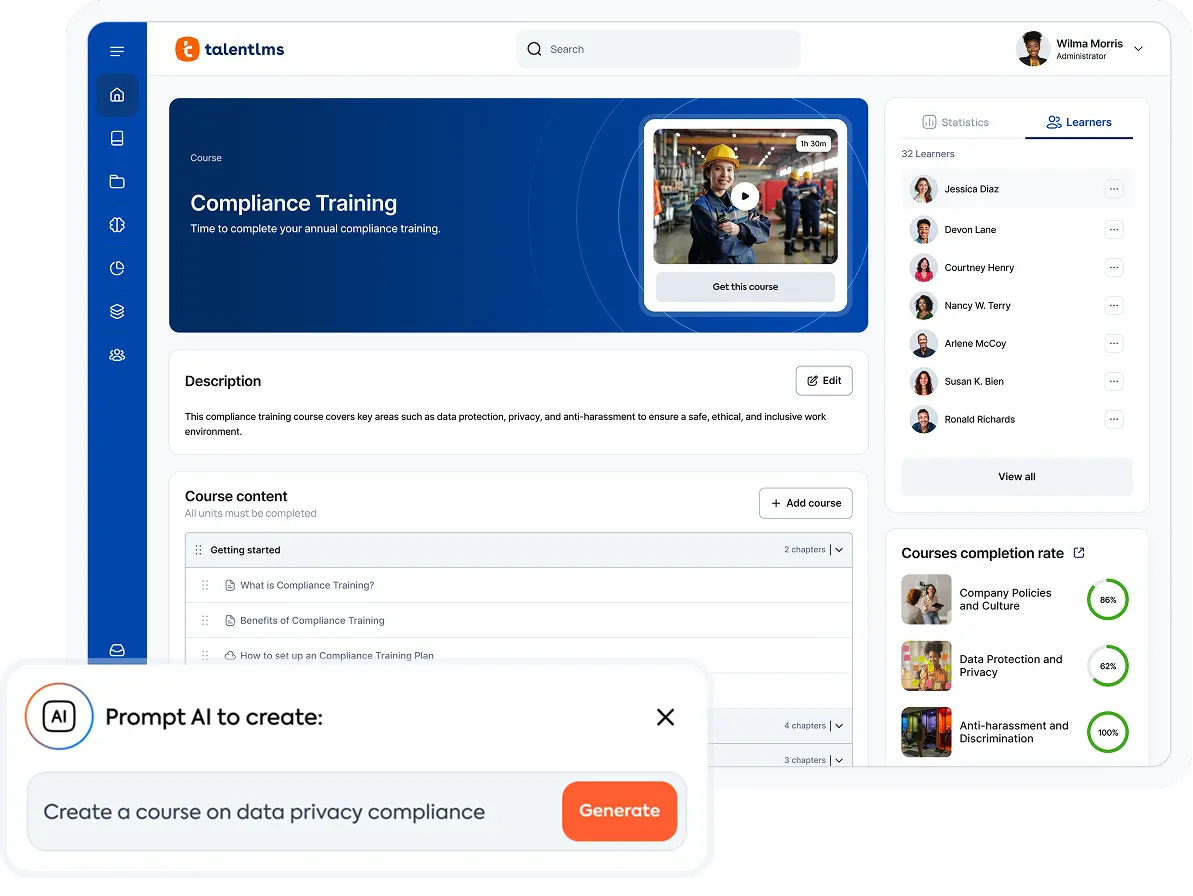
Make it completely safe to say, “I don’t know.” Give them a low-stakes space to experiment and fail, like the TalentLMS Learning Playground, where they can test these tools without the pressure of a live client project.
Update how you evaluate performance
Output alone doesn’t tell the full story anymore.
You need to look at the process. Can your employee explain their decisions? Can they challenge the AI? Do they know when not to use it?
It is time to update your performance management process to reflect this new reality. You can use standard reporting to run quarterly skill check-ins, focusing on comprehension rather than just checking off completed tasks.
Check your own visibility first
You can’t manage what you can’t see.
Before you try to fix your team, fix your own blind spots. You need a clear, accurate picture of what your team can actually do without a machine doing the heavy lifting.
This is where a tool like TalentLMS Skills paired with a group supervisor view comes in. It gives you the actual data on where your team stands, so you aren’t waiting until a live presentation to find out someone is struggling.
Where to start
You know the blind spots are there. Now you just need to close them.
Grab the AI-era Manager Checklist to start auditing your team’s actual capabilities today.
And when you are ready for a more standardized way to track those skills and build real competence, TalentLMS can help you make it happen.