

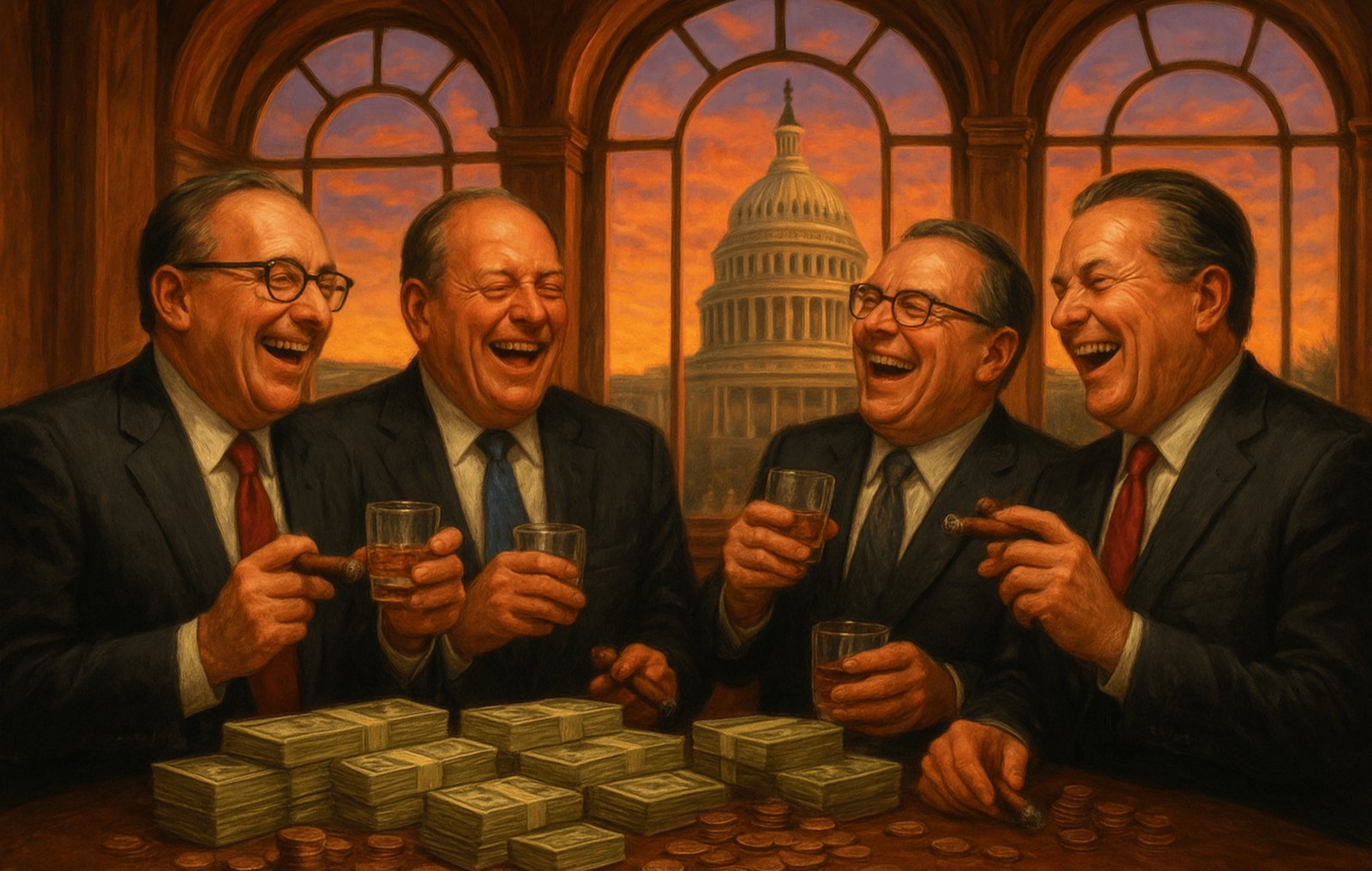
In early 2025, National Review reported that lobbying expenditures on tariffs had jumped an astonishing 277 percent over the prior year. Trade associations and industry groups flooded Washington with petitions, exemption requests, and campaign checks.
Steel companies, electronics firms, and agribusinesses weren’t suddenly struck by patriotism or altruism. They were doing what public choice theory predicts: seeking concentrated benefits while offloading costs onto the public. What is striking is not rent seeking. That is familiar enough. What is striking is how easily it gets dressed up as civic virtue. Tariffs survive and thrive not just because they pay, but because we persuade ourselves they are somehow noble. That is where self-deception enters, something to which we shortly return.
On the surface, tariffs are border taxes. Governments levy them on imported goods, raising their price. The official rationale is to “protect” domestic industries by “leveling the playing field” with foreign rivals. The economic reality is less flattering. Tariffs distort prices — the very signals we rely on to allocate resources efficiently.
This is something economists have often explained: FA Hayek stressed prices are information, aggregating dispersed knowledge better than any planner could manage. When you tax imports, you aren’t simply raising revenue. You are also garbling the knowledge system that allows specialization and cooperation across borders. What looks like protection is really manufactured ignorance. This willing distortion of market information makes it easier for politicians, special interests, and others to deceive themselves about the benefits of tariffs.
First, though, we should unpack the nature of self-deception. The evolutionary biologist Robert Trivers offered one of the most influential accounts: people deceive themselves in order to better deceive others. For most people, it is hard to lie convincingly if you know you’re lying. But if you can persuade yourself to believe the claim, then it is no longer a lie, allowing you to project confidence, sincerity, even indignation, and avoid casting suspicion with physical and emotional tells. Tone, eye movement, and body language are powerful second-order evidence in social life. They make other people more likely to believe you, especially when the subject is too complex for them to evaluate directly.
Politics is exactly that kind of environment.
Few voters read trade policy studies. Most rely on conviction and narrative. So when politicians insist tariffs will “save American jobs” or “revive industry,” with confidence and gusto, the claim is not effective because it is true but because it is sincerely believed (at least in some cases).
That sincerity is often a product of self-deception. And in addition, poor incentives potentially enable self-deception. As public choice theory reminds us: politicians are not benevolent planners; they’re actors responding to incentives. For firms facing competition, the incentive to lobby for tariffs is obvious. Protection from imports means higher profits and market share. For politicians, the incentive is just as obvious: deliver concentrated benefits to a vocal, well-organized industry while dispersing the costs thinly across millions of consumers who barely notice the extra dollars at the checkout line.
This asymmetry explains why tariffs are politically attractive but economically destructive. Benefits are concentrated and visible; costs are diffuse and hidden. But incentives alone don’t tell the whole story.
If voters suspect they are being fleeced, resentment builds. The system works better when the rationalizations are actually believed. And that is where self-deception meets public choice: it helps politicians, special interests, and others better convince others of the benefits of tariffs because they are (in some cases) self-deceived.
At this juncture, the logic of tariffs and self-deception is straightforward:
- Tariffs create clear opportunities for concentrated gains (through economic “protection”).
- Concentrated gains attract lobbying and rent-seeking.
- Rent-seeking requires a moral and political cover story.
- Self-deception makes that story convincing.
The steel executive convinces himself that tariffs are about “fair trade,” not rents. The senator convinces herself that tariffs are about “working families,” not campaign donations. The citizen convinces himself that higher prices are patriotic dues, not hidden taxes. All of them may be wrong, but all of them are sincere. That sincerity, enabled by self-deception, is precisely what makes the rent-seeking effective.
This is why the debate feels so disconnected from economic reality. Economists can calculate the deadweight losses, the pass-through of costs to consumers, and the retaliatory spiral. They can show that tariffs lowered real incomes in the US by billions during the 2018–2019 wave. Tariffs show how that capture — highlighted by public choice theory — can be greased not just by money but by psychology. If regulators, legislators, and industry lobbyists all come to believe that their cause is just, then the capture doesn’t feel like capture at all.
Anne Krueger famously noted that the social cost of rent-seeking isn’t just the transfers themselves but also the resources wasted chasing rents. When self-deception enters the picture, that waste can multiply — extending beyond economic resources to epistemic ones, in the form of intellectual energy spent rationalizing a tax on consumers that benefits only a concentrated few.
In the end, the 277 percent spike in tariff lobbying is not an accident. It’s the predictable result of a policy that creates concentrated privileges. But what allows those privileges to endure is not just money — it’s psychology. Tariffs harness our natural tendency toward self-deception, making rent-seeking persuasive and capture respectable.
