


What Is Positive Deviance?
Positive deviance is when some people or groups achieve better results than others in similar situations, even when they have the same resources and face the same challenges. In organizations and sociology, the definition of positive deviance describes those who “deviate” from the norm in a successful way, rather than a problematic one. The individuals who show this behavior are called positive deviants. In simple terms, positive deviance is about finding unexpected success within existing systems.
The definition of positive deviance in sociology comes from behavioral studies that examine how uncommon but successful behaviors exist within communities. It originates in research focused on understanding differences in behaviors, especially in contexts such as health, education, and social systems. Unlike traditional deviance studies, which focus on rule-breaking or negative behavior, positive deviance in sociology focuses on behaviors that break norms in a beneficial way.
In the workplace, positive deviance highlights outperformers who succeed under the same constraints as others. This is especially valuable in L&D and HR, as it helps organizations learn from their own best practices rather than relying solely on external benchmarks.
In This Guide
Positive Deviance Theory In Sociology And Organizational Science
The main idea behind positive deviance theory is that existing solutions are often already present within the system. For example, in every team, department, or community, there are “positive deviants” who perform better than others. Their success usually comes from different behaviors, habits, or decision-making patterns, rather than from having more resources.
This approach is different from traditional problem-solving and benchmarking methods. Instead of looking at competitors or best practices, organizations focus on their own unique successes within the company. Traditional methods often assume that a problem requires a new solution, whereas the positive deviance approach holds that a solution already exists but isn’t widely used.
It is also important to distinguish this from the broader deviance approach in sociology, which often focuses on negative deviance such as rule-breaking or harmful behavior. Positive deviance focuses only on exceptions that lead to better outcomes.
This theory is very useful for L&D and improving performance. It helps leaders create systems that learn from how employees actually act, and makes learning more practical, easier to expand, and directly linked to results.
Positive Deviance Model And Approach in Organizations
The positive deviance model is a straightforward framework for finding and promoting successful individuals or teams within an organization. Instead of focusing on problems, it looks at those who are already achieving better results despite the same challenges. In simple terms, it combines data analysis to identify performance gaps and outliers with behavior research to see what high performers do differently. This model is especially useful for Learning and Development (L&D) and Human Resources (HR) leaders who want practical, evidence-based improvements rather than vague best practices.
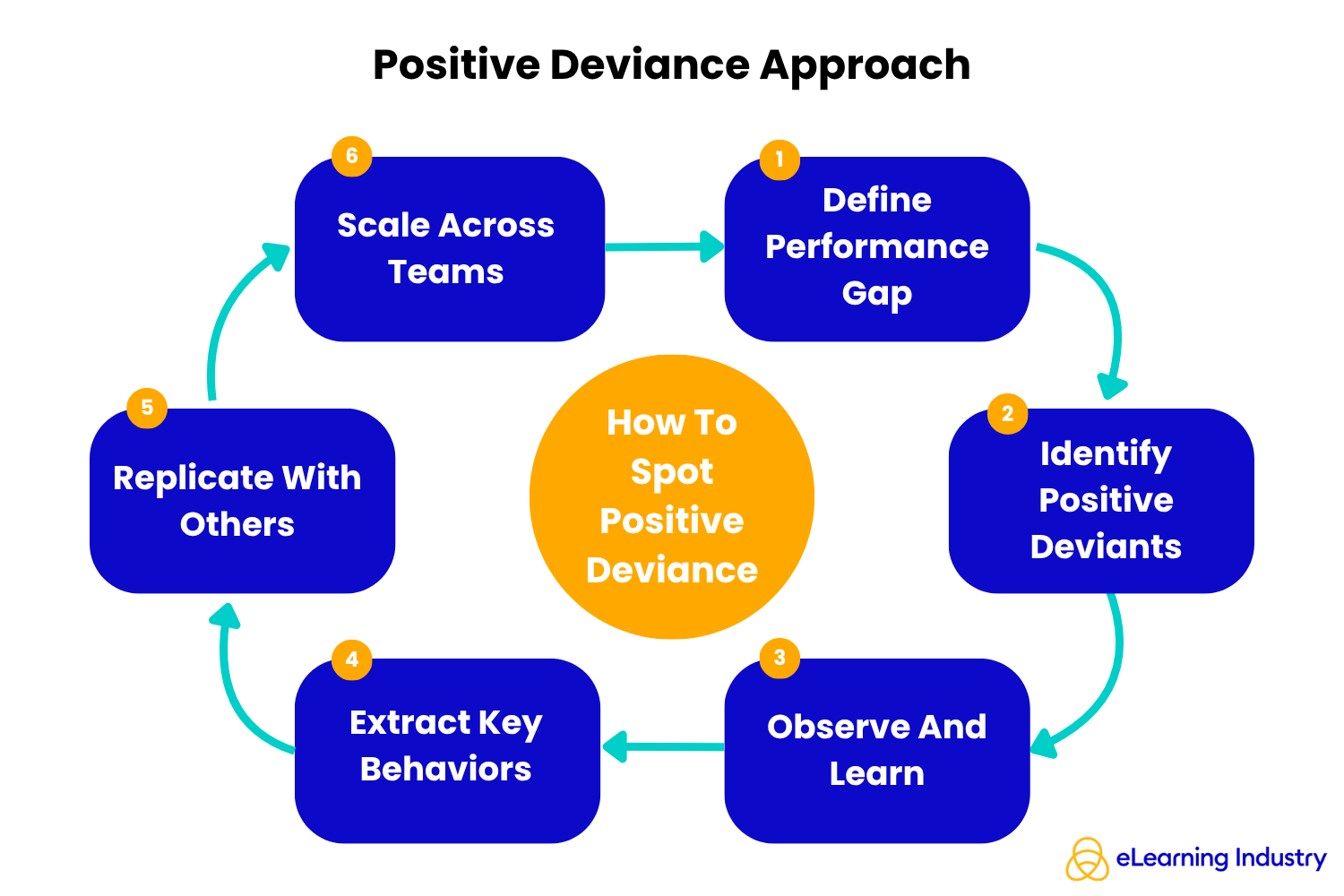
The positive deviance approach follows a clear cycle:
Identify → Study → Replicate → Scale
- First, organizations identify “positive deviants,” or high performers who succeed against the norm.
- Next, they study their behaviors in detail to understand what makes them effective.
- Then, those behaviors are replicated across teams through peer learning rather than instruction.
- Finally, successful practices are scaled while still allowing flexibility for teams to adapt them.
Organizations use the positive deviance approach because it is a quick, cost-effective, and sustainable method. It encourages peer learning and helps build a culture of excellence within the organization. Rather than bringing in outside solutions, companies tap into the knowledge and skills already present among their employees.
Characteristics Of Positive Deviants
They Are More Successful Than Their Peers
One key characteristic of positive deviants is that they achieve better outcomes under the same conditions. For example, in a sales team with identical tools, training, and targets, a small group may consistently outperform others. This is central to understanding the meaning of positive deviance in practice: success isn’t determined solely by external benefits, but by one’s attitude and method.
They Follow Rules But Unconventionally
Another important feature is that positive deviants operate within system rules but use unconventional behaviors. They do not break policies or step outside organizational boundaries. Instead, they find unique ways to solve problems inside the system. This is a core idea in the positive deviance approach, which focuses on discovering better behaviors already at work within the organization.
They Don’t Stand Out
Positive deviants are often overlooked internally. Because their methods are different, they may not always stand out in traditional performance reviews or standard reporting systems. This is why the definition of positive deviance is important: it helps leaders see that going against the norm can sometimes lead to success rather than failure.
They Usually Go In Groups
Finally, positive deviance is often a group phenomenon rather than just individual behavior. Positive deviance in sociology shows that these behaviors can be spotted within teams or communities. When groups share good habits, they can consistently achieve improved outcomes. Understanding this can help organizations take successful examples and create systems that boost performance across the board.
Positive Deviance Examples
Understanding positive deviance examples helps L&D and HR leaders see how high performance already exists within their own organizations. Instead of copying others’ “best practices,” the positive deviance approach focuses on identifying people or teams inside one’s own company who succeed using the same resources as everyone else, but in slightly different ways.
Unique Workflows
In corporate settings, positive deviant behavior often manifests in subtle yet measurable ways. For instance, some successful teams create their own workflows to improve speed, accuracy, or collaboration. These workflows may not follow official processes, but they help the team work better. These teams are not breaking the rules; they are just finding ways to use them more effectively.
Sales Teams
Another common positive deviance example is seen in sales. Sales teams using the same tools, training, and leads can still perform very differently. The key difference often comes from how they handle follow-ups, personalize their communication, and work together. These small changes in behavior can lead to big differences in performance.
L&D
In L&D, positive deviants may be teams that achieve higher course completion rates without additional budget. Instead of relying on formal rules, they promote informal peer learning, establish internal accountability groups, and leverage social motivation. These methods are not officially required, but they are very effective.
Other Examples
At the micro level, positive deviant behavior includes small actions that produce outsized results: a manager who consistently delivers faster feedback loops, an employee who proactively shares knowledge without being asked, or a team member who connects silos across departments.
These behaviors often go unnoticed because they are informal. However, they are important for improving performance. Things like informal leadership and sharing knowledge are signs of positive contributors in an organization. When we identify and encourage these behaviors, they can help create effective learning across the organization.
How To Identify Positive Deviants In Your Organization
Identifying positive deviance in an organization starts with understanding where performance is unexpectedly better than the norm. In simple terms, you are looking for individuals or teams who deliver strong results using the same or fewer resources than others. This is the core idea behind the positive deviance definition in workplace settings.
Data
Look at data that stand out, like engagement and productivity increases. These signs often indicate those who excel and consistently outperform their peers. For instance, one team may have higher completion rates or faster delivery times without needing extra support.
Qualitative Methods
These include interviews, shadowing employees, and observing daily workflows. These methods help uncover positive deviant behavior that numbers alone cannot explain. Often, small habits or informal practices drive big performance differences.
Manager Insights
Both managers and L&D teams play a role. Managers are closer to day-to-day execution, while L&D professionals help interpret patterns through a broader positive deviance approach and learning lens. Collaboration between them is essential for accurate identification.
Avoiding Bias
High performance should not be confused with rule-following or compliance. True positive deviance focuses on uncommon but successful behaviors, not just standard efficiency.
Implementing A Positive Deviance Approach In L&D Strategy
A positive deviance approach in L&D focuses on finding out what already works well in your organization and using it more widely. This approach is especially useful for L&D and HR leaders who want practical, data-driven improvements rather than just theoretical ideas. The main goal is clear: discover “positive deviants,” learn what makes them different, and help others benefit from their success.
Step 1: Define The Performance Gap
The first step in applying the positive deviance model is for L&D leaders to identify measurable outcomes, such as sales performance, learning completion rates, employee productivity, or customer satisfaction scores. For example, if two teams have access to the same tools and training but one consistently performs 30% better, that gap becomes the starting point.
This step clarifies what we mean by “better.” This is important because, according to positive deviance in sociology, we can only understand deviance by comparing it to a norm. In the workplace, you need a baseline to recognize what “positive deviant behavior” looks like.
Step 2: Locate Positive Deviants
The next step is to find the positive deviants, the individuals or teams who perform better than others in similar situations. To do this, L&D teams need to segment performance data. They can break down the data by region, role, experience level, or team structure. The goal is to identify outliers who consistently outperform the average.
At this stage, it is important to understand the difference between internal and external benchmarking. Traditional benchmarking looks for ideas outside the organization. In contrast, the positive deviance approach first focuses on internal benchmarking. This is because the best and most practical solutions often already exist within the organization. External benchmarking can still be helpful later, but it should not replace finding excellence within the organization. This change in focus is what makes positive deviance theory different in how it shapes how organizations learn.
Step 3: Discover Uncommon But Successful Behaviors
After identifying positive deviants, the focus shifts to understanding what they actually do differently. This is where behavioral analysis becomes critical. L&D teams can use structured observation, interviews, and performance mapping to spot patterns. These patterns are not always easy to see. Often, the key difference lies not in knowledge, but in behavior, like how people communicate, prioritize tasks, or collaborate.
Workplace ethnography methods are especially helpful here. By watching employees in their natural work environment, L&D professionals can find subtle behaviors that lead to success. These insights connect to the concept of positive deviance in sociology, where small behavioral differences can lead to large differences in outcomes. The goal is to go beyond assumptions and find real, repeatable actions that explain why some people perform better than others.
Step 4: Design Peer-Led Replication
Once you identify successful behaviors, the next step is to replicate them. This should not come from top-down instructions. Instead, the positive deviance approach uses peer-led learning. Methods like mentoring, shadowing, and team-sharing sessions help naturally spread effective behaviors.
It is also important to design learning in a way that fits into daily work. Instead of formal training programs, organizations should weave these behaviors into everyday tasks. This leads to better adoption and less resistance, as employees learn from peers they trust. This is how the positive deviance model becomes a useful tool for L&D, not just a theory.
Step 5: Scale Without Standardizing Too Early
The last step is to spread successful behaviors across the organization. A key idea in positive deviance theory is to avoid standardizing too early. Over-standardizing can take away the flexibility that made the behavior effective. Instead, organizations should share successful patterns while allowing for changes. This helps teams adjust behaviors to fit their own situations while keeping core principles intact. Sustainable scaling using a deviance approach means maintaining variety while sharing success. This balance allows organizations to grow without losing innovation.
Conclusion
L&D pros can use positive deviance to improve performance. Instead of just fixing problems, this approach helps organizations find and strengthen what works well. Often, internal best practices are more effective than outside benchmarks because they reflect the organization’s real culture and constraints. Leverage this approach and see how you’ll play a crucial role in discovering, confirming, and sharing hidden strengths across teams and functions.
Frequently Asked Questions (FAQ) About Positive Deviance
Positive deviance is an approach that looks at individuals or groups who achieve better results than others in the same environment, using the same resources. Instead of focusing on problems, it studies what these “positive deviants” do differently so their successful behaviors can be understood and shared.
In sociology, positive deviance refers to behaviors that break social norms constructively and lead to better outcomes for individuals or communities. Unlike negative deviance, which is harmful or disruptive, positive deviance highlights uncommon but successful actions within a social system.
Yes. Deviance can be positive when behavior differs from the norm but produces beneficial results. For example, a team that ignores standard workflows yet achieves significantly higher performance may be seen as engaging in positive deviance.
Examples of positive deviance include employees who consistently outperform peers using the same tools, hospitals that achieve lower infection rates through unusual hygiene practices, or teams that improve learning outcomes through peer-led methods instead of formal training alone.
Positive deviance leads to beneficial outcomes, even though it breaks norms, while negative deviance violates norms and results in harm or dysfunction. The key difference is impact: positive deviance improves performance or well-being, while negative deviance disrupts it.
A “good deviance” is another way of describing positive deviance. It refers to behaviors that are unusual or non-standard but still produce better results than expected within a given system or environment.
A positive deviance approach is a problem-solving method that identifies high-performing individuals or groups within a system, studies their uncommon behaviors, and then helps others adopt those behaviors. It focuses on internal solutions rather than external best practices.
