

One often-repeated anecdote about Milton Friedman has the famous economist visiting a canal under construction in nineteen-sixties China. Noticing the sheer number of human laborers digging away with shovels, he asked the official in charge why they weren’t getting the work done faster with excavators and other modern machines. The bureaucrat explained to him that doing it by hand created more jobs. Friedman’s reply: “If it’s jobs you want, you should give those men spoons instead.” Whether or not this exchange ever actually happened, it illustrates a conflict that’s arisen more than once in the history of civilization, possibly since the dawn of industrialization — and at least since the heyday of the Luddites.
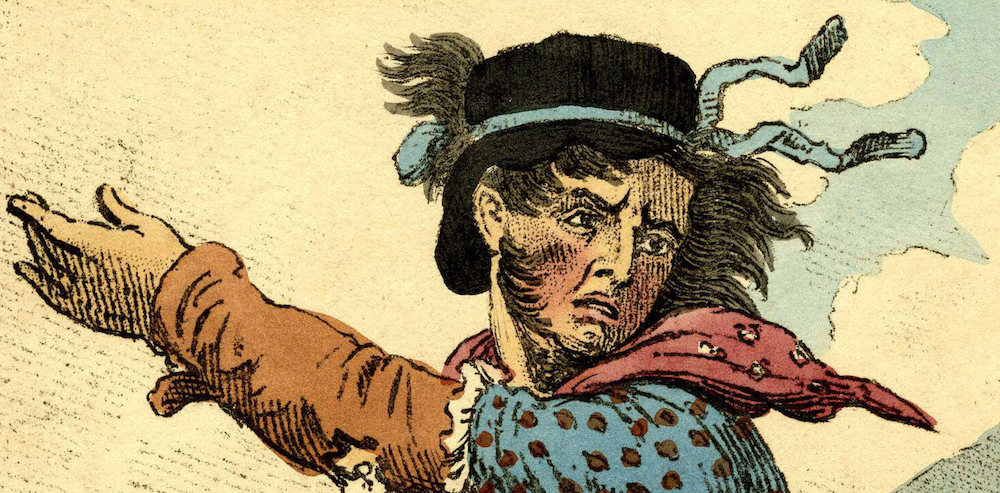
According to the University of Cambridge, that heyday came in 1812, the year of “an assault by some 150 armed laborers on a Huddersfield mill, in which soldiers opened fire on the mob to stop them breaking into the premises, fatally wounding two attackers.” This was the culmination of a series of protests across England, all of them inspired by anger at “new technologies, like automated looms, which were being used in the textile industry in place of the skilled work of artisans, threatening their livelihoods as a result.” These desperately infuriated protesters, whose documented actions include the murder of a Yorkshire mill owner, loudly expressed allegiance to one Ned Ludd, a weaver said to have taken the bold step of smashing a couple of newfangled stocking frames some 25 years before.
The story of Ludd’s early stand against mechanization may be even more questionable than the one about Milton Friedman and the spoons, but his name survives today nevertheless. In fact, it’s undergone somewhat of a revival thanks to the artificial-intelligence boom of recent years, during which even the modern “knowledge workers” have come to fear the trampling of their livelihoods under technology’s inexorable march. Their calls for restrictions on the development and deployment of AI are, in one side’s framing of the argument, merely the latest public spasm of Luddism, a movement explained in the video above from The History Guy. How many here in the twenty-first century, after all, would argue that the mass production of socks ultimately constituted a real loss for humanity?
Luddism never did count a large proportion of the English labor force as its own. Rather, the movement appealed to “a relatively ‘elite’ group” of legally protected workers only allowed into their professions after years of apprenticeship, at which point “they tended to feel that they were owed a living.” Nor did the conditions, hours, and compensation at the factories then springing up seem favorable compared to the way of life enjoyed by their predecessors. Similar sentiments may underlie the “Luddite clubs” forming on college campuses, on which NPR has reported, or this year’s social media-free “Summer of Ludd” at the New School, to say nothing of ongoing protests against data-center construction. It would be fascinating to hear what genuine nineteenth-century Luddites would make of our situation. Perhaps, one day, we can use AI to resurrect them.
Related content:
Hear Alan Watts’s 1960s Prediction That Automation Will Necessitate a Universal Basic Income
How Qatar Built Stadiums with Forced Labor
Based in Seoul, Colin Marshall writes and broadcasts on cities, language, and culture. He’s the author of the newsletter Books on Cities as well as the books 한국 요약 금지 (No Summarizing Korea) and Korean Newtro. Follow him on the social network formerly known as Twitter at @colinmarshall.
