

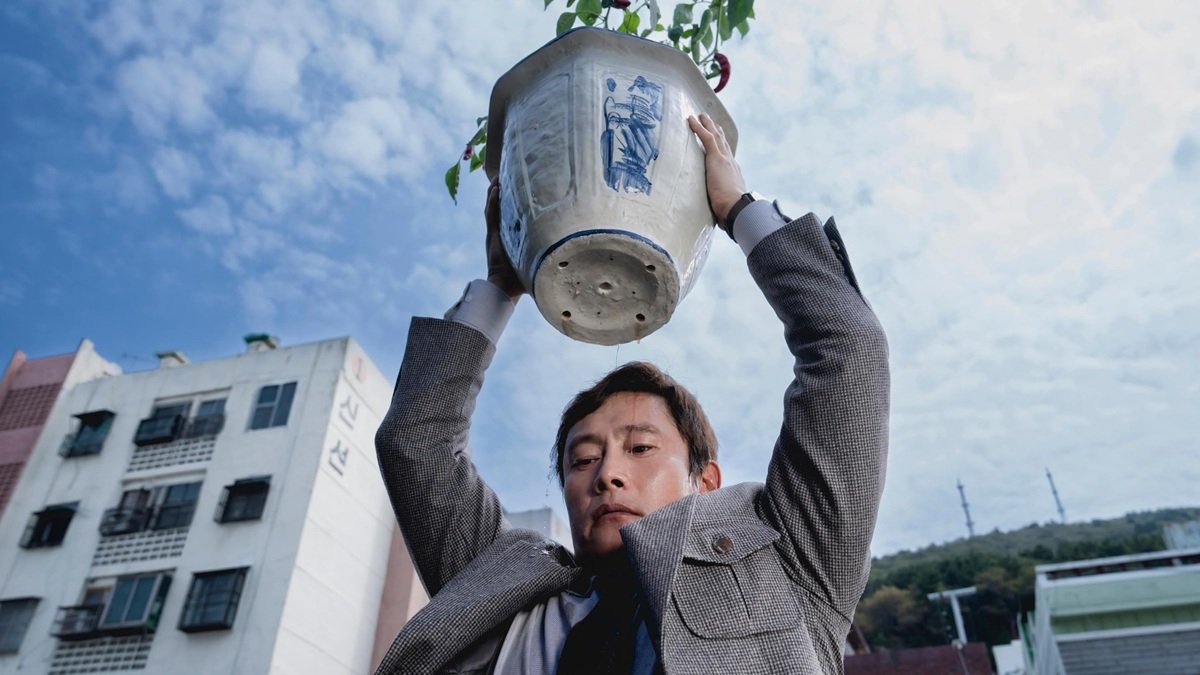

There’s a particular cruelty in doing everything right and still end up losing. You work hard, you climb the ladder, you buy the house, you provide for your family. And then one day, someone you’ve never met decides you’re expendable. Park Chan-wook‘s No Other Choice (Korean: 어쩔수가없다) understands that cruelty intimately. Based on Donald Westlake‘s novel The Ax, the film transplants an American story of economic collapse to South Korea and finds something universal in the rage of a man who played by all the rules and got screwed anyway.
Lee Byung-hun has been one of South Korea’s most reliable actors for decades, but this might be his finest work yet. In this film, he plays Yoo Man-su, an award-winning veteran employee of Solar Paper, a papermaking company where he’s climbed the ladder through years of dedication. Man-su has it all: good salary, his childhood home purchased and paid for, a wife Mi-ri (Son Ye-jin), a teenage stepson Si-one, a young daughter Ri-one who’s a cello prodigy, two dogs. It’s the kind of comfortable middle-class life that feels earned, deserved. And then Americans buy out Solar Paper and fire him along with dozens of others.
A Career-Best Performance
Lee doesn’t telegraph Man-su’s devastation in a showy, explosive way. Instead, it’s quieter than that, more insidious even. He comes home, tells his family that he’s among the production line that the new ownership decides to cut, and vows to resume papermaking within three months. It’s the kind of promise a man makes when he still believes the system will work for him if he just tries hard enough.
Thirteen months later, he’s doing low-paying retail work. His family has cut spending everywhere. They’ve given away the dogs. His daughter’s teacher wants her in advanced cello classes they can’t afford. The mortgage is past due. Man-su’s childhood home (the thing he worked his whole life to reclaim) is about to be sold to the parents of his stepson’s best friend. The humiliation is complete.
Lee plays all of this with a kind of coiled tension that makes you nervous even in quiet scenes. There’s a moment early on where Man-su suffers a toothache and ignores it, and you can see in Lee’s face that he’s ignoring more than just physical pain. He’s ignoring reality. He’s ignoring the fact that the life he built is collapsing. And when he finally decides to take drastic action, when he retrieves his father’s Vietnam War gun, Lee makes you understand exactly how a decent man convinces himself that extreme measures are justified. It’s a performance that’s very hard to ignore.
Park Chan-wook Does Class Warfare
Park Chan-wook adapting Donald Westlake’s The Ax shouldn’t work as well as it does. Westlake’s novel features upstate New York, and the specifics of American corporate culture inform the story. But Park, working with co-writers Lee Kyoung-mi, Don McKellar, and Lee Ja-hye, transplants the material to South Korea and finds something universal in Man-su’s desperation. The film works as a satirical black comedy that gradually stops feeling like fiction and starts becoming documentary-like in its resonance today.
Job insecurity and the erosion of middle-class stability aren’t abstract concepts in 2025. They’re lived-in realities for millions of people globally. Automation displaces workers, outsourcing kills local industries. Corporate buyouts gut companies and leave employees scrambling. Man-su’s story isn’t extreme; it’s just honest. He’s not some unhinged psychopath. On the contrary, he’s a man who played by the rules his entire life and got screwed anyway. Park understands this, and he films Man-su’s descent not as a thriller but as a procedural. Man-su identifies his competition for the few remaining papermaking jobs (Beom-mo played by Lee Sung-min, and Si-jo played by Cha Seung-won) and the film follows his increasingly desperate attempts to secure his future by any means necessary.
On the other hand, the corporate buyout by Americans isn’t a subtle symbolism. Far from it, it’s Park making a point about global capital and the myth of the American Dream. Local industries don’t just fail; they’re consumed by multinational corporations that answer to shareholders, not workers. Man-su worked for decades to secure his place in the world, and it took one boardroom decision to erase all of that. The film asks: what do you do when the system that promised stability reveals itself to be a lie?

Operating Within the Margins of Choicelessness
It’s tempting to compare No Other Choice to Bong Joon-ho‘s Parasite, and the comparison holds weight. Both films examine what happens when people are pushed to the margins of society, forced to operate within systems that were never designed to include them. But where the Kim family in Parasite resorts to deception and leeching, parasitically infiltrating a wealthy household through forged credentials and elaborate cons; Man-su goes further, diving headfirst into blood. Bong’s family schemes to survive, each member playing a role in a collective hustle that’s almost theatrical in its coordination. Park’s protagonist operates alone, methodically eliminating competition to reclaim what he believes rightfully should be his. The Kims are opportunists. Man-su is something darker: a true believer in the system whom the same system has betrayed.
Both films, though, ask the same question: when the system offers you no legitimate path forward, how far will you go? The difference is in the answer, and in what that answer reveals about class consciousness. The Kims want in. They’re not interested in dismantling the system or even questioning it. They just want a piece of the pie, and they’re willing to lie, manipulate, and betray each other to get it. There’s a scrappy, almost comedic energy to their desperation.
On the flip side, Man-su wants something else entirely: revenge disguised as justice, validation disguised as employment. He’s not trying to infiltrate the upper class. He’s trying to reclaim his place in the middle class, that promised land of stability that was supposed to be his reward for playing by the rules. His violence isn’t opportunistic. It’s ideological.
What makes both films so unsettling is that they understand desperation doesn’t excuse monstrosity, but they also understand why that desperation exists in the first place. Whereas Parasite shows you the collapse of the con, No Other Choice shows you what happens when the con was never the system failing you—it was believing in the system at all.
Masculinity in Freefall
One of the things I found fascinating in No Other Choice is its exploration of Man-su’s moral decline. Here, the film ties it directly to his sense of masculinity. He’s the provider, the head of household, the man who bought back his childhood home. When he loses his job, he doesn’t just lose income. He loses his identity.
Meanwhile, his wife Mi-ri starts working as a dental assistant for a suave dentist named Jin-ho (Yoo Yeon-seok). Man-su watches her at a costumed dance party, late because he was burying evidence, and sees her dancing with Jin-ho. The jealousy and rage that flood his face aren’t just about potential infidelity. They’re about feeling replaced, obsolete, emasculated.
This taps into something uncomfortably real. Traditional gender roles are being questioned and dismantled, and for men who built their identities around being providers, that shift can feel like annihilation. Man-su doesn’t know how to be a man if he’s not working, not providing. So he does the only thing that makes him feel powerful again: he takes control in the most extreme way possible. Park doesn’t excuse this. He doesn’t glorify it. But he understands it, and that understanding makes the film more disturbing than any amount of graphic violence could.
Park’s Signature Style in Service of Something New
Park has made a career out of stylized violence and moral ambiguity. Oldboy, Lady Vengeance, The Handmaiden: these are films where revenge, desire, and betrayal collide in operatic fashion. No Other Choice has all of Park’s trademarks (the meticulous framing, the dark humor, the sudden eruptions of brutality). But it’s wielded in service of something closer to documentary than fantasy.
Things go wrong for Man-su. His plans unravel in messy, chaotic ways that feel deeply un-cinematic compared to how Park usually operates. That’s the point. Desperate acts aren’t clean, after all. They don’t solve problems; they create new ones. Each choice Man-su makes complicates his life further, entangling him in consequences he never anticipated.
The violence here isn’t cathartic. It’s exhausting. By the end, Man-su has secured what he wanted: the job, the home, his family intact. From the outside, he’s won. But one of the most powerful images in the film (Man-su celebrating alone in a modern paper mill run by machines instead of workers) undercuts any sense of triumph. He’s secured his place in an industry that’s already obsolete. He’s sacrificed everything for nothing.
Cranking Moral Ambiguity Up to Eleven
Park refuses to make No Other Choice a simple morality tale. Is Man-su a victim of an unforgiving system or a man who lost all moral grounding? The answer is both, and that’s what makes the film so unsettling. You understand why Man-su does what he does. The film never asks you to condone it, but it asks you to sit with the uncomfortable truth that desperation can push ordinary people to extraordinary extremes.
There’s a scene where Man-su’s stepson Si-one witnesses something he shouldn’t. Si-one tells his mother. Mi-ri has to make an impossible choice about what to do with that information. These aren’t evil people. They’re people making impossible choices in an impossible situation. Even so, the film doesn’t let anyone off the hook: not Man-su for his actions, not the system that pushed him there, not the audience for understanding his logic.
This moral ambiguity feels especially relevant today. We’re living through crises—climate change, economic inequality, political polarization—where questions of justice, privilege, and accountability have no easy answers. No Other Choice taps into that uncertainty. It’s a film about a man who breaks every rule and still ends up with nothing that matters.

The Supporting Cast and Park’s Craft
Son Ye-jin as Mi-ri does strong work as a woman trying to hold her family together while her husband spirals. She’s not a passive victim; she makes her own compromises, starts her own life. When she and Man-su accuse each other of infidelity before reconciling, it’s one of the few moments where their marriage feels like an actual partnership rather than a transaction.
The film also gives Lee Sung-min and Cha Seung-won, the other unemployed papermakers competing for the same scarce jobs, enough dimension that you see them as people, not obstacles. Beom-mo is an unemployed drunk whose wife has given up on him. Si-jo sells shoes and talks about his young daughter. They’re men in the same desperate situation as Man-su, just trying to survive. Park Hee-soon‘s Seon-chul rounds out the cast as a social media influencer who landed the job Man-su wanted.
Cinematographer Kim Woo-hyung and composer Jo Yeong-wook, both frequent Park collaborators, do excellent work. The film looks crisp and modern, which makes the darker turns feel more jarring. Jo’s score, restrained most of the time, lets scenes breathe without telegraphing emotion.
If the film has a weakness, it’s that some of the subplots feel underdeveloped. Si-one’s theft storyline with his friend Geon-ho, while thematically relevant (kids learning to cheat the system because they see adults doing it), doesn’t integrate as smoothly as it could. The film sets up Ri-one’s cello prodigy arc without much payoff. These are minor complaints in a film that otherwise fires on all cylinders, but they’re worth noting.
‘No Other Choice’: Why It Matters Now
No Other Choice is the kind of film that feels ripped from today’s headlines, even though it’s based on a novel from 1997. The anxieties it explores—job loss, economic displacement, the collapse of the middle class—haven’t gone away; they’ve gotten worse. Park Chan-wook has made a film that’s darkly funny, viscerally uncomfortable, and disturbingly prescient, blending satire and despair with his trademark precision.
And in it, Lee Byung-hun delivers one of the year’s best performances, playing a man who thinks he has no other choice and makes all the wrong ones anyway.


A self-described cinephile who can’t stop talking—and writing—about films. Paul also moonlights as ghostwriter and editor for a few memoirs. He currently resides in the Philippines.
