

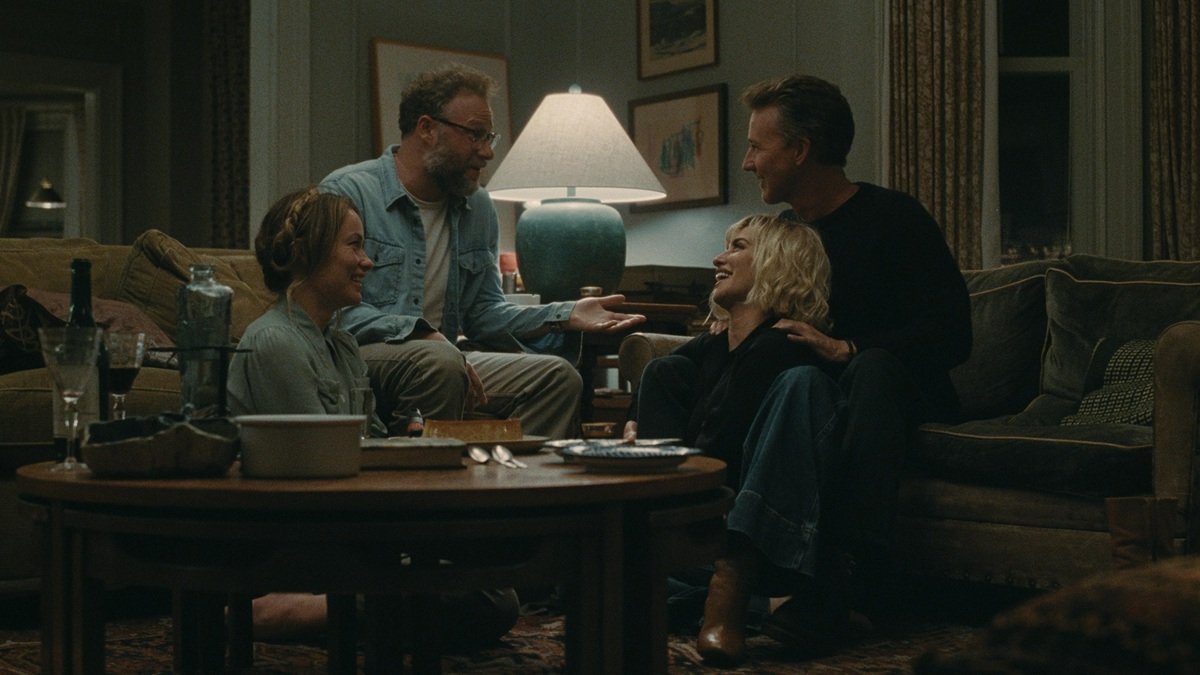
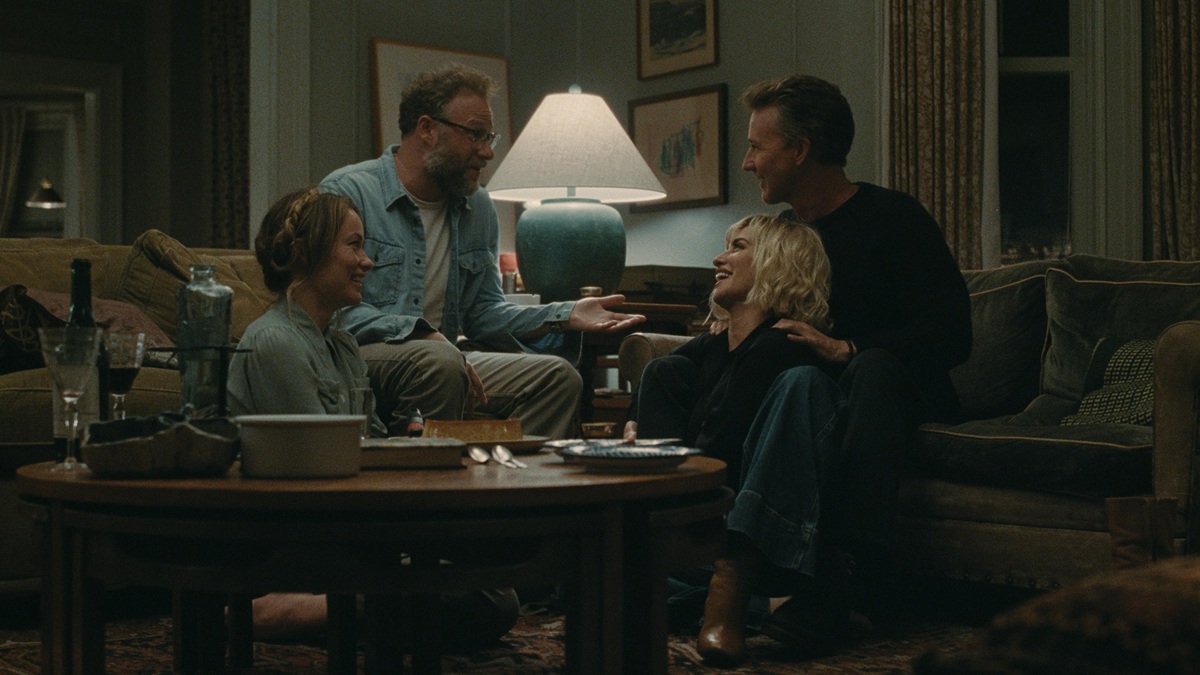
It’s one thing to hear your upstairs neighbors having better sex than you. It’s another to invite them downstairs for dinner.
That’s the bad decision at the center of Olivia Wilde’s The Invite, though it isn’t Joe (Seth Rogen) who makes it. His wife, Angela (Wilde), invites their neighbors over without telling him, partly because she wants to show off the San Francisco apartment she has spent months renovating. Joe, meanwhile, would rather they keep their voices down, their furniture still, and whatever else they do upstairs out of earshot.
The neighbors are Piña (Penelope Cruz), a sexologist, and Hawk (Edward Norton), a former firefighter. They’re attractive, uninhibited, and seemingly more at ease with each other than Joe and Angela have been in years. Angela is fascinated by them. Joe is irritated before they even arrive. Then the evening reveals its real purpose: Piña and Hawk practice non-monogamy, and they’re interested in the couple downstairs.
From there, The Invite turns into a long dinner-table negotiation about sex, marriage, jealousy, aging, depression, disappointment, and the stories people tell themselves about who ruined whose life. The film takes a while to settle into that conversation, and it loses some nerve once the night begins winding down. For much of its middle, however, Wilde finds a funny and genuinely insightful adult comedy about a marriage in which resentment may be the only closeness left.
The Marriage Beneath the Jokes
Rogen is terrific because Joe initially resembles a character he could play without much effort. He’s exasperated, sarcastic, physically uncomfortable, and always ready with a line whenever a conversation threatens to expose him. Yet Rogen keeps letting the hurt show through. Beneath Joe’s irritation is the embarrassment of a man who suspects his better life has already passed him by and doesn’t know whom to blame except the person beside him.
Joe was once a musician. Now he teaches music, lives with depression, and treats enthusiasm as something faintly suspicious. His disappointment has hardened into a worldview. If he can mock something before it matters, then it can’t embarrass him by failing. If he assumes the worst, he never has to admit that he wanted anything better.
The film doesn’t dismiss his depression, nor does Rogen use it to make Joe sympathetic by default. Joe is suffering, but he has also learned how to hide inside that suffering. He can act as though Angela alone trapped him in a life he partly chose, then use every joke as a way to keep her from answering back on equal terms. Rogen makes that contradiction human. Joe’s vulnerability doesn’t cancel his cruelty, and his cruelty doesn’t make the pain beneath it less convincing. He can be wounded and remain very good at wounding everybody else.
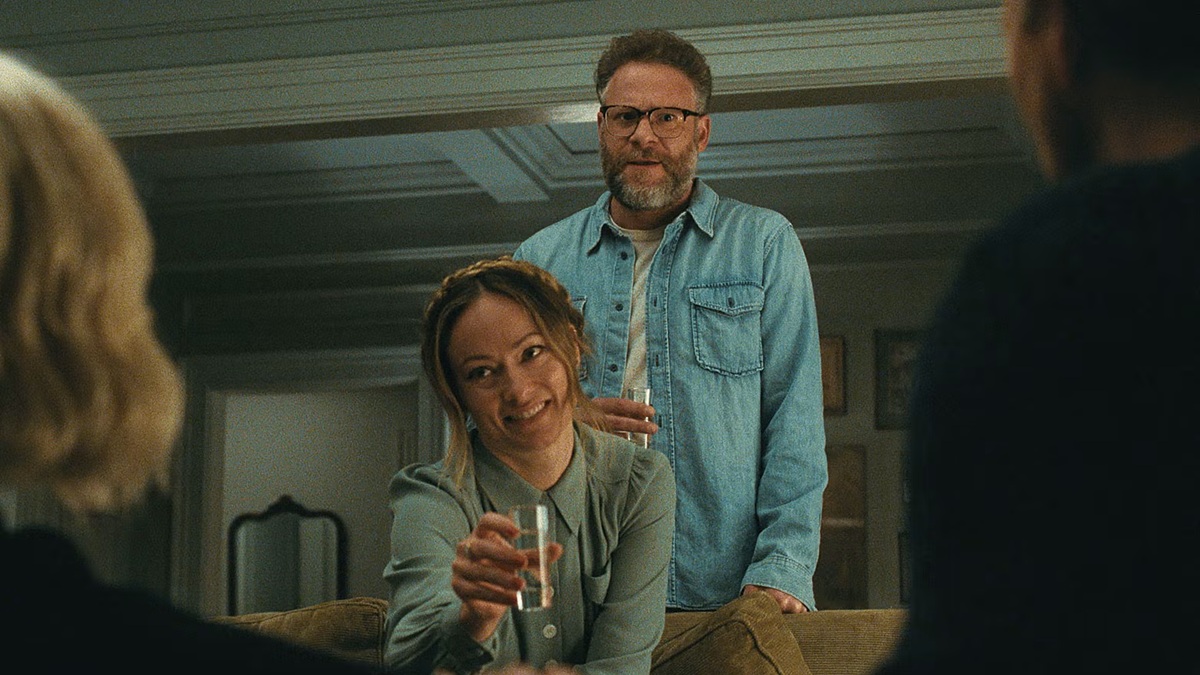
Wilde, meanwhile, gives Angela a more outwardly anxious energy. She wants to impress the neighbors, keep dinner moving, defend her marriage, and prove that she hasn’t entirely lost the spontaneous person she remembers being. Her interest in Piña and Hawk isn’t purely sexual, either. They seem to embody a version of adulthood that hasn’t settled into routine and low-grade mutual annoyance.
That’s where the renovated apartment begins to matter. Angela can replace the fixtures, redo the rooms, and arrange the furniture until the space looks like the life she wants other people to see. What she can’t do as easily is repair the relationship taking place inside it. The apartment is polished, expensive-looking, and finished. The marriage isn’t. Wilde doesn’t belabor that idea, which helps. The renovation sits there as a visual fact rather than a metaphor somebody eventually explains. Angela has made the apartment beautiful because beauty is something she can control. Joe is harder to redesign.
Their couple’s arguments work the same way. Joe and Angela know each other too well to fight harmlessly. Their jokes double as small punishments, delivered with the ease of people who have spent years learning where the bruises are. At first, the exchanges have the rhythm of familiar marital banter. Once Piña and Hawk are watching, though, the same lines start sounding uglier.
Resentment has become one of the few languages Joe and Angela still speak fluently, and Rashida Jones and Will McCormack’s screenplay (based on the Spanish film The People Upstairs by Cesc Gay, which in turn was based on Gay’s own play) is strongest when that bitterness slips out through interruptions, offhand remarks, and jokes that go half a step too far. The dialogue doesn’t stop the film from explaining the marriage. It instead lets the marriage expose itself, one cheap shot at a time.
While the film makes it clear that Joe and Angela talk to win, it presents Piña and Hawk as more honest, more evolved, and far more comfortable discussing what they want. As the evening continues, though, that image starts showing cracks too. Their openness has rules, insecurities, and jealousies of its own. They aren’t necessarily the freer, healthier alternative that Angela imagines. Their problems simply come dressed in more progressive language.
That makes them mirrors rather than opposites. They have a different arrangement, but they’re no less capable of performance, denial, or using the vocabulary of honesty to avoid saying something difficult. The invitation may be sexual, yet the movie is more interested in what the proposition allows Joe and Angela to imagine. They aren’t only considering different partners. They’re considering different versions of themselves: more attractive, more confident, and no longer burdened by years of unfinished arguments. Piña and Hawk make another life appear temporarily available. Of course, changing the rules of a relationship doesn’t automatically change the people inside it.
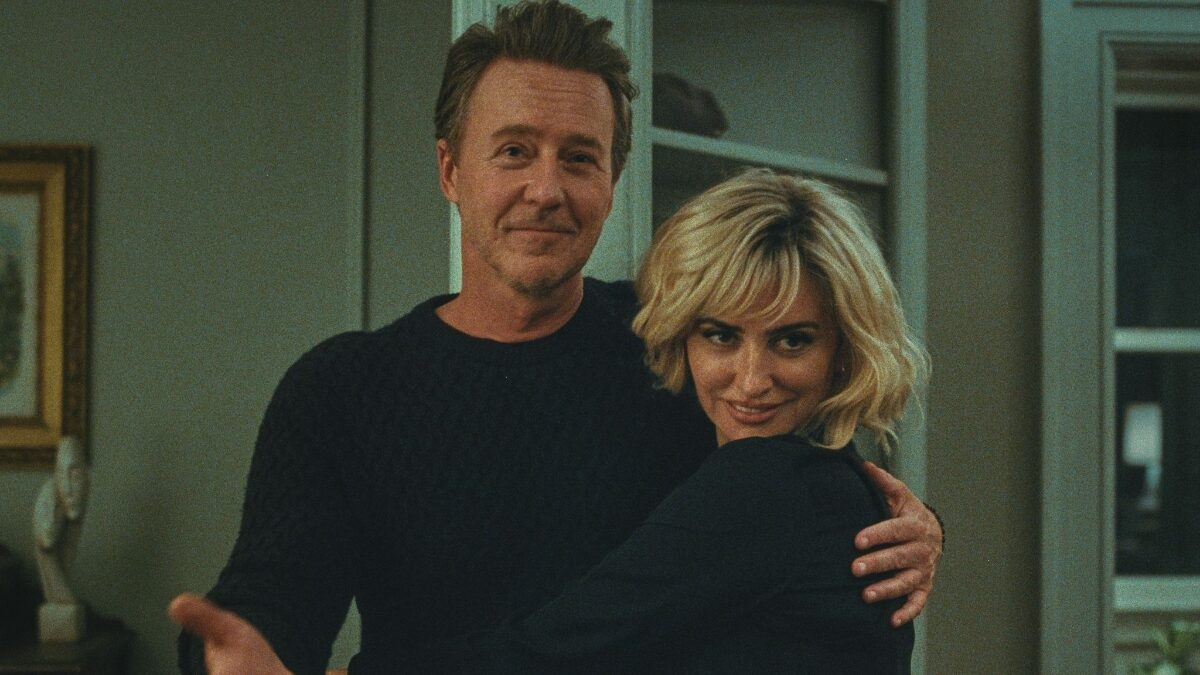
Once the Neighbors Walk In
The Invite improves considerably when Cruz and Norton enter the apartment. Before then, Wilde works too hard to establish that Joe and Angela are unhappy. The cutting, camera movement, score, and screenplay all keep arriving at the same conclusion, even though Rogen and Wilde have already made the tension clear. The opening stretches feel arranged rather than observed. Every visual choice seems eager to announce the strain in the marriage, every line carries a little extra emphasis, and the film doesn’t quite trust the discomfort to build on its own.
Then the guests arrive, dinner begins, and the movie finally relaxes. The conversations have room to breathe. Alliances shift without warning, and the jokes start emerging from the actors’ reactions rather than from the screenplay marching toward another punchline. Someone is always leaving the room, overhearing the wrong part of a conversation, or noticing their partner connecting with somebody else. The apartment gradually turns from Angela’s showpiece into an emotional obstacle course.
Cruz brings the energy the film has been missing. Piña is warm, invasive, flirtatious, and professionally incapable of leaving another person’s psyche alone. She can turn a casual exchange into either seduction or diagnosis, sometimes both, and Cruz gives her enough volatility to keep the character from becoming a simple symbol of sexual freedom. Norton, on the other hand, goes in the opposite direction. Hawk appears calm enough to be the least complicated person at the table, which makes him easy to underestimate. Norton listens, waits, and lets the other characters fill the silence around him. Then, as the evening continues, he exposes the needs and insecurities beneath that composure.
The four actors have very different comic rhythms, and that becomes one of the film’s strengths once Wilde stops trying to control every beat. Rogen stays conversational even when Joe is cornered. Wilde plays Angela’s panic through her face and body, as though every pause might expose her. Cruz pushes outward, while Norton holds back until Hawk finally has something worth saying.
Together, they give the film the energy of a Mike Nichols chamber comedy, with Noah Baumbach’s flair. The comparisons to Who’s Afraid of Virginia Woolf? are valid, although The Invite is a gentler descendant (and way better than Roman Polanski’s Carnage, itself a film about four bickering adults). Both films understand what alcohol, outside company, and the suggestion of sexual transgression can do to people who have spent years saving their best insults for private use.
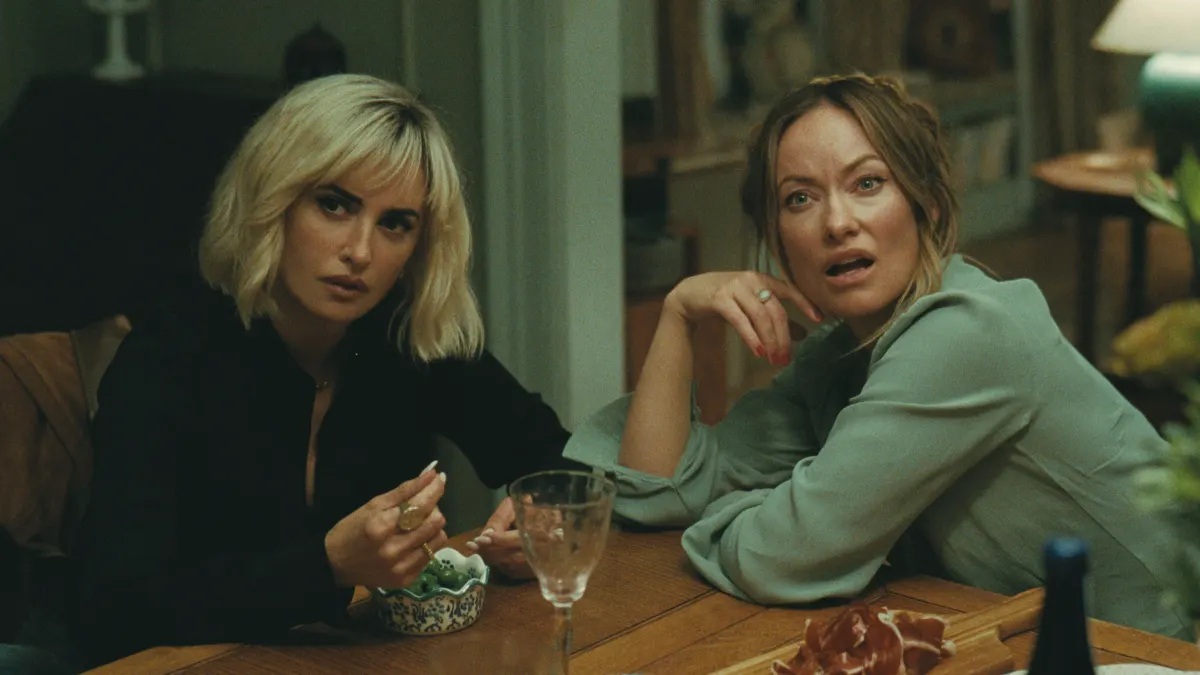
‘The Invite’: An Overall Return to Form for Olivia Wilde
Wilde also keeps a talk-heavy, mostly single-location movie visually active. Doorways divide the characters, rooms provide temporary escape, and different pairings change the emotional shape of the apartment. The filmmaking feels most assured when Wilde’s visual decisions remain invisible. As the evening’s rhythm takes hold, her camera navigates the room with a precision that allows the ensemble’s friction to occupy the center of the frame.
Shooting on 35mm was a brilliant choice, too. The grain and warmth give the apartment a texture that cleaner digital photography might have flattened, while the actors’ faces retain every flush, grimace, and flicker of embarrassment. It also helps The Invite escape the boxed-in look that often comes with stage adaptations. The setting may be confined, but the images never feel airless.
That alone makes The Invite a marked improvement over Don’t Worry Darling, a film that often tried to impose importance on material that couldn’t support it. This is closer to the comic instincts Wilde showed in Booksmart. It isn’t as good as that film, which had a more natural looseness and emotional generosity. Fortunately, the smaller scale of this film gives room to focus her strengths. There’s a confidence here that Don’t Worry Darling didn’t have. At the same time, Wilde occasionally gets in her own way. Dev Hynes’s score is especially hit-and-miss because it keeps underlining jokes and emotional turns the actors have already made obvious. At certain points, the music behaves like someone nudging you in the theater: “Did you catch that? This part matters.”
The movie also runs longer than its premise comfortably allows. Its central stretch remains engaging because every conversation alters the balance among the four characters, but a few grievances circle the table once too often. A tighter cut could have made the night feel less arranged and more dangerous.
Even so, Wilde handles the transition away from comedy better than expected. The film doesn’t simply grow sad. It starts sounding more recognizable. The jokes remain, but they no longer let anyone retreat from what has been said, and Joe and Angela’s marriage loses the protective exaggeration of farce. Their unhappiness begins to look lived-in rather than performed.

Then the third act starts searching for the safest route home.
After raising interesting questions about monogamy, sexual freedom, regret, and the stories couples tell about who ruined whose life, The Invite turns toward a more reassuring resolution. The characters explain themselves with a clarity that doesn’t quite match how defensive they’ve been all evening, and the film softens at the point when it could have pushed its ideas somewhere less comfortable.
That choice doesn’t erase the strength of the screenplay or the performances, but it reveals how dependent the movie is on the dinner party. Before Piña and Hawk arrive, it strains. After they begin making their exit, it grows conventional. Between those points, The Invite is funny, uncomfortable, and perceptive about four people trying to figure out whether they want different partners, different marriages, or simply some distance from the people they’ve allowed themselves to become.


A self-described cinephile who can’t stop talking—and writing—about films. Paul also moonlights as ghostwriter and editor for a few memoirs. He currently resides in the Philippines.
