

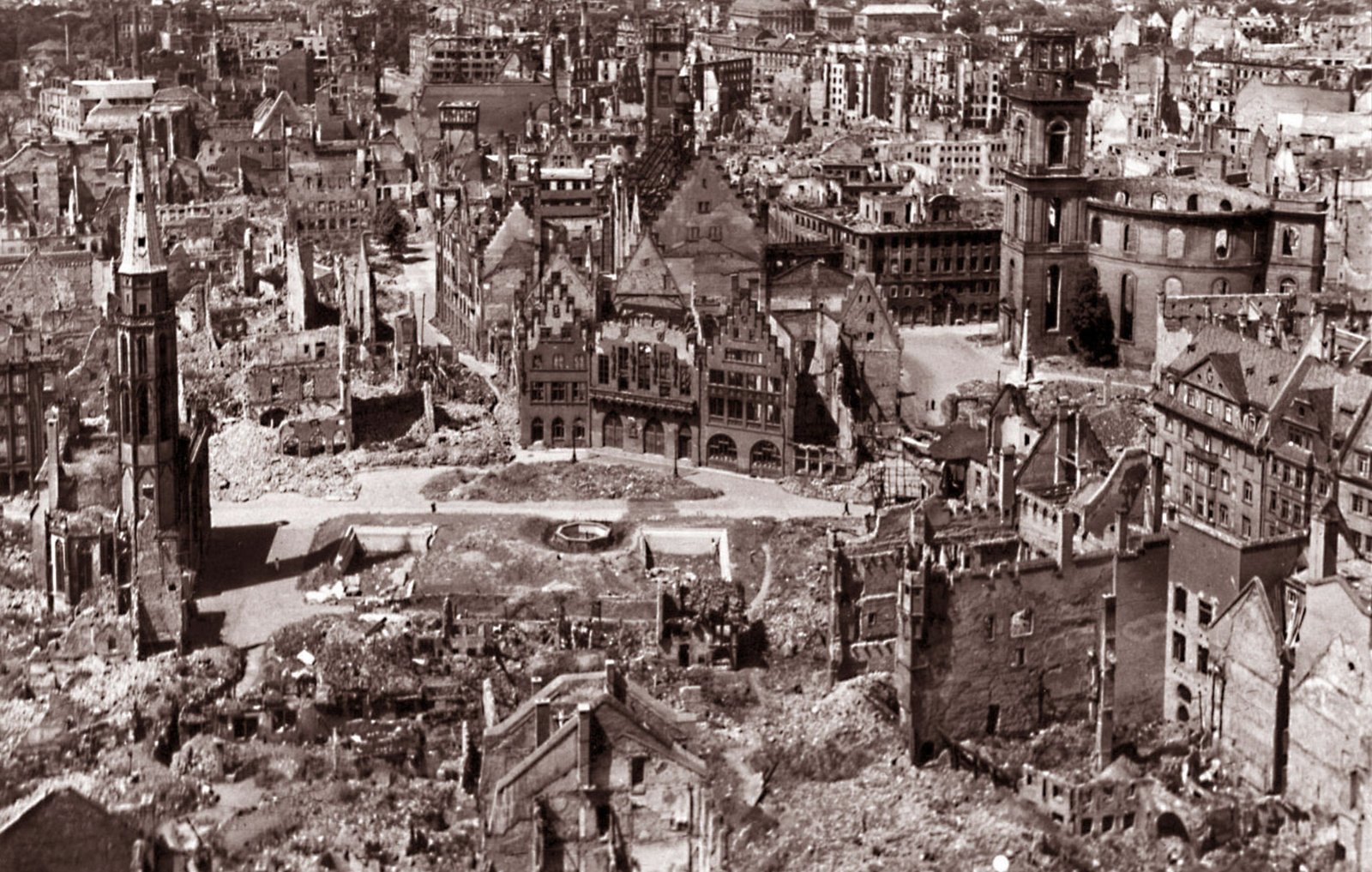
In the spring of 1945, Duke economics Professor Calvin B. Hoover traveled to Germany at the behest of the US Office of Strategic Services, the forerunner of the CIA. They wanted him to assess the German economy in the wake of the recent surrender of the Nazis in World War II.
What he found was sobering. Central Frankfurt was “almost pulverized,” Hoover reported. The city of Munich “was a bombed-out wreck.” An American tank repair battalion was stationed in its largest park, where a small lake, once a home for ducks, had been drained and used for a debris dump. And in the capital, Berlin, he found “unbelievable desolation” and “the smell of sewage and inadequately burned bodies.”
This was the price paid to rid the world of Hitler’s “Third Reich” and its planned thousand-year reign. But it left behind a mess to clean up, and destroyed cities were only a part of it. Part of that mess was moral. What did Germany now owe to the world, and how could that debt be collected?
This is the subject of economic historian Tobias Straumann’s book, Out of Hitler’s Shadow: Debt, Guilt and the German Economic Miracle. Focusing on the period 1950 to 1953, when diplomats and politicians worked out the financial deals that reincorporated western Germany back into the free world, it effectively explores the first two ideas in the book’s subtitle — debt and guilt. Straumann’s thesis is that the Allies took a useful lesson from the end of World War I, when harsh reparations had impoverished Germany and fueled the rise of the Nazis.
But the third item in the subtitle, the German economic miracle, Straumann glosses over. That’s unfortunate, because just as the Allies took a lesson from World War I, today we should take a lesson from West Germany’s postwar economic performance. It’s a case study on the efficacy of free markets over central planning.
The Problem of Germany’s Debts
In 1947, another Hoover, former US president Herbert, arrived in Germany on a new fact-finding mission. It was at the behest of then-president Truman. The United States, Britain, and France still occupied and controlled three separate zones of western Germany (with eastern Germany controlled by the Soviet Union).
The western Allies enforced strict rationing and price controls across their zones. Store shelves were mostly bare. Even potable water was in short supply. Germans were kept alive by foreign aid, including the Berlin Airlift and the Marshall Plan. Military authorities and their economic advisors, including John Kenneth Galbraith, believed they were making the best of a bad situation. But a stalled German economy dependent on foreign aid was not good for anyone in the long run.
“We can keep Germany in these economic chains,” Hoover told Truman, “but it will also keep Europe in rags.”
In 1949, the United States, Britain, and France united their zones into the Federal Republic of Germany, then called West Germany, allowing negotiations on the new nation’s financial obligations for the war to begin in earnest.
Triangulating between the western Allies and West Germany’s newly elected representatives and its Chancellor Konrad Adenauer was far from simple. Straumann chronicles the diplomatic moves and countermoves in impressive detail.
In March 1951, Adenauer formally acknowledged, in a letter to the Allied High Commission, German responsibility for an appropriate level of pre-war external debt and postwar foreign aid.
The next major issue, that of reparations to Israel for the Holocaust, was delicate, to say the least. The modern, political State of Israel had only been established in 1948. And the more militant Israelis opposed any reparations settlement, viewing it as “blood money.” They wanted a state of pure hostility between the two nations preserved.
“[Germany] must know that there is not and never will be any pardon for their deeds,” one group, the Organization of Jewish Partisans, told a French newspaper in March 1952.
Negotiations finally settled on a figure of three billion Deutsche Marks (DM) paid by West Germany to Israel, provisionally over 12-16 years, with an additional DM 450 million for non-Israeli victims. Case-by-case compensation to individuals would eventually pay out a much larger figure, estimated by Straumann to be in the tens of billions of Deutsche Marks.
Representatives signed the Luxembourg Agreement in September of 1952. To avoid potential violence from those who opposed the accord, the ceremony occurred at an earlier time (8 am) and in a different place (the city hall in Luxembourg) than had been publicly announced. German Chancellor Adenauer and Israeli Foreign Minister Moshe Sharett shook hands and walked into a conference room where the two delegations sat across from each other at a long table. The signing was a gigantic step forward, though relations between the two nations would not be fully normalized for fifteen years.
At another long table, this one at Londonderry House in Westminster, the London Debt Agreement was signed in February of 1953. It established repayment terms for West Germany’s pre-war debt and postwar foreign aid. Pre-war creditors took a “haircut” of some 50 cents on the dollar. And the United States wrote off 62.5 percent of what it was owed for postwar aid. The final bill, Straumann reports, left West Germany with a foreign debt ratio of 10 percent of GDP. After World War I, that figure had been 200 percent.
Perhaps most significantly, the London Agreement affirmed that any additional reparations would not be negotiated until East and West Germany could be reunited.
That didn’t happen, of course, until 1990, when ordinary Germans attacked both sides of the Berlin Wall with hammers, chisels, and crowbars. It was an exuberant reunification, decades overdue. Afterwards, the World War II Allies decided no new reparations would be negotiated.
“Hitler’s debt appears to have been canceled irrevocably,” Straumann writes.
Economics of the Miracle
A fine line separates justice and revenge. The most interesting parts of Straumann’s book ponder this for postwar Germany. He argues that subsequent events — no second Hitler, no third world war, a prosperous Europe, peaceful reunification — mostly justify the western Allies’ moderate terms.
But at the time of the London Agreement, many considered those terms far too generous. Others questioned whether West Germany would be able to pay even the agreed-upon amounts. But in 1953, West Germany’s GDP grew by some 8 percent, a torrid pace it would sustain for ten years.
“Contrary to all expectations,” Straumann writes, “the post-war period turned out to be a golden age of peace and prosperity.”
By this time, the nightmarish scenes Calvin Hoover saw on his 1945 tour had been replaced by rebuilt cities, churning factories, bustling stores, and comfortable neighborhoods. New cars, from Mercedes-Benzes to BMWs to Volkswagens, circulated along streets and autobahns.
West Germany enjoyed some 25 years of sustained expansion, continuing into the 1970s, when a growing welfare state caught up to the sprinting economy and growth slowed dramatically. Straumann doesn’t comment much on the sources of this long economic miracle, the Wirtschaftswunder. But he does give some credit to the man arguably most responsible for it.
In June of 1948, Ludwig Erhard, a German who had never joined the Nazis, was director of economics for the United States’ and UK’s occupation zones. A classically liberal economist with a PhD from the University of Frankfurt, he had helped the zones transition to the new Deutsche Mark currency.
At the time, stores were still barren and black markets allocated many goods and services. Without authority or approval from the occupying military leaders, Erhard moved to eliminate extensive consumer price and wage controls.
“As a result,” Straumann writes, “barter trade disappeared literally overnight, and the shops were full again.” The policy move was so successful, it was politically impossible to reverse.
A new economic challenge came in 1950. Due to disruption from the Korean War, West Germany experienced a trade deficit and balance of payments crisis. Inflation spiked. Planning-oriented politicians and economists demanded a return of price controls. But Erhard, by now the national minister for economic affairs, successfully campaigned against it. With the help of structural reforms and an international loan, by April of 1951 Germany achieved a trade surplus. It was the beginning of a long run of surpluses that were a key driver of the economic miracle.
Erhard’s market-based liberalization included slashing taxes and lowering tariffs, catalyzing rapid growth. West Germany not only left East Germany in its wake, but also surpassed the economies of Britain and France, which pursued more government-directed models. Between 1950 and 1969, German real GDP growth averaged 6.2 percent. Britain and France averaged 2.7 and 5 percent, respectively. By the early 1960s, West Germany was the largest economy in Europe and third in the world.
Erhard’s popularity also grew, and he served as chancellor from 1963 to 1966. As West Germans enjoyed the benefits of the economy he helped create, East Germans suffered privation and oppression. They had traded the Nazis, national socialists, for Soviet socialists.
Straumann’s book is a reminder that it’s possible to learn from history. Americans today would do well to learn about West and East Germany: socialism often presents itself as medicine for economic ills, only to introduce maladies of its own.
