


SCORM File: What It Is, How It Works, And Why It Matters
A SCORM file is a standardized package of eLearning content that communicates learner data, such as completion, scores, and time, to a SCORM-compliant Learning Management System (LMS). While it sits at the center of most corporate digital learning ecosystems, many professionals who rely on it every day struggle to clearly define it. Everyone uses it, but few can explain what it actually is. However, when you are investing in compliance training, onboarding programs, or other training initiatives, understanding the infrastructure behind your content is a must.
Basically, it is the underlying framework that allows organizations to scale training across departments, regions, and vendors without losing tracking integrity. The SCORM file format ensures that learning content can communicate consistently with an LMS, regardless of who created it or where it is deployed.
This interoperability is why SCORM remains central to corporate learning. Whether you are evaluating a new SCORM authoring tool, selecting a SCORM file creator, or creating SCORM content internally, the strategic question is the same: Will this content work seamlessly across systems while delivering reliable reporting? In this guide, we will clarify what SCORM files are, break down the SCORM format, explain how SCORM training works inside an LMS, and outline how to create a SCORM file with long-term scalability in mind.
In This Guide
What Is A SCORM File?
SCORM stands for Sharable Content Object Reference Model. It is a technical standard developed by the Advanced Distributed Learning (ADL) initiative to ensure that eLearning content works across different platforms.
In simple terms, SCORM creates a shared language between online courses and LMSs. Without it, content built in one tool might not function properly in another system. With it, organizations can move training content between systems without having to rebuild it from scratch. When professionals ask, “What is SCORM?” the practical answer is this: it is a framework that guarantees interoperability, portability, and basic learner tracking between content and an LMS.
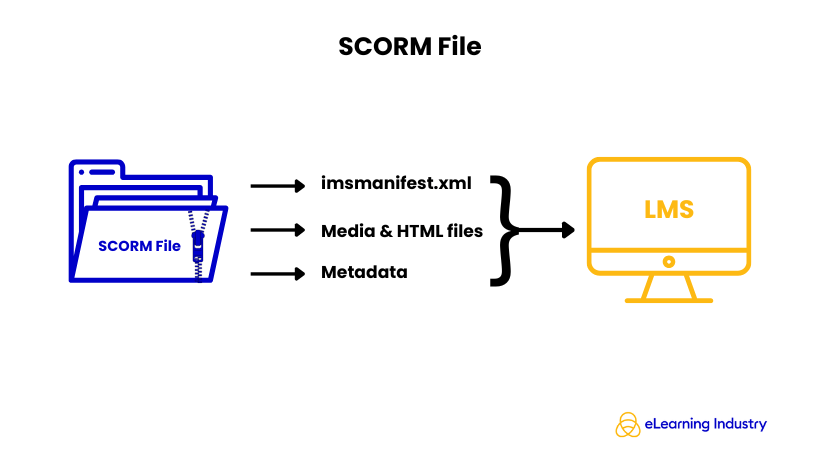
Now, a SCORM file is the packaged version of that standardized content. Technically, it is a .zip file containing everything required for a course to run in a SCORM-compliant LMS. This includes HTML pages, media assets, assessments, and a special configuration file. Once uploaded into an LMS, the SCORM file communicates through a JavaScript API. This allows the system to track completion status, assessment scores, time spent, and bookmarking data.
Inside the SCORM file format, you will typically find:
- imsmanifest.xml (the core instruction file).
- Resource files (HTML, CSS, JavaScript, media).
- Metadata describing the course structure.
The SCORM file format follows strict packaging rules so LMS platforms can correctly interpret and launch the course.
How Does A SCORM File Work In An LMS?
At the core of the SCORM file format is a browser-based API adapter. When a learner launches a course, the LMS loads the SCORM file and establishes a JavaScript connection between the course and the system. Through this API, the SCORM file can send and receive data in real time. This data includes:
- Completion status
- Score results
- Pass/fail outcomes
- suspend_data (used to store learner progress for bookmarking)
In simple terms, the SCORM file tells the LMS what the learner did, how they performed, and where they left off. The LMS then stores that data for reporting and compliance tracking.
What Data Can SCORM Files Track?
Most SCORM files are designed to track structured learning interactions. Common data points include:
- Completion status (completed/incomplete)
- Pass or fail
- Time spent in the course
- Number of attempts
- Bookmarking progress for resumed sessions
For compliance-heavy environments, this level of tracking is often sufficient for SCORM training programs.
SCORM 1.2 Vs. SCORM 2004
Both versions follow the same core communication model, but they differ in some respects. SCORM 1.2 supports basic tracking and is widely compatible. SCORM 2004 introduced sequencing rules, improved reporting capabilities, and more complex navigation logic. For most organizations, SCORM 1.2 remains operationally adequate due to broad LMS compatibility. However, enterprises requiring structured learning paths and advanced sequencing may benefit from SCORM 2004.
Tip: If you want to track learning in a traditional LMS, a SCORM file is a good choice. However, if you need detailed information about learner behavior beyond the LMS, newer options like xAPI might be better.
SCORM File Format Explained
Let’s break down the SCORM file format. As mentioned above and shown in the graph, at the heart of every SCORM package is the imsmanifest.xml file, commonly called the manifest. This file serves as a map for the LMS: it lists all SCOs (Sharable Content Objects), tracks their sequence, and defines how learner progress should be recorded. Each SCO represents a standalone piece of content, such as a video, quiz, or module, that can communicate completion data back to the LMS.
SCORM packages also include assets like images, PDFs, and media files. These differ from learning objects, which are the interactive modules or lessons themselves. Proper organization ensures the LMS can load each component correctly and track learner activity without errors.
Finally, metadata in the SCORM file format is crucial. Metadata describes the content, such as title, language, version, and learning objectives. Accurate metadata improves searchability, reporting, and compliance auditing, making it easier for organizations to manage large training libraries. Here’s a table to help you get a better grasp.
Component |
Purpose |
imsmanifest.xml |
Maps all SCOs and defines sequencing and tracking. |
SCOs |
Independent learning modules that report completion, scores, or time. |
Assets |
Supporting files like images, audio, or PDFs. |
Metadata |
Provides information about content for tracking, search, and reporting. |
How To Create A SCORM File
Creating a SCORM file may sound technical, but for L&D leaders, HR directors, and training managers, it’s more about making strategic choices than writing code. The process of creating SCORM content can be broken down into four clear steps, each critical for producing effective, trackable, and compliant learning experiences.
Step 1: Choose A SCORM Authoring Tool
The first step in creating a SCORM file is selecting the right SCORM authoring tool. This software allows your Instructional Designers or content creators to build learning modules and export them as SCORM files compatible with your LMS.
When evaluating authoring tools, consider their capabilities: support for multimedia content, interactive elements, assessment design, mobile responsiveness, and SCORM version export options. Enterprise teams should also look for collaboration features, version control, and integration with existing LMS platforms. Choosing the right SCORM file creator ensures that your content can be reused, updated, and tracked efficiently without technical bottlenecks.
Step 2: Create SCORM Content
Once your authoring tool is selected, the next step is to develop the actual learning content. Start by aligning the content with your Instructional Design strategy and clearly defining learning objectives. Each SCORM file should have a logical flow, clear outcomes, and measurable assessment points.
Incorporate multimedia, such as videos, graphics, and simulations, to engage learners, but ensure these elements do not hinder SCORM tracking. Designing assessments within the SCORM file allows you to capture learner performance, completion, and interaction data, which is critical for reporting and compliance. This step transforms your instructional plans into SCORM-compliant learning modules that can deliver measurable results.
Step 3: Export As SCORM Package
After content creation, the SCORM file must be exported. Most authoring tools let you choose between SCORM 1.2 or SCORM 2004, depending on your LMS’s compatibility and reporting needs. Configure tracking settings to determine which learner actions are recorded, including completion status, scores, and time spent. Correctly exporting your SCORM file ensures it functions as expected and communicates effectively with the LMS.
Step 4: Upload To A SCORM-Compliant LMS
The final step is to upload your SCORM file to an LMS. Once uploaded, run thorough testing to confirm that content launches correctly, assessments track properly, and all multimedia elements display as intended. Debugging errors and conducting quality assurance checks before release are essential for a smooth learner experience.
What Is A SCORM File Creator?
A SCORM file creator is a tool that helps Instructional Designers and L&D professionals package their eLearning content into a SCORM file for upload to an LMS. It is important to understand that a SCORM file creator is not a standalone file builder. Instead, it is typically part of a larger authoring tool or content creation platform. These tools allow you to design courses, add quizzes, embed media, and then export everything as a SCORM package that tracks learner progress.
Some LMS platforms also include built-in SCORM creation features. These are convenient for organizations that want to create SCORM content without purchasing separate authoring tools. However, built-in options may offer less design flexibility and fewer advanced tracking capabilities than dedicated SCORM authoring tools.
When evaluating a SCORM file creator, organizations need to consider the following:
- Business size
Large enterprises often require scalability, advanced reporting, and governance features to manage hundreds or thousands of SCORM files across multiple teams. Smaller businesses may prioritize ease of use, speed of SCORM file creation, and cost-effectiveness. - Governance
Using a reliable SCORM file creator ensures consistent SCORM formats, prevents errors when importing content into an LMS, and maintains compliance with eLearning standards.
Ultimately, a SCORM file creator bridges the gap between Instructional Design and LMS deployment. It allows L&D leaders, HR directors, and learning teams to deliver structured, trackable SCORM training that aligns with organizational goals, compliance requirements, and professional development initiatives. Choosing the right SCORM file creator can save time, reduce errors, and ensure that your files work seamlessly across platforms.
Common Challenges
While SCORM files have long been the backbone of corporate eLearning, professionals often encounter practical challenges when deploying them across different platforms.
LMS Compatibility Errors
Not all LMSs support every version of SCORM, and differences between SCORM 1.2 and SCORM 2004 can create unexpected behavior. To reduce risk, L&D leaders should ensure their SCORM files are tested in a sandbox environment before full deployment and confirm that the LMS is fully SCORM-compliant.
Reporting Inconsistencies
SCORM files rely on the LMS to track completion, scores, and time spent, but not all systems interpret this data consistently. Regular audits of learner reports and clear communication with LMS administrators can help prevent misaligned data, ensuring that SCORM training remains accurate and actionable.
Version Conflicts
Mixing content created in different SCORM formats can lead to errors or broken interactions. Standardizing on a single SCORM file format across all courses helps maintain stability and simplifies updates.
Mobile Responsiveness
Older SCORM files may not display correctly on smartphones or tablets. Using a modern SCORM authoring tool that supports responsive design ensures that learners can access content anywhere, without compromising usability.
Slow Loading Or System Crashes
Large file sizes can cause slow loading times or system crashes. Compressing multimedia assets, optimizing images, and breaking content into smaller modules can improve performance while keeping the SCORM file manageable.
SCORM Vs. Other eLearning Standards
For many learning leaders, understanding how SCORM compares to other eLearning standards is essential for making informed decisions about training content and technology investments. A SCORM file has long been the standard for tracking learner progress in LMSs. However, newer standards have emerged to address some of SCORM’s limitations.
xAPI
xAPI can track learning experiences outside the LMS, including mobile apps, videos, and informal learning. Unlike SCORM, xAPI doesn’t require a packaged course, offering greater flexibility and more detailed analytics. For organizations exploring learning beyond traditional modules, xAPI can complement or even replace SCORM-based courses.
cmi5
cmi5 combines the structured approach of SCORM with the flexibility of xAPI. cmi5 packages content as a SCORM file but supports more advanced tracking and offline learning. This standard is particularly relevant for organizations planning hybrid or mobile learning programs.
AICC
AICC is a legacy standard that predates SCORM. While once widely used, AICC is now largely obsolete, as most LMSs and authoring tools no longer prioritize support for it.
The Bottom Line
A SCORM file is not just a technical format for eLearning content. It helps move training materials between different LMSs without losing any features. SCORM ensures that organizations follow the required training rules, whether they are regulatory or internal. It also tracks important data, like learner progress, scores, and completion status. Additionally, SCORM protects the time and resources invested in creating training materials. Its real value lies in providing compatibility, consistency, and management across training programs in businesses.
Frequently Asked Questions (FAQ) About SCORM Files
A SCORM file is a packaged eLearning module that communicates learner data, like completion, scores, and time spent, to a SCORM-compliant LMS. It ensures training content works across different platforms.
Use a SCORM authoring tool to design your course, add media and assessments, then export it as a SCORM package (usually a .zip file) compatible with LMS platforms.
Log into your SCORM-compliant LMS, navigate to the course or content library, select “Import” or “Upload SCORM package,” and follow the prompts to publish.
Open your PowerPoint in a SCORM authoring tool, add interactivity if needed, and export the presentation as a SCORM package (.zip) for LMS use.
No, SCORM files are interactive eLearning packages. You can extract content manually, but the tracking and interactivity will be lost in a PDF.
SCORM files can’t be opened like a normal document. Use a SCORM-compliant LMS or a SCORM testing tool to preview and run the course.
