


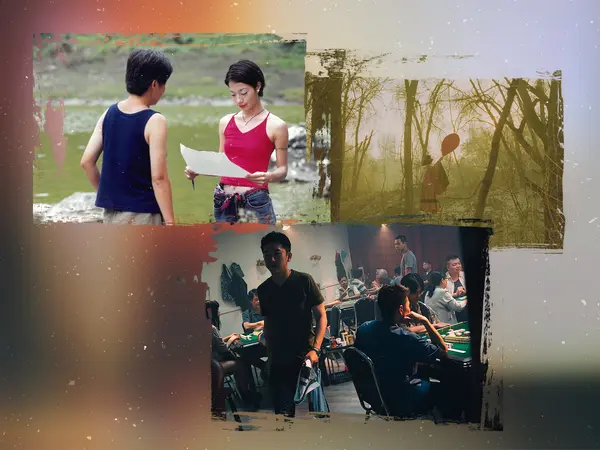
In collaboration with the Queer East Film Festival, our second pair from the Emerging Critics cohort offer their thoughts on this year’s programme.
This is the second of three pieces published in collaboration with Queer East Film Festival, whose Emerging Critics project brought together six writers for a programme of mentorship throughout the festival.
Yuki Yoshikawa
Dear Pear,
How was your experience at this year’s Queer East Film Festival? We ran into each other at a few screenings, didn’t we? Even though we were in the same space watching the same films, I’m sure our experiences were different.
I had the opportunity to watch some repertory Taiwanese films, ranging from the 1980s to the 2000s. Among them, I found the double bill screening of Jo-Fei Chen’s Where Is My Love? and Incidental Journey especially beautiful. I’ve always been drawn to older films. There’s something about the slightly rough quality of the footage, the film’s wear and tear, and the bluish tint that captivates me. The occasional sound of the film’s scratches, like something is being set afire, adds a peculiar charm to the movie, as if it were a background track. Of course, my fascination doesn’t just stem from the film being physically old. There’s something nostalgic in the streets, landscapes, the demeanor of a person, and the relationships between characters that are depicted in the movie. While watching these films, I asked myself, why do I feel nostalgic for something I’ve never experienced? I’ve only been to Taiwan once, in the late 2010s, as a tourist. It seems like this nostalgic feeling that arises when watching these films has nothing to do with my own personal experiences.
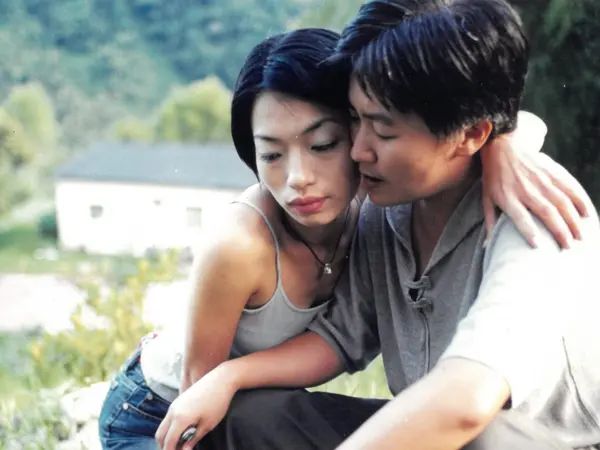
I’m also interested in the queer people from that time. I can’t help but feel a sense of melancholy. In Where Is My Love?, the film portrays the romantic relationship between Ko, the protagonist who resists coming out as gay, and his openly gay friend, Pierre. In Incidental Journey, we see two lesbian characters: Ching, a woman who travels across Taiwan after breaking up with her girlfriend, and Hsiang, a lonely artist whose past lover married a man. After running into each other by chance, the two stay at the house of Hsiang’s past lover. Their evolving feelings and the growing attraction between them left a strong impression on me. Both these films delicately portray the struggles and emotions of queer people at the time, through depicting experiences of coming out, heartbreak, finding a partner, and deciding where and how to live. I imagine these issues must have weighed even more heavily on them back then than they might do now. It must have been incredibly difficult to search for a way to live without social acceptance. Watching these films, I feel as though I’ve been touched by the characters’ pain and lived experiences, which I’m now carrying with me. It feels like cinema enables the past and the present to connect through time.
Even though the LGBTQIA+ movement was gaining momentum in Taiwan around the 90s, that still wasn’t an era when queers were socially accepted. However, it’s certain that gay, lesbian, transgender, and queer people did exist. Through cinema, we feel their very existence. It doesn’t matter that the stories depicted in these films are fictional. Somehow, they transform into a memory that’s not quite my own, but still resurfaces within me.
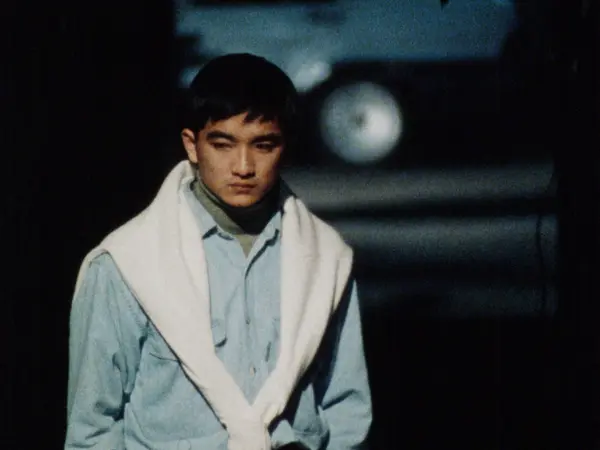
In one scene in Where Is My Love?, a young gay man sits in a dimly lit study, delicately holding a cigarette between his fingers as he concentrates on his writing under the glow of a banker’s lamp. Another young man gazes at him wistfully. The camera captures each of them at eye level, aligning with their perspectives. Their gazes and expressions reach us across the screen and through time. Even if this is a fictional story or comes from a past that doesn’t belong to me, queer memories continue to speak to us as nostalgia.
In Incidental Journey, an artist is captivated by a free-spirited and alluring woman standing by the riverside. From a short distance, Hsiang finds herself sketching the woman. Framed by the stillness of the mountains, we watch the scene from afar, tracing the distance between the two. I felt as if this was a landscape I wanted to remember. The film is, of course, a fantasy, and I’ve never actually seen this place. But Incidental Journey painted a quiet, inner landscape in me, like a memory I carry in my mind. Perhaps watching films allows queers, each with their own histories and experiences, to create such pockets of memory within themselves.
Queer fantasies created by film blur the lines between past and present, disrupt the flow of time, and mix reality with fiction, ultimately constructing a romantic past for queer people. These films offer us something beyond mere visual stories. Through the characters’ pain, their joy, and the time they lived through, we can experience an imaginary history. This is the power of nostalgia that transcends time and space, allowing us to reaffirm our existence as queer individuals.
Pear Nuallak
Dear Yuki,
I remember when your hands described time on the pub table soon after we met for the first time. You said, “People think time is like this,” sliding your index finger forward. By considering queer time, we understand the potential of being temporally wayward: time can “drag on” because of societal pressure to live a straight and narrow life, so queering time can mean finding our own winding path. Or maybe time itself can become drag – material for destabilising performance.
History became burlesque in An Ass-Shaped Butterfly. Part of Queer East Expanded, this performance-lecture by film scholar Misha Zakharov was followed by a rare screening of Vocal Parallels, directed by Rustam Khamdamov. Zakharov, who self-describes as “russian-Korean” with a lowercase ‘r’ with a decolonial intention, offered a queer speculative reading of Erik Kurmangaliev, a Kazakh tenor who flourished in newly post-Soviet Russia.
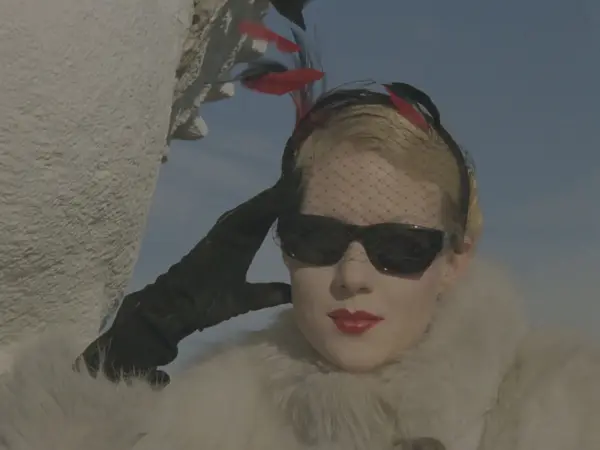
Zakharov’s playful inquiry and careful research encouraged my reading of Vocal Parallels as a biting satire of the Soviet film-concert. This art form introduced art to the masses by combining musical and documentary; Vocal Parallels turns it into a surreal cabaret that treats Soviet cultural history like a dress-up box. Our host for this film-concert is Russian actor Renata Litvinova. With her ultra-femme Soviet retro style and barbed quips, Litvinova introduces each act and explains the film-concert’s thin plot. “One soprano hates another soprano […] and the mezzo soprano hates them all,” she says. We follow opera divas engaged in rivalry, including Erik Kurmangaliev. Always in full drag, his dark, rich, gender-ambiguous voice weaves through the film. When he sings “Vanya’s Aria” from Glinka’s Ivan Susanin, he’s a “female” character in a “male” military uniform playing a boy’s role intended for a contralto, the lowest “female” voice range that overlaps with a “male” tenor. The film treats gender like it treats time – playfully.
Because of Vocal Parallels‘ sweeping historic scale and ironic tone, we’re kept at a distance. In contrast, when I went to the UK premiere of Chu Ping’s Silent Sparks, I was struck by the close invitation to feel time pass alongside the main character, a young gay Taiwanese gangster called Pua. I was curious about this film because I’d been reading Jackie Wang’s abolitionist writing on time and imprisonment. The movie begins with Pua being locked into his prison cell. His scheduled mealtime – what Wang describes as “making time digestible” – is spent silently.
Silent Sparks gently observes how criminalisation shapes Pua’s daily life. Upon release, Pua resumes work as a casual porter and hired thug for his car-and-crime-dealing boss, generally disappointing his long suffering mother, Ru, a fortune-teller who insists he eats mee sua (wheat vermicelli) for 100 days to change his fate. Pua and Ru live next to the train tracks and cannot afford to soundproof their home, the compensation payment for his previous victim adding to their mounting bills. I thought of how Wang describes debt as foreclosing people’s futures, with incarceration as “temporal punishment.” The film’s slow pace, along with tunnelling compositions and rhythmic lines of city infrastructure, create the feeling of confinement outside prison walls.
Pua’s refusal of food outside prison marks his general lack of appetite for life. The only thing Pua desires with single-minded focus is Mi-Ji, who seemingly remains cold to Pua despite the passion they once shared in prison. Pua and Mi-Ji are employed by the same crime boss; as their relationship rekindles, their work becomes more risky. Near the end of the film, when Pua decides to up the stakes in his pursuit of love, he finally eats his mother’s mee sua, which failed to change his fortune but sustains him when he makes a life-altering decision in his pursuit of queer love.
Queerness and time create different layers and paths in each of these films. Where Vocal Parallels views the breadth of time as a camp spectacle, Silent Sparks shows how the main character tries to exert his will over time. In the closing scene, we flash back to a moment where Pua seems content with himself: hitching a ride on a motorised warehouse cart. We’re pulled along with him, journeying forwards and back at the same time. Although Pua is heavily implied to return where he was at the beginning of the film, his dedication to Mi-Ji refuses a conventional narrative.
I’ve been thinking about how queerness isn’t always fun or affirming. These films link time with destruction, lingering inside the ruins of past cultures or individual lives shattered by violent systems. After watching them, I feel strengthened in my resolve that we can’t abandon ourselves or the people we love. Queers have always found each other in every timeline.
