

The Federal Reserve lowered the federal funds target range by 25 basis points on Wednesday—its third consecutive rate cut—to 3.5 to 3.75 percent. Markets had anticipated the decision for weeks, reflecting growing expectations that the Fed would respond to rising downside risks in the labor market. Three officials dissented: Governor Stephen Miran again favored a larger 50-basis-point cut, while Chicago and Kansas City Fed Presidents Austan Goolsbee and Jeffrey Schmid preferred to hold rates steady. Schmid’s dissent was his second in as many meetings.
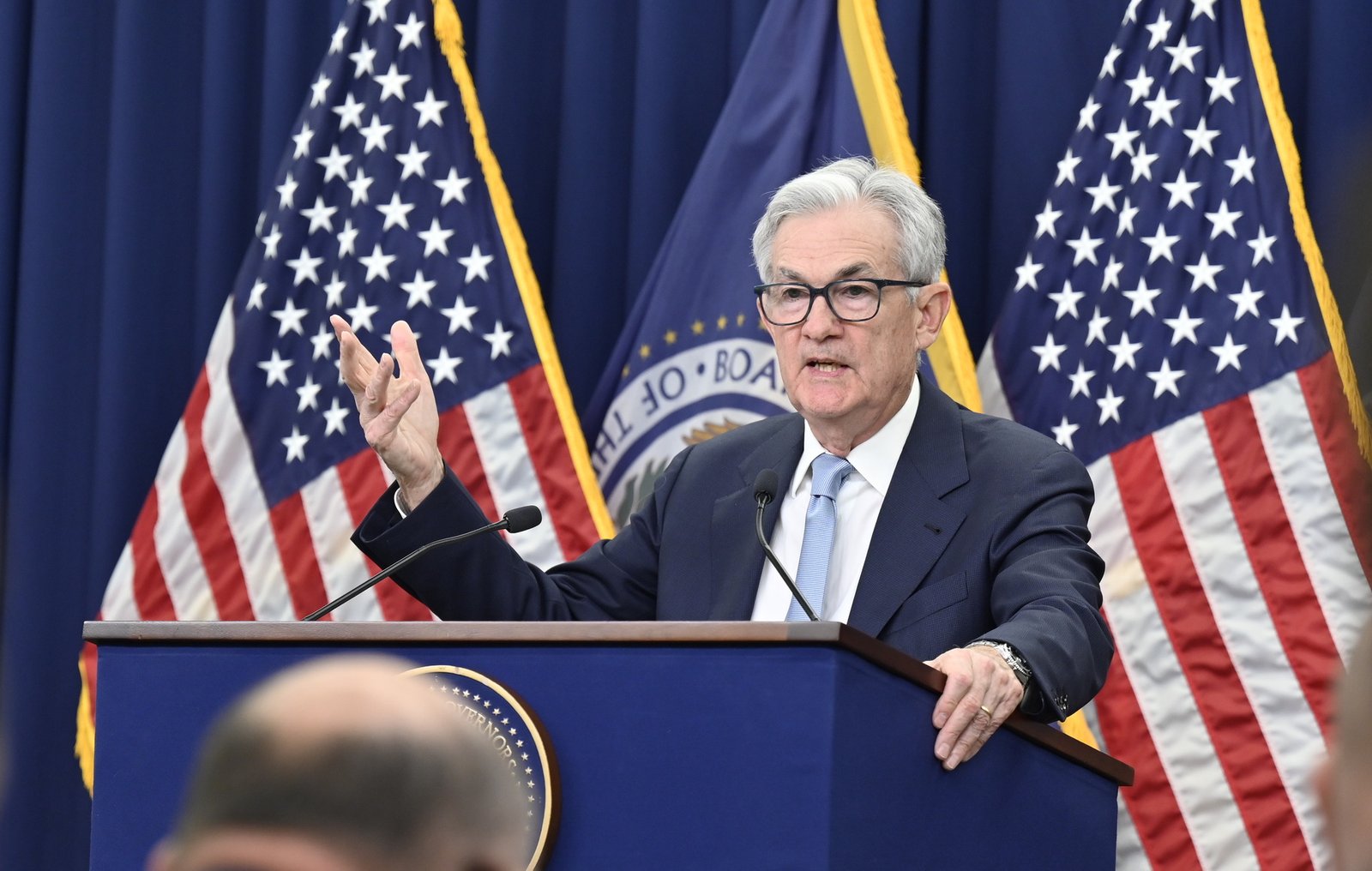
Powell used his press conference to place the decision within the broader tensions facing the Fed’s dual mandate. He emphasized that “[c]onditions in the labor market appear to be gradually cooling, and inflation remains somewhat elevated.” He noted that the government shutdown restricted access to some data, but that the available evidence suggests the “outlook for employment and inflation has not changed much” since the Fed’s October meeting.
Still, Powell said the available indicators point to moderate economic growth, supported by solid consumer spending and continued business fixed investment. He noted that the temporary government shutdown likely slowed activity somewhat, but that this effect “should be mostly offset by higher growth” in the coming months. The updated Summary of Economic Projections reinforces that outlook, with the median projection for 2025 GDP growth rising modestly from 1.6 in September to 1.7 percent.
Looking ahead, the median GDP projection for 2026 rose more sharply, increasing to 2.3 percent from 1.8 percent in the September projections. Powell acknowledged the size of the revision when asked about it at the press conference, pointing to continued resilience in consumer spending and a pickup in business investment tied to data centers and artificial intelligence. He added that a similar upgrade in growth expectations has also appeared among private-sector forecasters, suggesting a broader reassessment of the medium-term outlook rather than a shift unique to the Fed.
Powell said the available evidence points to a softening labor market, noting that “layoffs and hiring remain low” and that perceptions of job availability and hiring difficulty continue to decline. As in recent meetings, he partly attributed the slowdown to “a decline in the growth of the labor force, due to lower immigration and labor force participation,” while noting that weakening labor demand is also playing a role. Still, the median unemployment projections for 2025 and 2026 were unchanged from September.
Powell acknowledged that inflation “remains somewhat elevated,” but said the government shutdown has limited the flow of new price data since the October meeting. At that point, the Fed had seen goods inflation pick up—likely reflecting tariffs—even as services inflation continued to ease. He added that “[n]ear-term measures of inflation expectations have declined from their peaks earlier this year” and that longer-term expectations still align with the Fed’s two percent goal. The Fed’s median inflation projection now stands at 2.9 percent for 2025 and 2.4 percent for 2026, both slightly lower than in September.
Powell said the Fed faces “a challenging situation,” with “risks to inflation…tilted to the upside and risks to employment to the downside.” He reiterated that the inflationary effects of tariffs should be temporary, describing them as “effectively a one-time shift in the price level,” and stressed that the Fed must ensure that this does not “become an ongoing inflation problem.” Because downside risks to employment have risen, he said, the balance of risks has shifted toward the employment side of the mandate—a shift he said justified lowering the policy rate.
Powell said the 75 basis points of easing over the past three meetings “should help stabilize the labor market while allowing inflation to resume its downward trend toward 2 percent once the effects of tariffs have passed through.” He added that the current stance of policy is “within a range of plausible estimates of neutral.” The newest projections put the policy rate at 3.4 percent at the end of 2026 and 3.1 percent at the end of 2027—unchanged from September. Even so, Powell stressed that the projections are not a plan, reiterating that policy “is not on a preset course.”
Beyond the stance of policy, Powell outlined several steps affecting the implementation framework. Alongside the rate cut, he announced that the Fed will “initiate purchases of shorter-term Treasury securities for the sole purpose of maintaining an ample supply of reserves over time.” He said the move responds to “continued tightening in money market interest rates relative to” the Fed’s administered rates. Such purchases, he explained, help keep the policy rate “within its target range” and accommodate the rising demand for liquidity that comes with economic growth. Powell stressed that the purchases are purely technical, though the return to balance-sheet expansion is likely to renew debate over its broader implications for monetary policy and government debt.
Powell explained that under the current framework, “the federal funds rate and other short-term interest rates are primarily controlled by the setting of our administered rates rather than day-to-day discretionary interventions in money markets.” Standing repurchase agreement operations are a key part of that framework, helping to keep the federal funds rate “within its target range” even when liquidity pressures rise. To ensure they can continue to operate effectively, the Fed eliminated the aggregate limit on their use. While not entirely new, Powell’s emphasis on administered rates—and the decision to remove limits on standing repo operations—highlighted the extent to which rate control now relies on policy-set prices rather than market clearing, raising broader questions about the future role of the federal funds rate itself.
Taken together, Powell’s remarks highlighted the inherent difficulty of balancing inflation and employment under the current mandate. The Fed continues to wrestle with competing risks on both sides of that mandate. Importantly, this tension is not imposed by external forces but created by the mandate itself, which compels policymakers to weigh higher prices against lower employment rather than focus on the underlying drivers of each. A nominal GDP target would avoid this conflict. By stabilizing aggregate demand, the Fed would allow prices and employment to adjust naturally, eliminating the need for continual fine-tuning and removing the artificial tradeoff between inflation and unemployment.
