

One of the most misleading ideas in American politics is that the United States has a large, fixed class of permanently poor people stuck at the bottom year after year, while everyone else moves on without them.
That story is emotionally powerful. It also happens to be a poor guide for serious policy.
Poverty is real. Hardship is real. Some people do remain trapped for long periods, and that deserves serious attention. But the popular picture of a vast, permanent underclass does not describe most Americans who show up in the bottom income quintile in any given year. As economist Anthony Davies has put it, many are there because of “retirement, homework, and diaper rash.” That line works because it captures something basic: a snapshot of income is not the same thing as a life story.
Students often have very low current earnings. So do many retirees living on savings or Social Security instead of wages. So do young parents working fewer hours, people between jobs, and entrepreneurs in low-cash-flow years. Treating all of them as members of a permanent poor class is not compassion. It is a category mistake.
The data back that up. The Federal Reserve’s Survey of Consumer Finances distinguishes between “actual” and “usual” income precisely because current-year income can be temporarily depressed. In 2010, about a quarter of families reported that their actual income was unusually low relative to normal. That matters because it means many households classified as poor in a given year are experiencing a temporary dip, not living permanently at the bottom.
In fact, the same survey found that a large share of households in the lowest quintile by actual income ranked higher when measured by usual income instead.
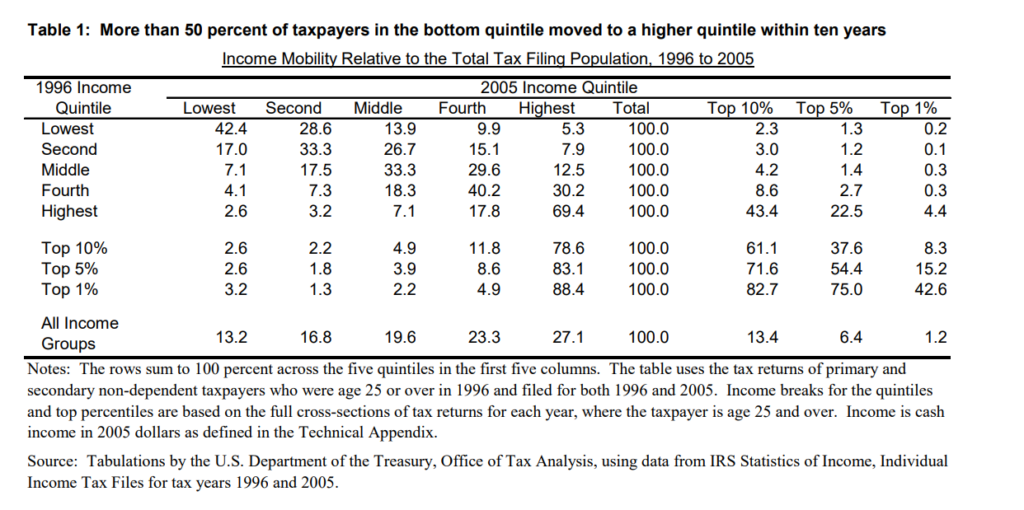
The tax data tell the same story. A Treasury study tracking taxpayers from 1996 to 2005 found that about 56 percent moved to a different income quintile over the decade. More important, roughly half of those in the bottom quintile moved up by 2005, depending on the measure used. About 29 percent moved up one quintile, another 29 percent moved up at least two quintiles, and roughly five percent moved all the way from the bottom quintile to the top quintile. That is not what a rigid caste system looks like. It is a dynamic picture in which many people pass through low-income years rather than remain stuck there permanently.
This is where so much bad policy begins. Politicians see a one-year income snapshot and talk as if they are looking at a permanent social class. They are not. They are often looking at transition.
This does not mean every measure of mobility is strong. A lot of the confusion comes from mixing together two different questions. The first is short-run income mobility: do people move up or down within their own lives? On that question, the evidence clearly shows substantial movement. The second is intergenerational mobility: do children rise above the economic position of their parents? That is a different question, and the answer there is more mixed.
The newer Census mobility data show that income mobility varies significantly by geography, age, race, and sex. And other work has shown that absolute mobility has weakened relative to earlier generations. Those are serious concerns. But uneven mobility is not the same as a large, fixed, poor class.
The latest Archbridge Institute report on social mobility in the 50 states broadens the analysis beyond annual income. Archbridge evaluates mobility through four pillars: entrepreneurship and growth, institutions and the rule of law, education and skills development, and social capital. It also distinguishes between natural barriers such as family instability or social networks and artificial barriers created by policy, such as excessive occupational licensing, weak school choice, or heavy regulation. That is a much better framework than casually conflating poverty, inequality, and mobility.
The state rankings tell an important story. In Archbridge’s 2025 report, Utah ranked first, followed by Vermont, Montana, Wyoming, and Idaho. At the bottom were Louisiana, Mississippi, Alabama, New York, and Arkansas. That does not prove one policy explains everything. It does show that institutions matter.
Mobility is shaped by the rules, incentives, and social conditions people live under. The poor are not static, but the barriers they face can be.
This is where the free-market case becomes especially important. If you care about mobility, you should care about growth. The AEI “Land of Opportunity” project and its essay on the greatness of growth and the American Dream make the point clearly: growth is not a side issue. Growth is the oxygen of mobility.
A faster-growing economy creates more businesses, more jobs, more opportunity, more room for incomes to rise, and more chances for people to accumulate wealth over time. A slower-growing economy makes class lines harder and mobility weaker.
That is why policies that burden growth hurt the poor most over time. Heavy regulation, bad schools, housing shortages, excessive licensing, and weak property rights do not just reduce efficiency in the abstract. They reduce mobility in practice.
A recent article highlights how land-use rules and housing constraints quietly kill mobility by making it harder for families to move to places with better labor-market opportunities. Another essay points to research showing that economic freedom, especially lighter regulation and stronger property rights, is associated with greater intergenerational mobility.
That is the key insight the static-poor narrative misses. If policymakers really want more upward mobility, the answer is not to freeze people into permanent income categories and redistribute more aggressively. The answer is to remove the barriers that keep people from climbing.
That means stronger growth, more entrepreneurship, more housing, better schools, more school choice, lower regulatory burdens, and institutions that reward work, saving, investment, and family stability. It also means respecting people’s freedom to vote with their feet toward states, cities, and communities with better opportunity. Mobility is not just something economists measure after the fact. It is something people actively pursue when they are free to move toward better institutions and opportunities.
The myth of the static poor survives because it is politically useful. It turns a moving picture into a still frame. It makes the government look like the only answer. But it misses the reality that most Americans who are poor at one point in time do not stay there forever, that incomes often rise over time, and that wealth accumulation frequently follows when people are free to work, save, invest, and build.
The real task is not to manage a permanently poor class. It is to build a freer society where more people can rise.
