


What’s The Pyramid Approach Of Learning?
Although eLearning is everywhere and most people do it, there are often overlooked challenges. Staying focused, understanding the content, and actually remembering what you’ve learned for a long time can be difficult when learning online. Actually, many learners go through hours of courses and still feel like the information just vanishes afterwards, not to mention what happens when it’s time to apply what they’ve learned. And while flexibility and freedom are always great in learning, a structured approach is also important. Specifically, we’re about to discuss the pyramid approach and how we can apply it in eLearning.
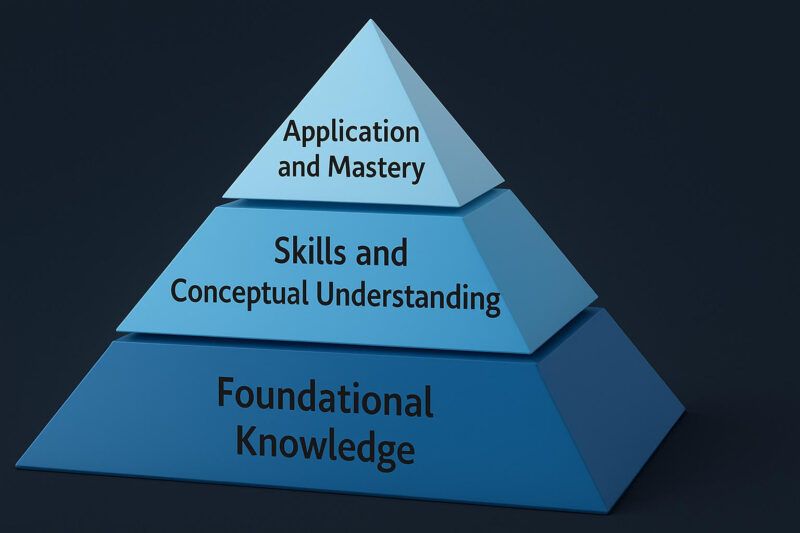
As we mentioned, the pyramid approach is all about structure. It’s a learning model that helps learners move through three stages of knowledge: foundation, understanding, and mastery. To visualize it like a pyramid, imagine the base first. Here, the focus is on foundational knowledge like facts, terms, and basic information. Then, the middle layer is about deeper understanding and skills. Learners connect the dots, notice patterns, analyze concepts, and practice what they’ve learned through exercises. The top of the pyramid is knowledge application and mastery. This is where learners apply their knowledge to solve real-world problems or complete complex tasks.
The pyramid approach is based on educational psychology, specifically Bloom’s taxonomy or scaffolding, which is why it’s easy to apply in eLearning. All these theories support the idea that learning is most effective when it builds gradually. Without further ado, let’s explore the pyramid approach bit by bit and see how we can make it work in eLearning.
The Layers Of The Pyramid
Base Layer: Foundational Knowledge
The base layer is all about getting to know the basics of a subject, like definitions, key concepts, and general context. This is where learners start asking questions such as: What does this term mean? How does this work? Why is this important? The key here is to focus on this layer as long as needed for learners to build a solid foundation.
Middle Layer: Skills And Understanding
The middle layer of the pyramid is all about connecting the dots. Learners will start recognizing patterns, understanding relationships, and exploring how ideas connect with each other. This is where deeper learning happens. Here, learners move past memorizing and start thinking critically.
Top Layer: Application And Mastery
The top of the pyramid is where learners apply what they’ve learned. This is where learning comes to life because they’re using their skills to solve problems, make decisions, and complete meaningful tasks. And this is where learning starts sticking with them because they’re actively using their knowledge.
Applying The Pyramid Approach In eLearning
Structure Courses Using The Pyramid
As an Instructional Designer, you know how to structure courses. When it comes to designing them with the pyramid approach in mind, you want to follow each layer. Start with the base layer and incorporate definitions, key terms, and even concept summaries. Then, move up to the middle layer and start building a context that your learners can understand and gain confidence. Finally, for the top layer, add problems, projects, or simulations that learners have to dive into and apply their knowledge. For example, if you’re designing a course on digital marketing for the base, explain terms like SEO, CTR, etc.; for the middle, have learners analyze strategies and check out case studies; for the top layer, they can create their own mock campaign.
Add Interactive Tools To Each Layer
eLearning can offer you plenty of tools that fit perfectly into each layer of the pyramid. You just have to find them. For the base layer of foundational knowledge, your goal as an ID is simple: learners must understand the basics. The perfect tools are microlearning videos focused on one topic at a time, flashcards for memorizing terms, and slideshows for jargon or complex definitions. For the middle layer, where learners must gain skills and understanding, use scenarios where learners make decisions and see their outcomes, discussion boards where they can exchange ideas, and simulations for them to try things out in a safe environment. Lastly, for the top layer, you want learners to start applying what they’ve learned. So, they should do projects solving real problems, role-play simulations, or assignments reviewed by their peers.
Support Layered Learning With Assessments
When you use the pyramid approach in eLearning, your assessments should evolve as learners move up the layers of the pyramid. At the base, have them complete quick quizzes, answer pop-up questions, or play vocabulary games. In the middle, include more applied assessments such as mini-scenarios, exercises, or short essays. At the top, go for real-life projects, challenges, or group tasks. In every step of the way, make sure to include formative assessments, which help learners and instructors see where they stand before moving on to the next step.
Align Learning Goals With Each Layer
Every step of the pyramid needs a clear purpose. That’s why aligning your learning goals with each layer is a must. For the base layer, use words like identify, define, recognize, list, etc. For example: “Identify three key elements of effective SEO.” For the middle layer, use verbs like explain or compare, like “Compare on-page and off-page SEO strategies.” Lastly, for the top layer, use active ones such as solve, create, or design. For instance, “Create an SEO campaign.” Learners are more focused and motivated when they know what’s expected of them at each stage. And when instructors build their lessons around clear objectives, the course becomes more intentional and effective.
Encourage Active Learning
To really make the pyramid approach work in eLearning, you need to keep learners active. So, to encourage active learning at every level, try asking them questions after videos, having them explain concepts in their own words, offering choices when it comes to assignments, or asking them to track what they’ve learned. And don’t underestimate the power of peer learning. Encourage group discussions, knowledge-sharing, and collaboration. Everyone has a unique perspective, and it’s valuable to share it with their peers.
Benefits Of The Pyramid Approach In eLearning
Improved Retention
If we try to take in too much information too fast, especially without connecting it to what we already know, we will forget it. That’s how our brains work. However, the pyramid approach can help with that. By starting with foundational knowledge, learners build knowledge slowly. Then, as they move into deeper concepts and finally into real-life application, they reuse that knowledge, which helps them remember it longer.
Increased Motivation
One of the biggest struggles in eLearning is staying engaged. When lessons feel repetitive, learners tend to skip them. But the pyramid approach allows for a variety of learning materials and interactive activities which keep things interesting. Plus, each layer of the pyramid helps them progress, motivating them to keep learning.
Skill Development
It’s hard to stay motivated when everything in a course feels too advanced, and many people give up because of this. Fortunately, the pyramid approach prevents overwhelm. At each layer, learners accomplish something, which builds their confidence. By the time they reach the top layer, they’ve gained the necessary skills in a way that feels natural.
Adaptability
The pyramid approach can adapt to any subject or concept. Why? Because it’s not about what you’re learning, it’s about how you’re learning it. Every topic has basic knowledge, deeper skills, and real-world applications. So, the learning content can be adapted accordingly, no matter what your learners train on.
Clear Goals
One often-overlooked benefit of the pyramid approach is how much it helps course designers and instructors. When you build a course with the pyramid model in mind, you’re naturally organizing your content by learning goals. This is because each layer has a specific purpose. When your goals are clear, this reduces confusion and builds trust between learners and IDs.
Conclusion
By building knowledge step by step, from the basics of a concept to mastering it, you create stronger, lasting knowledge. Breaking down topics and structuring modules to follow this progress not only boosts engagement but also makes learning feel natural and rewarding. So, why not give it a try?
