

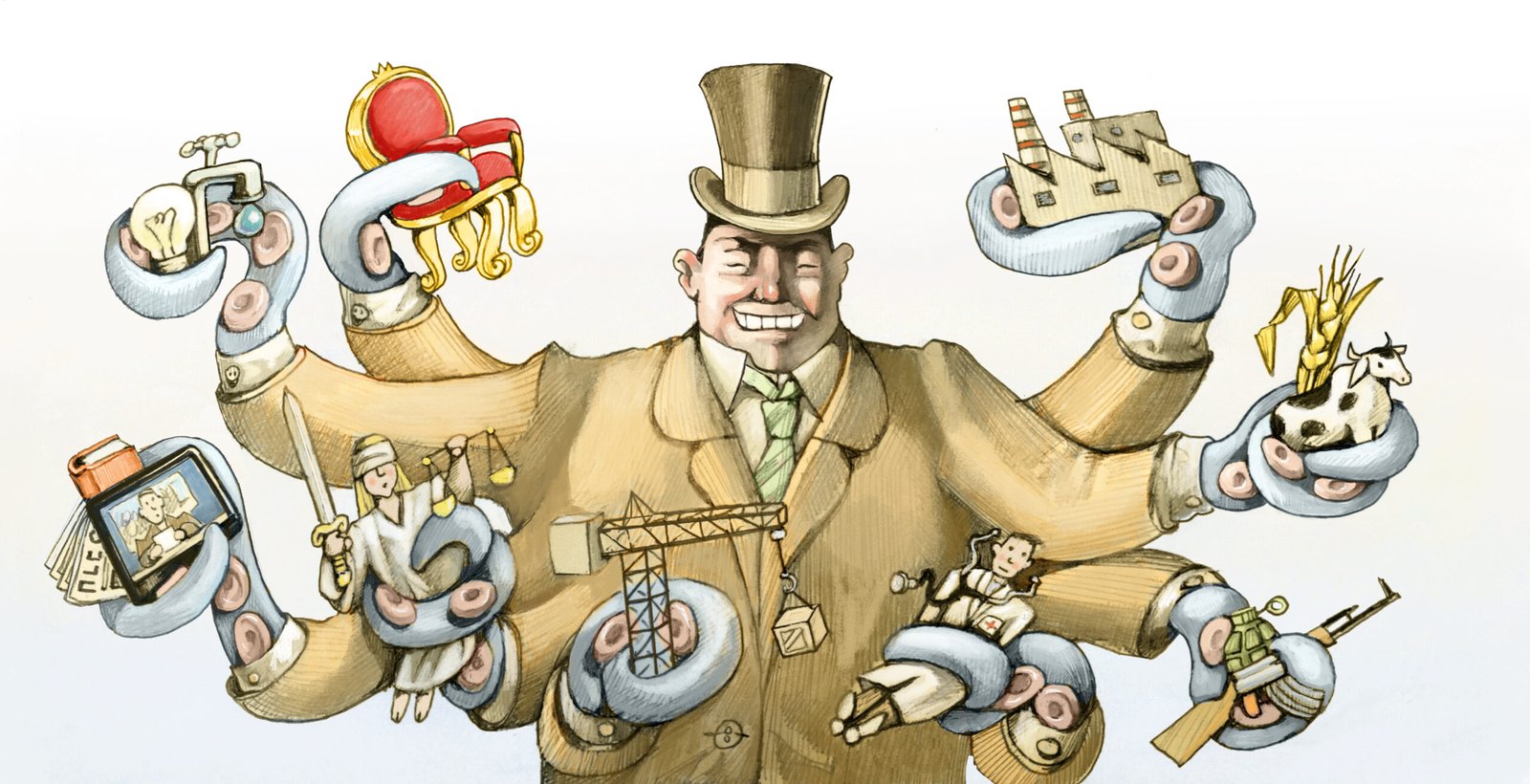
It seems everyone hates corporations these days, but that is nothing new. For more than a century, Americans have swung between denouncing large firms as predatory Leviathans and attempting to conscript them for nonbusiness ends. That process may now be entering a new phase — one with broader implications for whether America remains a free country.
In the Progressive Era, corporations were portrayed as extractive engines of class power, tolerated only if constrained by supposedly impartial regulators and administrative oversight. Since the New Deal, many of those same critics shifted ground, arguing that corporations could be harnessed to advance environmental goals, collect taxes, deliver health insurance, impose maximum working hours, and pursue public priorities that legislatures had avoided, delayed, or even rejected.
Now the New Right has mounted its own indictment, charging corporate America with “woke” cultural coercion, economic disloyalty, and an unhealthy intimacy with left-wing regulators and the administrative state. The result is a curious consensus of hostility, in which corporations are cast either as tyrants or as sycophants, rather than as what they are in a free society: organizations that coordinate capital and labor to produce goods, services, and prosperity within the rule of law.
The Progressive Era attacks on corporations grew out of the massive expansion in economic activity following the Industrial Revolution. Local markets merged into a national economy, and firms scaled up in response. The federal government began regulating at the national level under the Constitution’s Commerce Clause, with measures like the Interstate Commerce Commission and the Sherman Antitrust Act asserting authority over what was seen as harmful corporate conduct.
The perceived harm took many forms: corporate profit was equated with exploitation, and corporate power was viewed as an instrument of entrenched wealth and class division, sometimes even a tool of political corruption. Over time, new corporate sins were added — manipulation of consumers, suppression of workers’ rights, and eventually the perpetuation of inequality and environmental degradation. In effect, the American left developed a theory of corporate vice, holding that corporate incentives are inherently misaligned with the public good.
The application of this theory of vice led to several purported remedies. Foremost was regulation and the entire apparatus of three-letter agencies that today intrude into almost every area of life, in the name of democratic control. Equally, however, if less conspicuous, was a growing suspicion of the idea of shareholder primacy, and the emergence of the idea that markets are morally insufficient. The ultimate result of this theory gaining dominance was the New Deal, with not just restrictions on virtually every area of corporate activity, but its attempt to use corporations directly to serve public ends.
The theory of vice eventually hit its limits. Courts and Congress applied some restraint, and thinkers like Milton Friedman persuaded many that ordinary corporate activity was not inherently suspect. By the late twentieth century, the American left had developed a new framework — a theory of corporate virtue.
This new theory held that corporations were not only morally redeemable but could advance broader social, economic, and political goals. It built on a key premise of the earlier theory of vice: that firms should be managed not solely for owners and investors but for all stakeholders, including society at large. Initially framed around corporate social responsibility, it evolved in the twenty-first century into ESG (environmental, social, and governance) and its subset, DEI (diversity, equity, and inclusion), which spread rapidly across corporate America.
As this theory took hold, corporations became vehicles for a wide range of initiatives. Diversity mandates reshaped hiring, climate priorities filtered through supply chains, and platform moderation influenced acceptable speech. Corporate activity itself became a form of political signaling. These efforts were reinforced by new internal structures — vice presidents of sustainability, proxy advisers, and external scoring systems.
By the time of COVID and the Black Lives Matter movement, much of corporate America and its surrounding institutions had embraced this framework. The older regulatory superstructure reinforced it. Firms that resisted could face political pressure, lawsuits, or penalties. Corporations became political actors not because markets demanded it, but because political incentives pushed them in that direction.
The political right has since mounted its own response, developing a rival theory of corporate vice. Much of it mirrors the left’s earlier critique. Corporations are now cast as coercive actors imposing social change that cannot win at the ballot box. Where regulation was once justified as democratic control, opposition to ESG reflects the same impulse in reverse — using state power to counter corporate influence.
This new critique also revives older themes. Claims that profit-seeking drove outsourcing echo long-standing labor arguments. Concerns about immigration — both low-skilled and high-skilled — reprise earlier critiques of corporate labor practices. These strands converge in the charge that corporations have “hollowed out” American communities and abandoned local ties.
The regulatory machinery built in the Progressive Era is now being redeployed in the opposite direction — against ESG and DEI. What regulators once encouraged, they now discourage through familiar tools: pressure, litigation, and penalties. The result is political whiplash. As administrations alternate, compliance burdens shift with the electoral cycle, and firms adjust accordingly.
This dynamic is predictable. Corporations respond to incentives, including political ones. When alignment with political power offers advantages, firms will adapt. As public choice economics suggests, political actors have incentives to expand their influence, not limit it.
There are signs, however, that the New Right is also developing its own theory of corporate virtue. In principle, such a theory could be constructive — emphasizing political neutrality, wealth creation, and a focus on core business functions within the rule of law. That approach would align with a traditional conservative view of enterprise.
In practice, the emerging version points elsewhere: toward protectionism, industrial policy, closer ties between firms and the state, and reliance on political patronage. This is a different form of corporate entanglement — less ideological, perhaps, but no less political.
The consequences are similar. When firms prioritize political alignment over serving customers and investors, resources are misallocated and incentives distorted. It is a formula not for growth, but for stagnation.
A better path is a classical liberal theory of corporate virtue: firms exist to coordinate labor and capital for productive ends; their social contribution is wealth creation within the rule of law; profit signals value creation rather than moral failure; and business and politics should remain separate. Regulators should set stable, predictable rules — not direct outcomes — and market discipline should guide behavior.
The choice should be clear. A return to mission-focused enterprise depends on it. Free enterprise, not political enterprise, built America — and it remains the only path to sustaining it.
