

Close Menu
KumbhCoinorg
    What's Hot

    The Pros And Cons Of Employee Engagement

    February 12, 2026

    Dawson’s Creek’s Katie Holmes Reacts

    February 12, 2026

    It All Starts With the Meditation App: Bart Layton on “Crime 101”

    February 12, 2026
    Facebook X (Twitter) Instagram
    Trending
    • The Pros And Cons Of Employee Engagement
    • Dawson’s Creek’s Katie Holmes Reacts
    • It All Starts With the Meditation App: Bart Layton on “Crime 101”
    • Kunci Keuangan Teratur Dan Masa Depan Aman » Dashofinsight
    • 12 February, 2026 – Alpha Ideas
    • Aiden Markram abuses, but ICC punishes Mohammad Nabi in Lungi Ngidi wristband row
    • Guardiola explains Haaland sub in 3-0 win
    • NHL Rumors: Edmonton Oilers Need to Improve Defensively
    Facebook X (Twitter) Instagram
    KumbhCoinorg
    Thursday, February 12
    • Home
    • Crypto News
      • Bitcoin & Altcoins
      • Blockchain Trends
      • Forex News
    • Kumbh Mela
    • Entertainment
      • Celebrity Gossip
      • Movie & TV Reviews
      • Music Industry News
    • Market News
      • Global Economy Insights
      • Real Estate Trends
      • Stock Market Updates
    • Education
      • Career Development
      • Online Learning
      • Study Tips
    • Airdrop News
      • Ico News
    • Sports
      • Cricket
      • Football
      • hockey
    KumbhCoinorg
    Home»Market News»What is the rate and why are prices still rising?
    Market News

    What is the rate and why are prices still rising?

    kumbhorgBy kumbhorgOctober 14, 2025No Comments6 Mins Read
    Facebook Twitter Pinterest LinkedIn Tumblr Email
    What is the rate and why are prices still rising?
    Share
    Facebook Twitter LinkedIn Pinterest Email Copy Link

    Getty Images Two women look at the price of cheese in a supermarket chilled dairy aisle.Getty Images

    Prices in the UK rose by 3.8% in the year to August, matching the rate recorded in July.

    It means inflation remains well above the Bank of England’s 2% target.

    The Bank moves interest rates up and down to try to keep inflation at that level, and has cut interest rates five times since August 2024.

    What is inflation?

    Inflation is the increase in the price of something over time.

    For example, if a bottle of milk costs £1 but is £1.05 a year later, then annual milk inflation is 5%.

    How is the UK’s inflation rate measured?

    The prices of hundreds of everyday items, including food and fuel, are tracked by the Office for National Statistics (ONS).

    This virtual “basket of goods” is regularly updated to reflect shopping trends, with virtual reality headsets and yoga mats added in 2025, and local newspaper adverts removed.
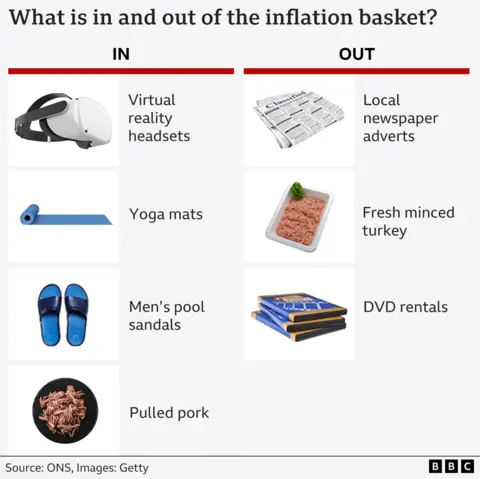
    Graphic showing what is in and out of the inflation basket. The in column shows virtual reality headsets, yoga mats, men's pool sandals and pulled pork. The out column shows local newspaper adverts, fresh minced turkey and DVD rentals.

    The ONS monitors price changes over the previous 12 months to calculate inflation.

    The main inflation measure is called the Consumer Prices Index (CPI), and the latest figure is published every month.

    What is happening to UK inflation?

    CPI was 3.8% in the year to August 2025, the same as in the 12 months to July.

    The July and August figure is the highest recorded since January 2024, when the rate was 4%.

    However, inflation remains well below the 11.1% figure reached in October 2022, which was the highest rate for 40 years.
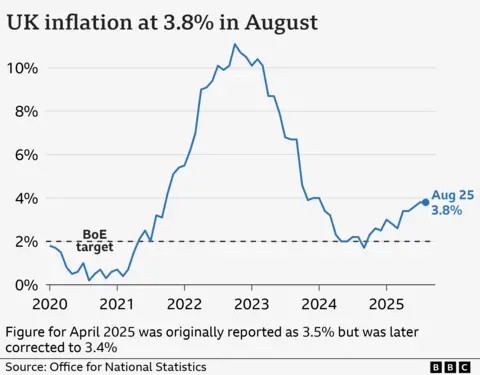
    A line chart titled 'UK inflation rate at 3.8% in August', showing the UK Consumer Price Index annual inflation rate, from January 2020 to August 2025. In the year to January 2020, inflation was 1.8%. It then fell close to 0% in late-2020 before rising sharply, hitting a high of 11.1% in October 2022. It then fell to a low of 1.7% in September 2024 before rising again. In the year to August 2025, prices rose 3.8%, in line with the previous month.

    The Bank also considers other measures such as “core inflation” when deciding whether and how to change rates.

    This doesn’t include food or energy prices because they tend to be very volatile, so can be a better indication of longer term trends.

    Core CPI was 3.6% in the 12 months to August, down slightly from 3.8% recorded in the year to July.

    Why are prices still rising?

    Although inflation has fallen significantly since the October 2022 high, that doesn’t mean prices are falling – just that they are rising less quickly.

    Inflation soared in 2022 because oil and gas were in greater demand after the Covid pandemic, and energy prices surged again when Russia invaded Ukraine.

    It then remained well above the 2% target partly because of higher food prices.

    These continue to be a significant factor in the current inflation figures.

    Inflation for food and non-alcoholic beverages was 5.1% in the year to August, up from 4.9% in the year to July.

    August’s rise was driven by higher prices for vegetables, milk, cheese, eggs and fish. Beef, butter, chocolate and coffee have also seen significant increases.

    Food price inflation has risen for five months in a row as economists said supermarkets were passing on the cost of government increases in the minimum wage and National Insurance Contributions to shoppers through higher prices.

    Why does putting up interest rates help to lower inflation?

    When inflation was well above its 2% target, the Bank of England increased interest rates to 5.25%, a 16-year high.

    The idea is that if you make borrowing more expensive, people have less money to spend. People may also be encouraged to save more.

    In turn, this reduces demand for goods and slows price rises.

    But it is a balancing act – increasing borrowing costs risks harming the economy.

    For example, homeowners face higher mortgage repayments, which can outweigh better savings deals.

    Businesses also borrow less, making them less likely to create jobs. Some may cut staff and reduce investment.

    In recent months, inflation has remained above the Bank’s target at the same time as the economy has remained relatively flat and the jobs market has softened.

    Therefore, the Bank has chosen to cut rates, despite high inflation, in an attempt to encourage people to spend more and get businesses to invest and create jobs to boost the economy.

    What is happening to UK interest rates and when will they go down again?

    The Bank of England began cutting rates in August 2024, and has made five cuts which have brought the rate down to 4%.

    Bank of England governor Andrew Bailey has repeatedly said that future cuts would be made gradually and carefully.
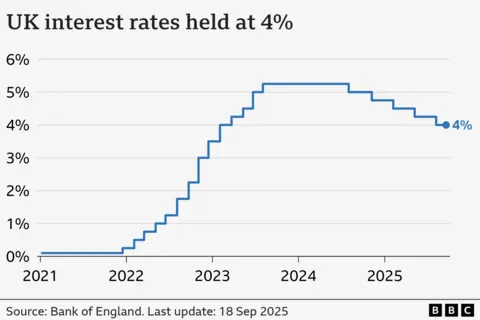
    A Line chart showing interest rates in the UK from January 2021 to September 2025. At the start of January 2021, rates were at 0.1%. From late-2021, they gradually climbed to a high of 5.25% in August 2023, before being cut to 5% in August 2024, 4.75% in November, 4.5% in February 2025, 4.25% in May, and 4% in August. At the Bank of England's latest meeting on 18 September, rates were held at 4%.

    At the Bank’s September meeting it decided to keep rates unchanged at 4%.

    The decision had been widely expected given that prices are still rising at a rate well above the Bank’s target.

    Indeed, the Bank’s governor Andrew Bailey said the UK was “not out of the woods yet” when it came to inflation, so any future rate cuts “will need to be made gradually and carefully”.

    In its most recent Monetary Policy Report in August, the Bank said it expected inflation to peak at 4% in September. That is twice the Bank’s target rate and above the 3.8% high it predicted in its previous report in May.

    At one point a further interest rate cut had been expected at the Bank’s meeting in November, but economists are now less sure this will happen.

    The Bank also has to consider the wider global economy. Mr Bailey has repeatedly warned about the unpredictable impact of US tariffs, and conflict in Israel and Iran has also created uncertainty.

    Announcements in the Budget on 26 November could also influence the Bank’s decision.

    Are wages keeping up with inflation?
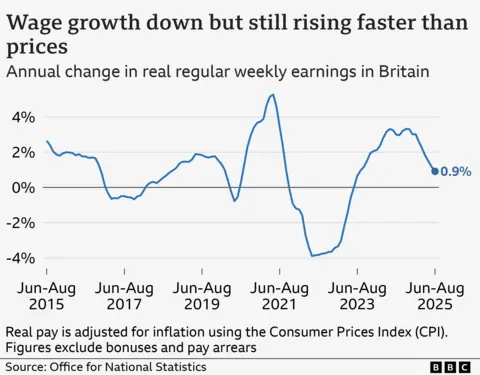
    A line chart showing the annual change in regular pay in Great Britain adjusted for CPI inflation, from June to August 2015 to June to August 2025. Figures exclude bonuses and pay arrears, and account for seasonal variation. In the year to June to August 2015, real wages rose by 2.6%, and then fluctuated between positive and negative growth before hitting a high of 5.3% in mid-2021. It then hit a low of -3.9% in mid-2022, before rising again to 3.3% in April to June 2024. It has fallen since then, reaching 0.9% in June to August 2025. The source is the Office for National Statistics.

    Annual average regular earnings growth was 6% for the public sector and 4.6% for the private sector.

    Meanwhile, separate ONS figures showed the estimated number of vacancies in the UK fell by 9,000 (1.3%) to 717,000 between July and September 2025.

    Vacancy numbers have now dropped compared with the previous three months for more than three years.

    The unemployment rate was 4.8% in the three months to August – up from 4.7% in the three months to July and the three months to June.

    This the highest figure since June 2021, which will also factor into the Bank of England’s rate decisions.

    What is happening to inflation and interest rates in Europe and the US?

    The US and EU countries have also been trying to limit price increases.

    The inflation rate for countries using the euro was 2.2% in September, up from 2% in August, according to EU data.

    In June 2024, the European Central Bank (ECB) cut its main interest rate from an all-time high of 4% to 3.75%, the first fall in five years.

    By June 2025, after several further cuts, its key rate stood at 2%, where it has remained.

    Inflation in the US rose to 2.9% in August, up from 2.7% in July and above the US central bank’s 2% target.

    In September, the US central bank, the Federal Reserve, said it was lowering the target for its key lending rate by 0.25 percentage points, which puts it in a range of 4% to 4.25%.

    The move – the bank’s first rate cut since December 2024 – is expected to kick off a series of additional reductions in the months ahead, which should help bring down borrowing costs across the US.

    The Fed said that fears about the weak job market outweighed concerns about above-target inflation.

    It has repeatedly come under attack from US President Donald Trump for not cutting rates.

    Prices Rate rising
    Share. Facebook Twitter Pinterest LinkedIn Tumblr Email
    Previous ArticleBitcoin Price Surges To $116,000 After Bloody Crypto Weeken
    Next Article NHL News: Lane Hutson Extends with the Montreal Canadiens
    kumbhorg
    • Website
    • Tumblr

    Related Posts

    Global Economy Insights

    Kunci Keuangan Teratur Dan Masa Depan Aman » Dashofinsight

    By kumbhorgFebruary 12, 2026
    Stock Market Updates

    12 February, 2026 – Alpha Ideas

    By kumbhorgFebruary 12, 2026
    Market News

    Russia moves to block WhatsApp in messaging app crackdown

    By kumbhorgFebruary 12, 2026
    Global Economy Insights

    To Save Social Security, Stop Subsidizing Wealthy Retirees

    By kumbhorgFebruary 11, 2026
    Stock Market Updates

    Aging Trade-Ins Collide With Surging Global Demand for Pre-Owned Smartphones, According to New Data Released from Circana and B-Stock

    By kumbhorgFebruary 11, 2026
    Market News

    Serial rail fare evader fined £3,600 over 112 unpaid tickets

    By kumbhorgFebruary 11, 2026
    Add A Comment

    Comments are closed.

    Don't Miss

    The Pros And Cons Of Employee Engagement

    By kumbhorgFebruary 12, 2026

    Importance Of Employee Engagement Employee engagement has its pros and cons, but it’s a crucial…

    Dawson’s Creek’s Katie Holmes Reacts

    February 12, 2026

    It All Starts With the Meditation App: Bart Layton on “Crime 101”

    February 12, 2026

    Kunci Keuangan Teratur Dan Masa Depan Aman » Dashofinsight

    February 12, 2026
    Top Posts

    Satwik-Chirag storm into China Masters final with straight-game win over Malaysia | Badminton News

    September 21, 2025132 Views

    SaucerSwap SAUCE Crypto Breaks Key Resistance Amid Nvidia-Hedera Deal

    July 15, 202545 Views

    Unlocking Your Potential with Mubite: The Future of Crypto Prop Trading

    September 17, 202533 Views

    Stablecoins 2025 Exchange Reserves: Insights into DeFi Trends

    September 8, 202532 Views
    Stay In Touch
    • Facebook
    • Twitter
    • Pinterest
    • Instagram
    • YouTube
    • Vimeo
    About Us

    Welcome to KumbhCoin!
    At KumbhCoin, we strive to create a unique blend of cultural and technological news for a diverse audience. Our platform bridges the spiritual significance of the Kumbh Mela with the dynamic world of cryptocurrency and general news.

    Facebook X (Twitter) Pinterest WhatsApp
    Our Picks

    The Pros And Cons Of Employee Engagement

    February 12, 2026

    Dawson’s Creek’s Katie Holmes Reacts

    February 12, 2026

    It All Starts With the Meditation App: Bart Layton on “Crime 101”

    February 12, 2026
    Most Popular

    7 things to know before the bell

    January 22, 20250 Views

    Reeves optimistic despite surprise rise in UK borrowing

    January 22, 20250 Views

    Barnes & Noble stock soars 20% as it explores a sale Barnes & Noble stock soars 20% as it explores a sale

    January 22, 20250 Views
    • Terms and Conditions
    • Privacy Policy
    • Contact Us
    • About Us
    © 2026 Kumbhcoin. Designed by Webwizards7.

    Type above and press Enter to search. Press Esc to cancel.