

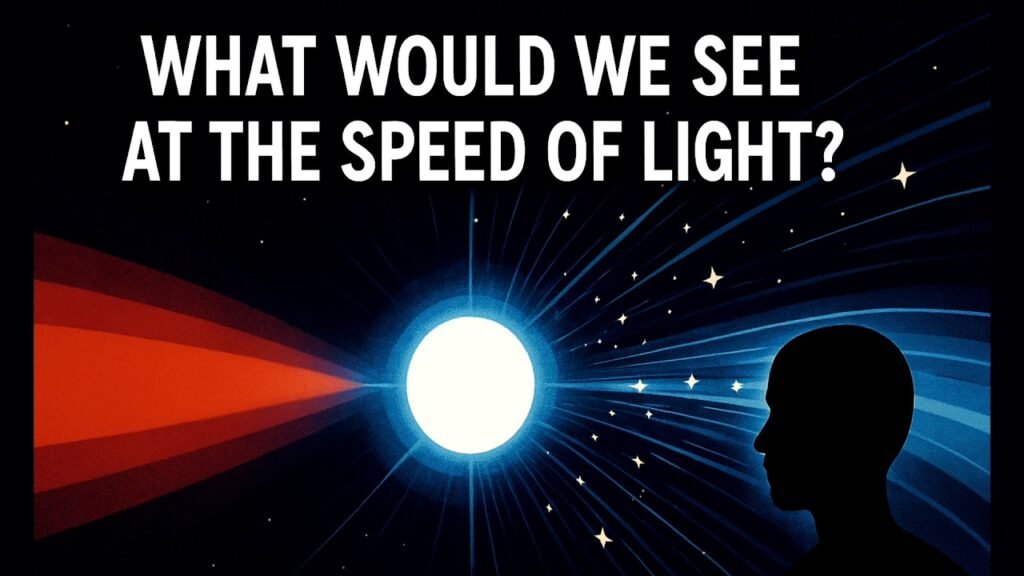
We all learn in school, or at least from our more rigorous choices of science fiction, that we’ll never be able to travel faster than the speed of light. At first, this may sound disappointing, but upon reflection, 186,000 miles per second is nothing to sneeze at. Questions about how to achieve that speed soon give way to questions about what an attempt to do so would be like, many of them answered by the animated video from ScienceClic above. The first surprise is that moving so fast, in and of itself, would have no negative effect on us. When we travel by bicycle, car, airplane, spacecraft, or what have you, we feel only the acceleration. If that remains at a safe rate, no absolute speed will be a problem, in theory, assuming you can get up to it. Still, it couldn’t hurt to buckle up, not that it would help much in the event of a collision, even with a speck of dust.
Putting that out of our minds by assuming that “our ship is equipped with a force field that repels dangerous objects and allows us to roam freely through space,” we can concentrate on what we’d see through the window. First, “the stars in front of us, which we get closer to, seem to gradually move away. The sky contracts before us,” much as rain appears to fall from the front when you’re driving through it.
“Behind us, the sky seems to widen, and becomes darker,” and any object we pass “would appear to be slightly angled in our direction.” Just as the light in the sky we see while stargazing takes some time to reach us, thus constituting a view of the stars as they were in the past, events on the Earth from which we’re moving away — presuming we had a way to see them — would appear to be taking place in “slow motion.” Earth’s image would shift toward the color red, and that of everything in front of us would shift toward blue. After a few hundred days, our ship begins to approach light speed, and that’s when things get even stranger.
This, scientifically speaking, is when special relativity comes into play, causing our ship to swerve onto its own “time axis” apart from the one followed by Earth. From our perspective, the entire universe would contract along our length of motion, making our journey shorter than we’d expected. As we move faster and faster, the view in front of us intensifies, while the view behind us turns completely black. And what would happen when we finally reach light speed? Nothing, because we can’t reach it: “You may try to catch a light ray, but from your point of view, it will always escape at the same speed.” Accelerate all you like; “from your point of view, you are still motionless, and light escapes inexorably.” At best, “our ship will continue to accelerate forever, and our field of vision will shrink ever more, until forming an infinitely bright spot in front of us, surrounded by an infinitely black sky.” But there may be a loophole, in that, even if an object can’t do it, “nothing prohibits space itself from moving faster than light” — a premise for some truly mind-blowing sci-fi if ever there was one.
via Aeon
Related Content:
M.I.T. Camera Captures Speed of Light: A Trillion-Frames-Per-Second
Professor Ronald Mallett Wants to Build a Time Machine in this Century … and He’s Not Kidding
What It Feels Like to Fly Over Planet Earth
Based in Seoul, Colin Marshall writes and broadcasts on cities, language, and culture. He’s the author of the newsletter Books on Cities as well as the books 한국 요약 금지 (No Summarizing Korea) and Korean Newtro. Follow him on the social network formerly known as Twitter at @colinmarshall.
