


Americans have spent the last few years watching prices climb faster than paychecks. Grocery bills, rent, insurance, car payments — the sting is real, and it shows up every month in the Consumer Price Index (CPI), the government’s official scorecard for inflation. When the CPI runs hot, it makes headlines. When it cools, politicians take a victory lap. They sometimes even warn about the dangers of deflation.
But here is a question nobody in Washington wants to ask: What if the CPI, even when calculated correctly, only tells half the story?
The CPI measures what households spend on goods and services they buy directly — groceries, gasoline, rent, haircuts. It does not measure the other big claim on household income: taxes. And taxes buy things, too. National defense, highways, public schools, regulatory agencies, entitlement bureaucracies — all are “consumed” by the public sector on our behalf and paid for by households, just not at a cash register. If the price of that government-provided bundle is rising faster than the price of the private bundle the CPI tracks, official inflation is systematically understating how much more expensive it is to live in America. That is not a rounding error. It is a structural blind spot, and it is not an accident.
Why Government Consumption Is Different
The reason traces back almost a century, to a habilitation thesis defended in Vienna in 1927 by a young economist named Gottfried Haberler (1900–1995) — later a towering figure at Harvard, and the teacher who set Paul Samuelson on the path to revealed preference theory. I wrote about Haberler’s contribution to index number theory in a 2024 working paper, and the argument is directly relevant here.
Haberler asked what it even means to say “the price level went up 3 percent.” Economists had long used many competing formulas, of which two stand out: the Laspeyres index (pricing yesterday’s shopping basket at today’s prices) and the Paasche index (pricing today’s basket at yesterday’s prices). They rarely give identical results, and nobody had a principled reason to favor one — until Haberler showed that, under certain conditions, the two formulas bracket the true change in a consumer’s cost of living from above and below. Something like their average, the kind of compromise index statistical agencies actually use, then becomes a reasonable estimate of true inflation.
“Under certain conditions” is doing a lot of work there. Goods must be available in identical quality across the periods compared. And crucially, they must be bought and sold voluntarily, on markets, by consumers freely choosing among alternatives within a budget. That second condition is the whole foundation of the argument Haberler proposed: Only because purchases reveal that consumers preferred the chosen bundle to every other one they could afford can we infer anything about their welfare from price and quantity data. Take away voluntary choice, and the logic collapses. This is the same insight Samuelson built revealed preference theory on a decade later.
Apply that logic to government spending. Taxpayers do not choose to buy national defense or a regulatory apparatus the way they choose eggs. They are compelled to pay regardless of whether they value it at the price charged. There is no market transaction, no revealed preference, and therefore — by the theory’s own logic — no obvious way to fold the “price” of government-provided goods into a consumer price index that aligns with Haberler’s reasoning. Economists did not carelessly forget about government consumption when building the CPI. They excluded it because Haberler’s own framework abstracted from it. Inflation is hard to measure. It becomes even harder when goods and services are not bought voluntarily.
A Reasonable Exclusion With an Unreasonable Consequence
The exclusion of government-provided goods and services is defensible on narrow theoretical grounds. But it creates a real problem for anyone using the CPI as a stand-in for the true cost of living, because taxes remain a mandatory claim on household income whether or not economists can build a rigorous index number for what that money buys. If the price of the government-provided bundle is rising faster than the price of the private bundle, households are absorbing a growing burden that never shows up in the number the Federal Reserve targets and the media reports.
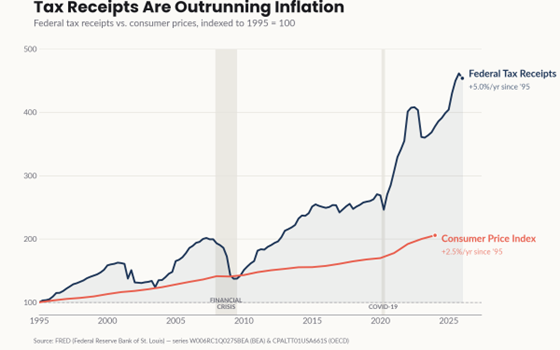
There is a reasonable proxy for that missing piece: total federal tax receipts. Since taxes ultimately cover the cost of whatever government buys, their growth offers a rough stand-in for the “price change” of public consumption.
Since 1995, the CPI has grown about 2.5 percent a year, while federal tax receipts have grown at roughly 5.0 percent — almost exactly double. That gap has been especially pronounced since the 2008 financial crisis and again since 2020, even after adjusting for the deep, temporary collapses in receipts during both recessions.
Building a Broader Cost-of-Living Measure
How much does this matter to a typical household? The OECD’s Taxing Wages 2025 report puts the average American worker’s total tax wedge — income tax plus payroll contributions — at 30.1 percent in 2024. The Tax Foundation’s “Tax Freedom Day” calculation, which folds in federal, state, and local taxes of every kind, has put the average household’s overall burden in a similar 29–31 percent range for most of the past decade. A round 30 percent is a defensible estimate.
Using that weight, a broader cost-of-living measure would be:
Broader Inflation = 0.7 × CPI Growth + 0.3 × Tax Receipts Growth
Plugging in the 1995–present growth rates gives a blended rate of about 3.3 percent a year, roughly 30 percent higher than the CPI’s 2.5 percent alone. Compounded over three decades, that gap implies a household’s true cost of living has risen on the order of 20 to 25 percent more than official inflation figures suggest. If the average tax burden is closer to 40 percent, as some broader estimates of the total tax wedge suggest, the blended rate rises to about 3.5 percent — and the gap widens further still.
None of this means the CPI is calculated incorrectly. Within the bounds Haberler laid out a century ago, it is arguably doing exactly what it was designed to do. The trouble starts when we forget those bounds exist and treat a measure of voluntary market prices as if it captured the full cost of living in a country where government now claims a third or more of household income.
