


In an era where “democratic socialism” has gained renewed traction among politicians, activists, and intellectuals, one might assume the term carries a clear, operational meaning. Yet, a closer examination reveals a concept shrouded in ambiguity, often serving as a rhetorical shield rather than a blueprint for policy.
Proponents often invoke it to promise equality and democracy without the baggage of historical socialist failures, but this vagueness undermines serious discourse. Precise definitions are essential for theoretical, empirical, and philosophical scrutiny. Without them, democratic socialism risks becoming little more than a feel-good label, evading accountability while potentially eroding the very freedoms it claims to uphold.
The Historical Consensus on Socialism: State Ownership and Its Perils
During the socialist calculation debate of the early twentieth century, a clash between Austrian economists like Ludwig von Mises and Friedrich Hayek and their socialist counterparts, including Oscar Lange and Abba Lerner, the consensus definition of socialism was straightforward: state ownership of the means of production. As I demonstrate in my coauthored paper, “The Road to Serfdom and the Definitions of Socialism, Planning, and the Welfare State, 1930-1950,” this understanding was shared not only by critics but also by the socialist intellectuals of the time.
Socialism, in this context, entailed the state directing resources through planning, often requiring ownership to fund expansive welfare programs. This definition is crucial for interpreting Hayek’s seminal work, The Road to Serfdom (1944), which posits a unique threat to democracy arising from state ownership of the means of production. Hayek argued that central planning inevitably concentrates power, leading to authoritarianism as planners override individual choices to meet arbitrary goals. Far from a slippery slope toward any government intervention, Hayek’s warning targeted the specific dynamics of state-owned economies, where the absence of market prices stifles the flow of information and the structuring of incentives, ultimately endangering democratic institutions. Using this definition, my coauthors and I, in our paper “You Have Nothing to Lose but Your Chains?” empirically test and confirm Hayek’s hypothesis that democratic freedoms cannot be sustained under socialism.
Economists working in this tradition, from Mises to contemporary scholars, retain this rigorous definition. It serves as a foundation for understanding why socialist systems have repeatedly faltered: without private ownership of the means of production, rational economic calculation becomes impossible, resulting in waste, shortages, and coercion.
The Vagueness and Contradictions of Modern Socialist Rhetoric
Contrast this clarity with the approach of many contemporary socialists, including those advocating democratic variants. Definitions of socialism often shift, praised in moments of perceived success and disowned when failures mount. This pattern is not new; it has recurred across a range of historical experiments, from the Soviet Union to Venezuela. Kristian Niemietz’s Socialism: The Failed Idea That Never Dies offers a comprehensive review of socialist rhetoric that highlights this inconsistency: regimes are initially hailed as “true” socialism, such as “worker-led” and “democratic,” only to be retroactively labeled as distortions or “state capitalism” once repression and economic stagnation emerge.
When Hugo Chavez introduced socialism in Venezuela in 2005, he claimed that he was re-inventing socialism so as to avoid the outcomes of the Soviet Union, stating that they would “develop new systems that are built on cooperation, not competition.” And that they “cannot resort to state capitalism.” Bernie Sanders famously endorsed this socialism, saying that the American dream was more likely to be realized in places like Venezuela and calling the United States a banana republic in comparison. Nobel laureate economist Joe Stiglitz was quick to point out the “very impressive” growth rates and the eradication of poverty. But socialism in Venezuela, according to the state ownership of the economy measure from Varieties of Democracy, corresponded to the classic definition of socialism, leading to the very blackouts, empty grocery shelves, and suppression of political freedom socialists explicitly sought to avoid.
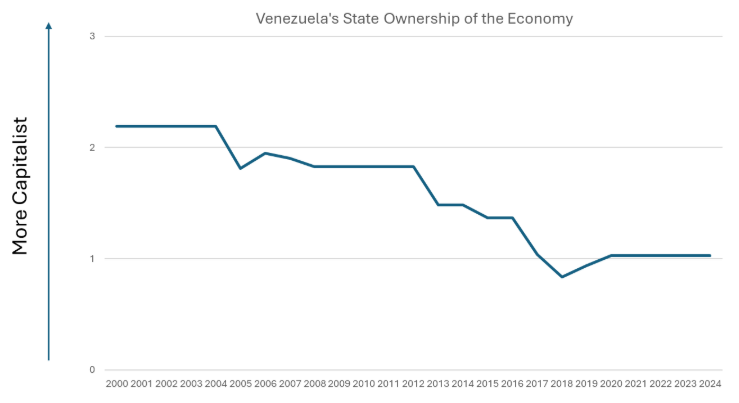
This vagueness extends to democratic socialism today. Proponents often speak in lofty terms, such as “workplace democracy,” without specifying policies. Such abstractions allow evasion of empirical evidence. By rendering the concept unfalsifiable, socialists can dismiss critiques as attacks on straw men, perpetuating debates that stall progress. If democratic socialists insist on reclaiming the term “socialism,” as distinct from the technical term used by economists, the burden falls on them to explicitly state their divergence and provide a concrete definition amenable to empirical testing.
The Imperative of Precision for Empirical and Philosophical Inquiry
A precise definition is not mere pedantry; it is the prelude to meaningful investigation. To enable cross-country comparisons, socialism must be defined through specific policies, not vague platitudes. What exact measures constitute this vision? Some socialists point to the Nordic countries as their model, but these countries have important differences between them. And, if a country is the model, then democratic socialists must consistently advocate for all the policies in that country, including those that might contradict their ideals, such as flexible labor markets or low corporate taxes. The Nordic countries, as measured by state ownership of the economy, are capitalist. Similarly, as measured by Fraser Economic Freedom of the World Index, they are also some of the most economically free.
Empirical literature in economics often examines the effects of specific policies in isolation, separate from the discussion of comparative economic systems, revealing trade-offs often ignored by democratic socialists. Minimum wage laws, for example, often supported by unions, can reduce employment opportunities, particularly for low-skilled workers and minorities. Prevailing wage requirements, pushed by unions, may inflate costs and exclude smaller firms, suppressing economic mobility and also having racially disparate economic impacts.
Philosophical debates demand equal rigor. Consider unions, a cornerstone of many democratic socialist platforms. Do proponents support open ballot laws, which protect workers from intimidation during union votes, or do they favor secret ballots to ensure true democracy? Exempting unions—as labor cartels—from antitrust laws raises concerns: why allow monopolistic practices that could hike prices and limit competition, regressively harming consumers? If a national or subnational electorate democratically enacts right-to-work laws, preventing closed-shop unions, should this override a workplace vote? Such questions expose potential anti-democratic undercurrents, where “worker democracy” might privilege special interests over broader societal choice.
These inconsistencies highlight a deeper issue: democratic socialism often conflates social democracy – market economies with robust safety nets – with true socialism, diluting the latter’s radical edge while inheriting its definitional baggage. Without clarity, it risks repeating history’s errors, where good intentions devolve into coercion.
Toward Clarity and Accountability
Democratic socialism’s appeal lies in its promise of equity without tyranny, but its vagueness invites skepticism. Only by adhering to historical definitions and demanding specificity can we foster advancement in these debates. What policies do democratic socialists argue for exactly? How will they avoid the pitfalls of past experiments in socialism, which often started with the noblest of intentions? Until answered, democratic socialism remains an elusive mirage.
