

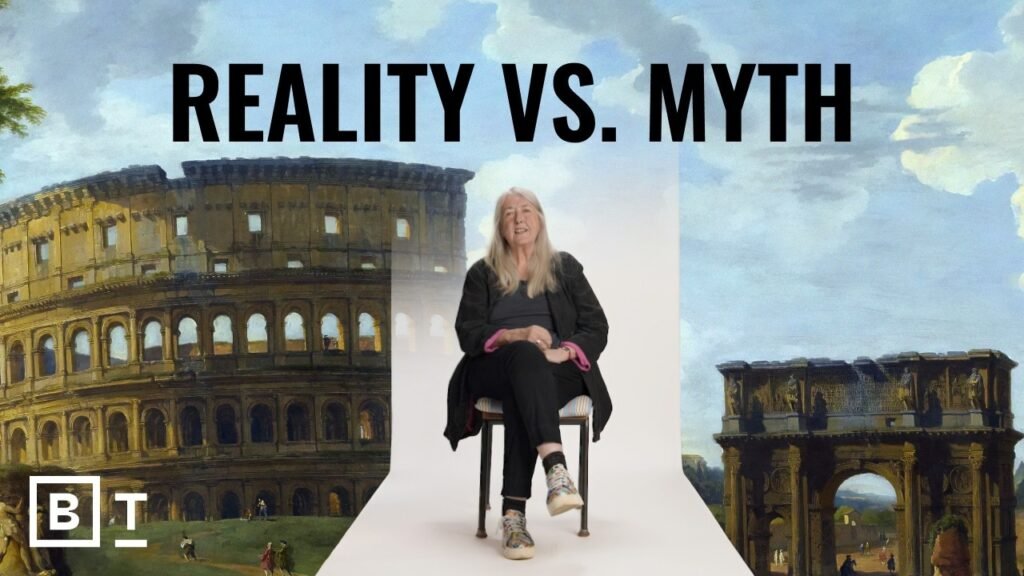
Everyone in ancient Rome wore togas, surrounded themselves with pure-white marble statues, bayed for blood as gladiators fought to the death in the Colosseum, programmatically imitated the Greeks, and, after each and every debaucherous feast, excused themselves to the vomitoria, where they ritually vacated their stomachs. Or at least that’s the picture any of us here in the twenty-first century might piece together out of the impressions we happen to receive from a steady flow of sword-and-sandals movies and TV shows — not to mention the countless references that popular culture makes to the Roman Empire, which inevitably make their way into the consciousness even of those of us who don’t think about it every day.
In the new, almost 80-minute Big Think interview above, Mary Beard explains some of the ways in which we’ve been “picturing ancient Rome all wrong.” The ancient Romans lived in a world in which men kissed each other as a standard greeting (at least until a massive outbreak of herpes put a stop to it it), statuary was painted in all manner of garish colors (though just how garish remains a matter of scholarly inquiry), citizens rich enough to wear togas needed the assistance of slaves even to get dressed in the morning, and Greece took cultural influence as well as gave it. These may not yet be features of the Rome we imagine, but they could be if we make a habit of listening to Beard’s new podcast Instant Classics.
Whatever liberties they take, the depictions of the Roman Empire that entertain us today also remind us that, as Beard puts it, “Rome has never gone away in the modern world.” Nowhere is that clearer than in ever-more-frequent discussions about the fate of modern global powers. If we look at our surroundings and see Rome, perhaps that’s because the Eternal City has “given us an image of what it is to be powerful, what it is to be larger than life, what it is to be funny, what it is to be an empire, so it’s provided many of the building blocks we need to think about ourselves.” Even if we’re not the modern equivalents of Augustus, Virgil, Cicero, or even Nero — to name a few of the Romans Beard name as, for better or worse, the most important — we could all stand to make our image of Roman life a little more realistic.
Related Content:
Empire Without Limit: Watch Mary Beard’s TV Series on Ancient Rome
Mythology Expert Reviews Depictions of Greek & Roman Myths in Popular Movies and TV Shows
Based in Seoul, Colin Marshall writes and broadcasts on cities, language, and culture. His projects include the Substack newsletter Books on Cities and the book The Stateless City: a Walk through 21st-Century Los Angeles. Follow him on the social network formerly known as Twitter at @colinmarshall.
